End-to-End AI Research Pipeline for Investment Due Diligence
Automating due diligence with AI lets deal teams see more targets faster than manual review alone.
PitchBook found that 28% of global M&A activity in 2025 was AI-related. That number matters because it means the assets under review are themselves AI-intensive, and checking a company's financials stops being enough when the company's core asset is a model, a dataset, or a training pipeline nobody outside the building fully understands.
Adoption went mainstream, and fast. Deloitte surveyed 1,000 corporate and private equity leaders in 2025 and found 86% had built generative AI into their M&A process, with 35% of that group pointing it specifically at due diligence. That's most of the room, not a fringe experiment anymore.
Coverage stays thin anyway. The 2024 Deal Origination Benchmark Report found the average private equity firm sees just 16.5% of relevant deals in its own target market. Most of the market goes unseen by any given firm, and that turns systematic data collection from a nice efficiency win into something closer to a survival requirement.
There's a wall of money waiting to move, too. PitchBook counted $4.63 trillion in uncommitted dry powder sitting in closed-end private capital funds as of Q2 2025. Capital under that kind of pressure to deploy makes slow, incomplete diligence more expensive the longer it drags on, not less. Teams still running fully manual review aren't just slower than the pack. They're losing ground on speed and coverage at the same time, and that's a bad pair to lose on together.
Knowing what a pipeline has to deliver only gets a team halfway. The rest comes down to how the thing is actually built, one layer at a time.
The four-layer architecture that makes a pipeline functional rather than brittle
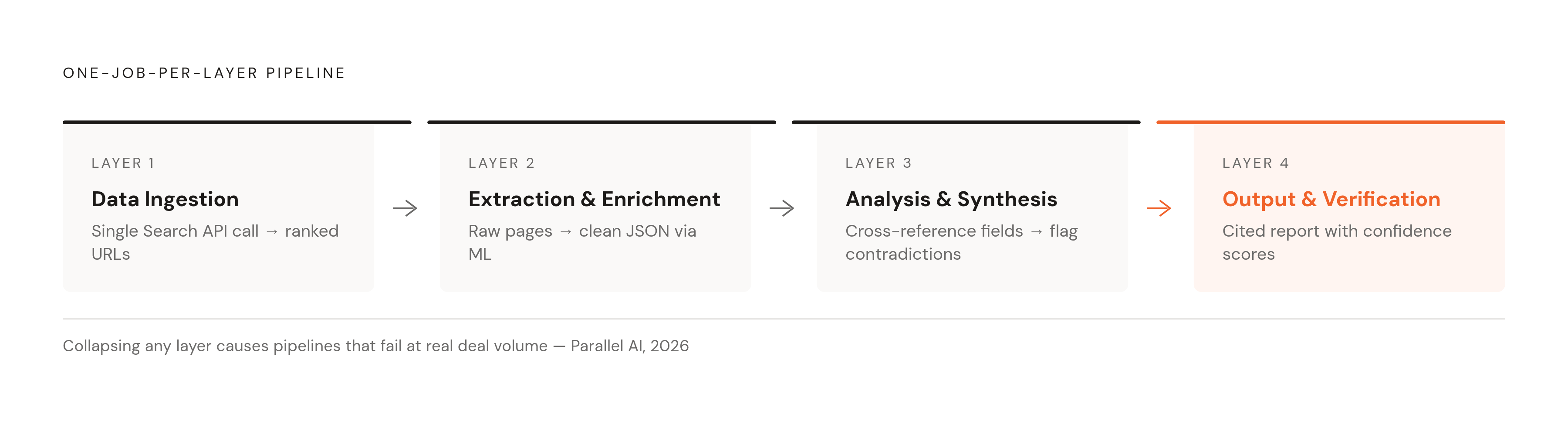
Parallel AI's 2026 guide lays out a four-layer reference architecture: data ingestion, extraction and enrichment, analysis and synthesis, and output and verification. Each layer does one job. Collapse two together, or skip one to save a sprint, and the result demos beautifully in front of a partner and falls apart the first week it faces real deal volume.
A functional pipeline queries every source in scope, with no sampling shortcuts hiding in the code. It enforces the same schema on every run, so output from January and output from August actually sit next to each other and mean the same thing. And it hands back something an analyst can check line by line, something a deal committee can trust without anyone picking up the phone to ask where a number came from.
A brittle pipeline looks fine right up until it doesn't, which is the annoying part about it. A scraper runs clean in a sandbox, then falls over the moment it hits real request volume. A language model writes a confident, well-formatted summary with zero citations attached. A report can't be traced back to a source the second someone in the room pushes back on it, and in a live deal, someone always pushes back.
Carry one definition through the rest of this piece: the pipeline takes in a research target and hands back a structured, cited intelligence report, with no manual patchwork stitching input to output. Everything below is that definition, broken into its working parts.
Layer 1: querying the right sources at ingestion
Missing PACER coverage means the pipeline has zero visibility into federal litigation. Skipping USPTO records means it can't tell a clean IP position from a lawsuit waiting to happen. Source coverage gets decided before anyone writes a line of code, not patched in after the fact, and treating it as an afterthought is how teams end up rebuilding the whole ingestion layer six months in.
Parallel AI's guide names five categories that cover most due diligence work. SEC EDGAR handles public company filings. Crunchbase covers funding history, investor rosters, headcount range, and founding year. PACER covers federal court records, USPTO covers patent filings, and news archives cover recent events, leadership changes, and any known security incidents.
Regulated industries need more than that baseline. FDA databases, EPA records, and state licensing boards get added depending on the target, because the source list is really just a function of what's being evaluated.
Mechanically, this layer runs as a single Search API call: financial health signals, leadership stability, customer sentiment, known security incidents, and regulatory actions, all queried in one pass. That call returns quickly with ranked URLs spanning every relevant source category. It isn't data yet, just a ranked map of where the data lives. The whole layer only works if the Search API behind it can reach news sources, review platforms, regulatory databases, and a target's own site in a single query, which is an infrastructure decision with real consequences downstream. Closing the gap between a list of URLs and usable information is Layer 2's entire job.
Layer 2: converting raw pages into structured data the pipeline can reason about
This layer turns a pile of raw pages into fields a pipeline can actually reason over. A Crunchbase profile becomes funding total, last round date, lead investors, headcount range, founding year. An SEC 10-K becomes a set of extracted financial metrics. The team defines the schema up front, and the Extract API returns clean data matching it, field for field.
Selector-based scraping, the old CSS selector and XPath approach, breaks at scale, and it breaks quietly, which is the dangerous part. A site redesigns its layout, the selector keeps running, and it returns garbage instead of throwing an error someone would notice. Researchers at McGill University found in 2025 that extraction built on a machine learning model held 98.4% accuracy even as page structures changed underneath it. Selector-based systems need constant babysitting to stay upright, and at due diligence volume, that upkeep cost stops making sense. Skipping this layer's design means a team ends up paying an engineer to fix broken selectors instead of paying an analyst to read the output, which is a bad trade no matter how the budget gets sliced.
AI-native extraction works differently. Describe the data in plain language, and the model finds it based on meaning, not on where a div happens to sit in the page's HTML. That's what lets one schema hold up across dozens of source types that all look nothing alike.
Access is what most teams underestimate. A scraper that runs fine in a dev environment hits rate limits, IP blocks, JavaScript walls, and session checks the moment it runs at real volume. Proxyway's 2025 benchmark tested a batch of providers against 15 heavily protected sites, and only four cleared 80% success. Infrastructure quality at this layer sets a hard ceiling on how much of the web the pipeline can actually see. Rotating residential proxies suit high-volume, distributed collection, while datacenter proxies fit softer targets where speed matters more than stealth.
Access itself is being renegotiated in real time. Cloudflare launched Pay Per Crawl in private beta, letting publishers charge for, or flatly block, non-human traffic. Getting to a page is turning into something publishers meter, and that shift keeps reshaping how ingestion infrastructure gets built.
What Layer 2 hands off is clean JSON, field by field, ready to be checked against every other field. The schema is the contract between this layer and the next, and everything downstream depends on that contract holding.
The web data infrastructure options teams are building on in 2026
By mid-2026, the tools sort into three rough buckets. AI-native, output-first platforms return clean Markdown or structured JSON straight into a RAG pipeline or an LLM, increasingly with MCP support for agent workflows. Access-focused platforms suit teams that already own their parsing logic but need an API-first route through Cloudflare or a JavaScript wall. Enterprise-scale platforms handle millions of requests against heavily protected targets, backed by SLAs and a dedicated account team.
For due diligence, AI-native is the right call, and it isn't close. Extraction schemas, LLM-ready output, and agent workflow support are what determine how usable the results are to an analyst. Raw bypass throughput barely enters into it, no matter how loudly some vendors market it.
Brave Search API built its own crawler and index from scratch instead of leaning on Google or Bing. It covers 30 billion pages with more than 100 million daily updates, and it's grown over 50 times its size since Q1 2024. That makes it a solid pick for pipelines that want an independent index with no licensing strings attached.
Parallel Web Systems (Parallel AI) raised a substantial Series A in early 2025, built specifically as web infrastructure for AI agents rather than human browsing. It ranks first on the Artificial Analysis Search Index, sitting on the frontier that balances quality, speed, and cost against one another. It's also the source of the four-layer architecture running through this piece, so its own tooling reflects that architecture directly.
Some platforms use neural link prediction instead of classic term-frequency ranking, training on the hyperlinks embedded in web text to predict which URL should follow a given passage. That suits research-heavy queries that need to surface high-citation sources, papers, and regulatory filings especially.
Others build their edge around entity data: machine learning and computer vision auto-classify pages and pull structured data into a knowledge graph running into the billions of entities, organizations, and articles, with natural language processing layered on top for relationship mapping. That fits due diligence work well, since the job is fundamentally about mapping entities and how they connect.
Open-source, self-hosted crawlers built for RAG round out the field, generating clean Markdown with content filtering and LLM-powered extraction, no per-request fees, for teams with the Python chops to run their own infrastructure. And here's the rule that actually cuts through the noise: for static, well-structured public pages at high volume, plain open-source tools stay cheaper per page than any AI-native platform, full stop. Paying for AI-native there is money left on the table. Save AI-native and enterprise-scale tools for protected, dynamic, or high-value targets where getting the schema right is what actually matters, and keep an eye on consolidation. This market is still shaking out, and betting a pipeline on a niche vendor is a bet that the vendor is still around next year.
Layer 3: cross-referencing extracted data to surface contradictions and red flags
Extracted fields sitting next to each other don't add up to due diligence on their own. This layer cross-references all of it, catches contradictions, and flags anything that looks wrong before a human ever opens the report.
Contradictions appear constantly, becoming visible when a target's self-reported headcount on its own website might not match SEC EDGAR, might not match LinkedIn, might not match Crunchbase. A target's self-reported headcount on its own website might not match SEC EDGAR, might not match LinkedIn, might not match Crunchbase. The job here is to surface that mismatch clearly, not average the numbers into one tidy figure that hides the conflict.
Parallel AI's Basis framework handles this by attaching paragraph-level citations, a visible rationale chain, and a calibrated confidence score to every claim in the output. The reasoning stays visible instead of getting locked inside a black box that spits out a conclusion and asks to be trusted.
This layer runs a handful of specific checks side by side. Financial signals get checked against public filings, testing whether the pitch deck's narrative actually matches the numbers on file. Leadership stability gets checked by cross-referencing LinkedIn tenure against news mentions and SEC officer disclosures. Litigation exposure runs PACER records against news archives and any regulatory action on file, and IP integrity checks USPTO records against licensing agreements and any infringement claims sitting in the news.
Document-level AI plays a role here too. Platforms like Harvey work through entire data room document sets, pull out key provisions, flag non-standard contract terms, and surface anomalies across volumes no human reviewer could get through at the same speed, or with the same consistency, working alone.