Crawling a Site at Scale to Audit Indexability and Crawl Budget
Large sites waste crawl budget on faceted URLs and soft 404s, not server capacity.

Crawl budget isn't a ranking factor. It's a scheduling constraint. Past a certain size, Google simply can't see everything you publish, and the pages it misses are usually your revenue pages, not your junk. The fix is an audit that crawls your site the way a search engine does, finds exactly where the budget leaks, and sequences repairs by how many requests each one recovers.
Why crawl budget becomes a real constraint past a certain site size
Crawl budget becomes a real ceiling around 10,000 pages that change daily, or a million pages that change weekly. Below that line, the binding problems are broken links, redirect chains, and canonical conflicts. Past it, ignoring budget means accepting that a meaningful share of your site may never be indexed in a given cycle. There's no way around the math. Googlebot has a finite number of requests to spend, and every low-value URL it fetches is a request it doesn't spend on a page that makes you money.
Crawl rate limit is what your server can absorb. Crawl demand is how much Google wants to revisit, based on PageRank and freshness signals. Whichever is lower becomes the ceiling. Most large sites aren't constrained by server capacity at all. They're constrained by crawl demand, because a bloated URL inventory full of low-value pages suppresses what Google thinks is worth crawling in the first place. You don't have a hardware problem. You have a prioritization problem, and Google is making the wrong call because you handed it a map full of dead ends.
How server performance directly shrinks the crawl rate limit
Server performance sets the ceiling every other fix operates under. Googlebot backs off automatically when your infrastructure looks fragile, and it doesn't send you a memo first. A Time to First Byte above 500ms causes the crawler to reduce its rate on its own. Slow servers get fewer requests, no matter how clean your URL inventory is. A 5xx error rate above 1% of daily crawl requests triggers something worse: a significant, sustained reduction, not a temporary dip. You can fix every canonical tag on the site and still lose crawl coverage because your origin is wheezing.
JavaScript rendering compounds the problem in ways that don't show up in user-facing analytics. A headless browser instance consumes 300 to 500MB of RAM per instance and produces far fewer pages per minute than static HTML. So a JS-heavy template is a crawl-cost multiplier. Googlebot's rendering queue adds indexing delays of days to a week or more for JS-dependent content. Pages that only exist after JavaScript executes may never be indexed at the velocity the business requires. Before investing in URL-level fixes, baseline three numbers: TTFB, 5xx error rate, and the share of templates that require JS rendering. Those set the ceiling everything else operates under.
The AI-crawler surge and what it means for origin infrastructure in 2026
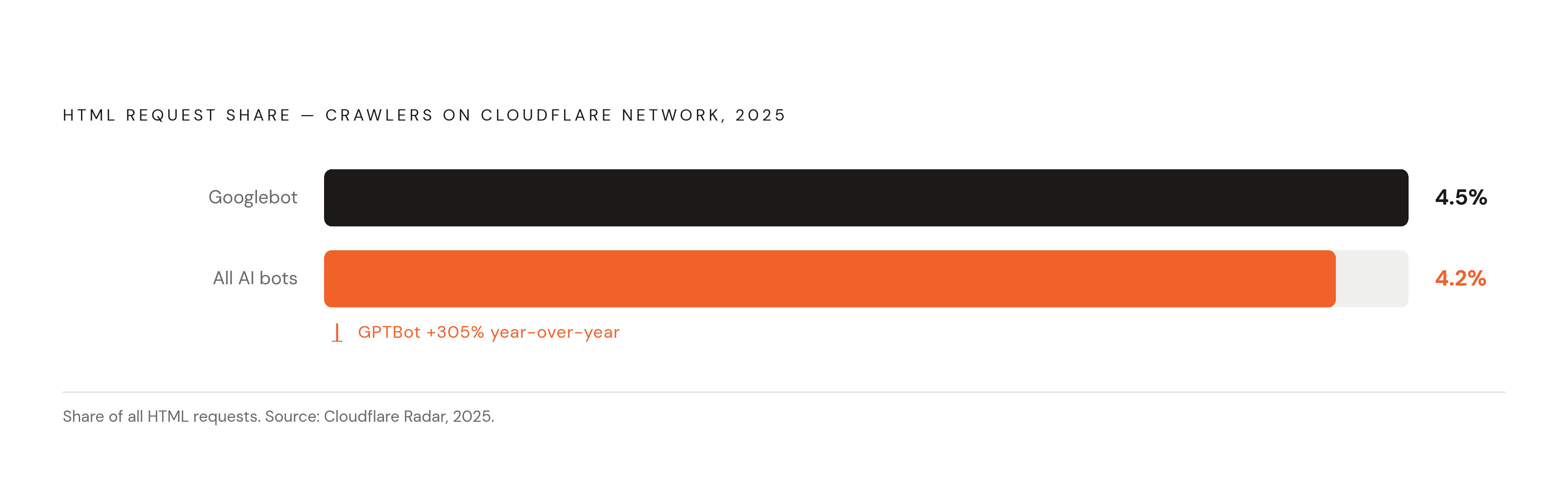
Crawl budget governance stopped being a Googlebot-only problem around the time AI training and retrieval crawlers showed up in force. Cloudflare's 2025 data puts Googlebot at 4.5% of all HTML requests on its network. That's more than all other AI bots combined at 4.2%. Googlebot crawls 11.6% of all sampled unique pages, more than three times GPTBot's rate. GPTBot alone grew dramatically year-over-year, with a 305% rise in requests. AI bot traffic isn't stable. It's accelerating, and it's eating origin capacity that used to belong to the crawler that actually sends you organic traffic.
The governance shift is just as important. From July 1, 2025, Cloudflare began blocking known AI crawlers at the network edge for new domains by default, with search crawlers still allowed. As of September 15, 2026, only Training and Agent crawlers are blocked by default on ad-supported pages. The point isn't what Cloudflare does. It's that crawl-access governance has moved out of robots.txt and into infrastructure and WAF configuration. Your effective crawl budget is now split across more actors than it was two years ago. Unmanaged AI crawlers can consume server capacity that would otherwise serve Googlebot, and no amount of sitemap hygiene fixes that.
Setting the crawl control layer before you audit anything
A misconfigured robots.txt in 2026 isn't an oversight. It's actively harmful. A broad Disallow directive under User-agent: * silently blocks Bingbot, which cuts ChatGPT Search and Microsoft Copilot citation eligibility. That single mistake appears in a meaningful share of audited sites, and it means your content stops being quotable in AI-powered search channels without anyone noticing. You can't read your crawl budget picture accurately if your control signals are lying to the crawlers you want to keep.
The defensible default for 2026 is straightforward. Disallow training crawlers in robots.txt. Allow search and retrieval crawlers explicitly. Enforce non-compliant bots like Bytespider at the WAF layer, not in the file, because a large share of AI crawlers violate robots.txt rules anyway. Robots.txt is advisory. WAF is enforced. Treat llms.txt as an agent navigation aid, not a training opt-out. AI search crawlers including GPTBot, ClaudeBot, and PerplexityBot overwhelmingly skip the file and crawl HTML directly. But IDE agents, MCP servers, and in-product AI assistants do fetch it, so it's worth publishing for agent-navigability at low cost. A June 2026 analysis of the top 10,000 sites found roughly 20% block at least one AI crawler. The other 80% leave all AI crawlers as open as Googlebot. Both extremes are a choice with costs.
Where crawl budget actually goes: the URL inventory problem
URL bloat is the primary driver of crawl budget waste at scale, and the categories are predictable enough to audit systematically. Faceted filter and parameter combinations are the dominant source. E-commerce sites with aggressive faceted navigation can generate ten to a hundred times more URLs than they have products. Soft 404s, pages returning a 200 status with no real content, consume requests without signaling that the URL is dead. Redirect chains multiply cost with every hop. A three-hop chain uses four crawl requests to reach the final destination. A site with thousands of such chains wastes a significant share of its budget before Googlebot reaches a single canonical URL.
The other categories are just as mechanical. Noindexed URLs listed in XML sitemaps send Googlebot to pages it cannot index. Orphaned pages with no internal links receive no PageRank signal and get deprioritized in crawl demand. Session IDs, calendar-based archive pages, and infinite scroll without pagination tags create crawl traps that exhaust budget on effectively infinite URL spaces. Canonical tag errors split PageRank across duplicates and confuse Googlebot about which version to crawl. One travel site's log file analysis showed Googlebot spending the majority of its crawl budget on parameter-generated URLs from search and filter functionality, none correctly canonicalized. By the end of the audit, crawl frequency of priority pages had increased and organic traffic to destination guide pages recovered. The waste isn't random. It's a list of known failure modes, and a systematic crawl surfaces them all.
Building the crawl infrastructure to audit at volume
Auditing a large site the way a search engine does requires crawl infrastructure matched to the site's actual scale. The practitioner toolkit divides by size. Screaming Frog handles desktop-level crawls with unlimited indexable URLs for £199 a year, and it integrates with the PageSpeed Insights API for performance and page-experience metric data at scale across a crawl. But once you're past 10,000 URLs with faceted navigation or tag explosion, a desktop crawl alone isn't enough. It shows you where a crawler could go. It doesn't show you where Googlebot actually went. Sitebulb runs usefully in parallel with Screaming Frog, surfacing different issue types and producing priority-weighted insights that work well in client-facing reports. Larger enterprises choose between Lumar and Botify based on whether pre-release QA and cross-functional governance or log-centric indexing analysis is the bigger gap.
For teams building programmatic crawl pipelines, the format question is decisive. AI agents need scraping tools that output token-efficient formats like Markdown rather than raw HTML. A unified web data API that handles crawling, scraping, and structured output in a single call removes the need to stitch together a desktop crawler, a proxy layer, a rendering engine, and a parsing step. Each of those pieces introduces its own failure modes and cost at scale. As a diagnostic baseline, run two Screaming Frog passes. One respects robots.txt, one ignores it. The difference shows exactly what's blocked from Googlebot's view versus what exists on the site. That delta is often the first real insight an audit produces.
Reading log files to see the crawl as Googlebot sees it
Server log analysis is the only source of ground truth on crawl budget allocation. Search Console's coverage report tells you outcomes. Logs tell you exactly which URLs Googlebot visited, how often, and in what order. Search Console alone is insufficient. It shows indexing status but not crawl frequency, not which URLs consumed the most requests, and not whether Googlebot is reaching priority URLs in a given cycle. Log files show the actual distribution of visits across URL types. That's how a team confirms, rather than suspects, that a majority of budget is going to parameter URLs rather than core category pages.
The signals to extract are specific. Crawl frequency by URL segment tells you whether core revenue pages are crawled as often as faceted filter variants. Status code distribution shows how many 200s, 301s, 404s, and 5xxs Googlebot is actually receiving. Redirect chain hits show how many requests go to URLs that immediately bounce elsewhere. Crawl timing reveals whether priority pages are visited within an acceptable window after publication. The log file picture and the crawl tool picture must be reconciled. Discrepancies between what Screaming Frog found navigable and what logs show Googlebot actually visiting reveal structural issues like orphaned pages, crawl traps, or robots.txt blocks that neither source alone exposes. Teams without an enterprise platform can parse raw logs programmatically, but at hundreds of thousands of pages, a structured pipeline is the practical approach. Manual inspection doesn't scale, which is the entire premise of this exercise.
Turning the crawl data into a prioritized fix list
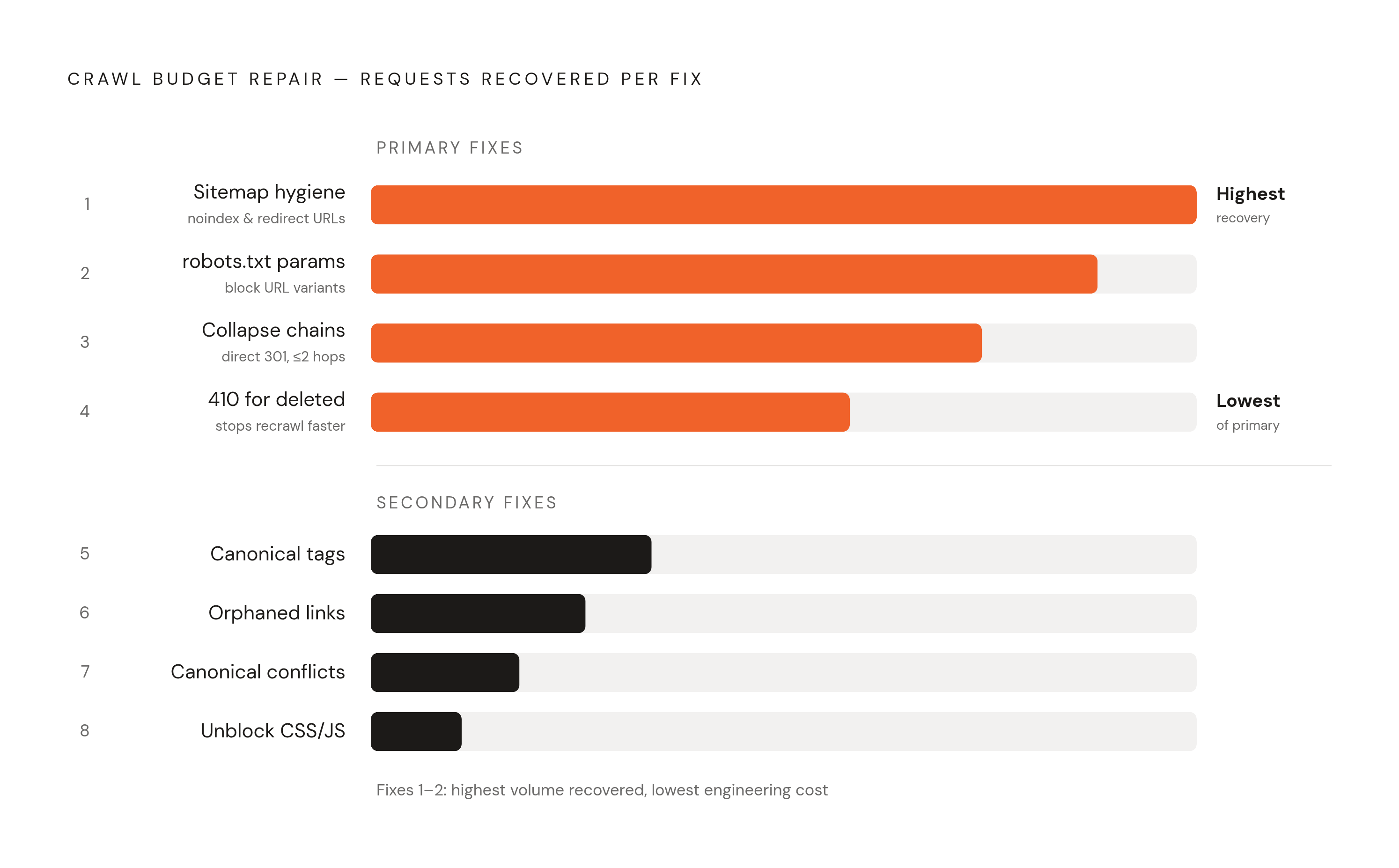
Enterprise SEO teams rarely have a crawling problem in the abstract. They have a prioritization problem at scale. The audit's value is that it supplies the evidence to sequence fixes in order of crawl budget recovered per fix. The highest-leverage repairs are mechanical and cheap. Remove noindexed and redirecting URLs from XML sitemaps. Cleaning the sitemap to only canonical, 200-status, indexable URLs is the single fastest way to redirect crawl demand to real content. Block parameterized URL variants in robots.txt or via Search Console URL parameter handling. Collapse redirect chains to direct 301s. Every hop costs a request, and chains longer than two hops should resolve to a single redirect to the canonical destination. Return 410 instead of 404 for permanently deleted pages. Googlebot stops recrawling 410s significantly faster than 404s, freeing those recurring requests for live content.
Secondary fixes come after. Add self-referencing canonical tags to every page. Fix orphaned pages by adding internal links from high-authority pages. Resolve canonical conflicts between HTTP headers and HTML head tags. Address CSS and JavaScript blocked by robots.txt, because Googlebot cannot render pages whose assets it cannot fetch. The prioritization matrix should weight three variables: crawl requests wasted per fix as the highest multiplier, revenue impact of the URLs being starved, and implementation complexity. Fixes that recover large volumes of budget with low engineering cost ship first. After they deploy, watch Search Console. Falling volume in the "Discovered — currently not indexed" bucket is the leading indicator that freed budget is reaching the discovery queue. Rising crawl frequency of priority pages in log data confirms it.
The strongest objection to this entire framework deserves a straight answer. Crawl budget may not be your actual constraint. Many teams mistake "Google didn't index my page" for a budget problem when it's really a content-quality or internal-link problem. Both can be true simultaneously. Log file analysis is the only way to distinguish them, because it shows whether Googlebot is even trying. If it's trying and failing, that's one problem. If it's not trying, that's another, and no amount of sitemap surgery fixes the second one.
Monitoring crawl budget continuously after the initial audit
Sites without ongoing crawl monitoring accumulate the same categories of waste within months of an audit. CMS deployments, faceted navigation changes, and crawler behavior all change continuously. New URL categories appear with every significant platform migration or feature deployment. A crawl that's clean at the time of the audit can be re-bloated by a single parameter change in a site search implementation. The AI-crawler surge means bot traffic composition itself isn't stable. New crawlers, new user agents, and changing volume require periodic review of robots.txt and WAF rules to avoid over-blocking, which cuts retrieval eligibility, or under-blocking, which allows budget drain from non-compliant bots.
What to monitor is specific. Track Search Console's "Discovered — currently not indexed" and "Crawled — currently not indexed" volumes for trend movement, not just point-in-time status. Watch log file crawl frequency by URL segment. A shift in the ratio of budget going to low-value URLs is the earliest signal that a new source of waste has appeared. Validate sitemap health on a regular cadence for noindexed, redirecting, or 404 URLs that have crept back in. And monitor TTFB and 5xx error rates continuously, because infrastructure degradation that triggers Googlebot's automatic crawl-rate reduction may not be visible in user-facing monitoring. Sites that held rankings despite technical debt are now visibly declining.
For teams running programmatic crawl pipelines, monitoring can be automated. A recurring crawl against the URL inventory, diffed against the previous run, surfaces new parameter variants, redirect chain regressions, and soft 404s without manual audit cycles. The retrieval dimension is the emerging second half of this problem. Which crawl-indexed pages are actually being quoted by AI engines is a question being indexed no longer answers. A complete monitoring layer will eventually track both signals, because being in the index and being retrievable by an AI assistant have already become two different things.