Automating Broken Link Detection Across Large Content Sites
A continuous crawler catches broken links before and after deployment.
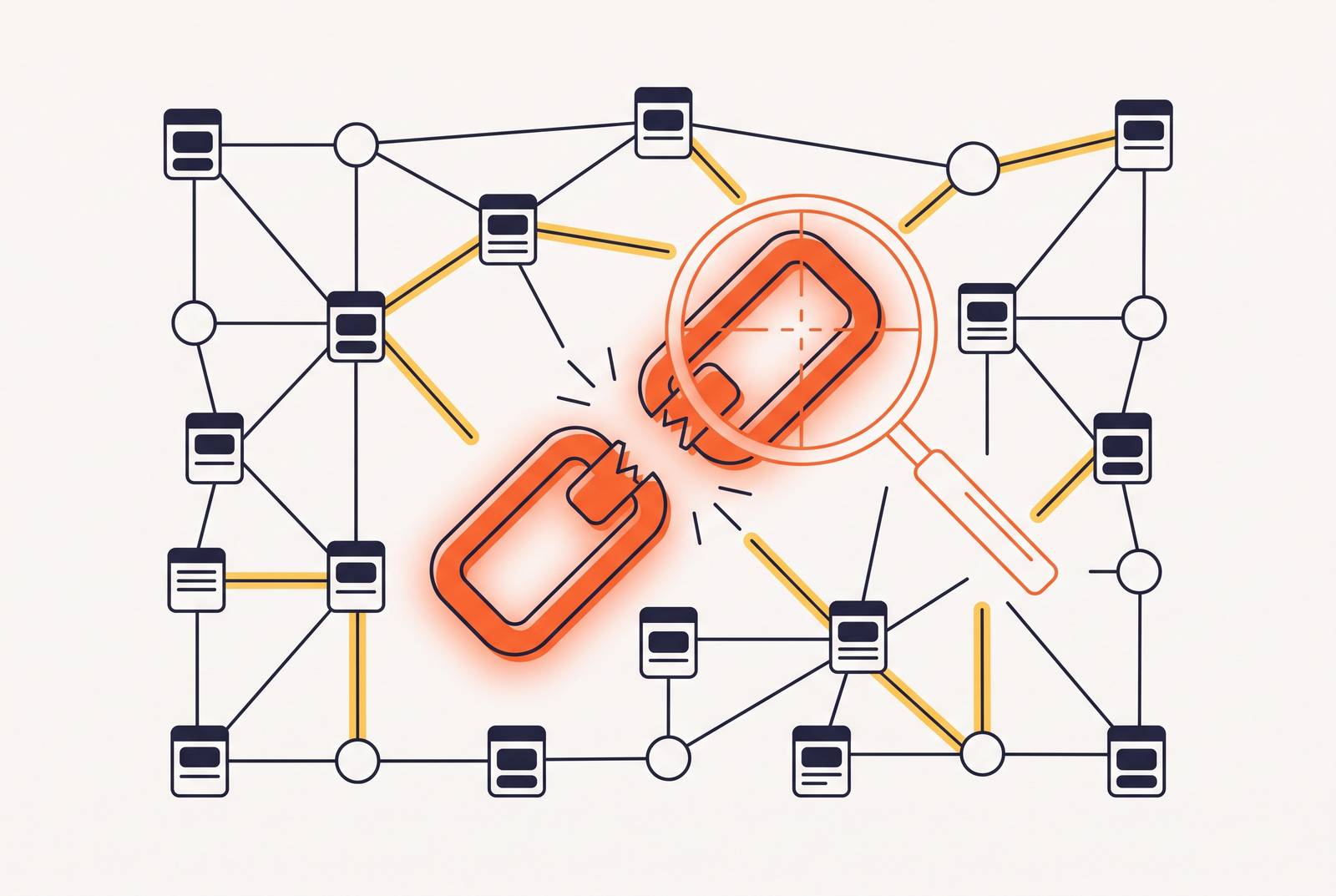
Across thousands or millions of URLs, the lasting answer is a system that continuously fetches, parses, and classifies link status, ranks the damage, and carries fixes through to deployment. Finding dead links is only the beginning. The system earns its keep when it stops them from piling up.
Why broken links become a structural problem as sites grow
Each time new content is published, the link graph can change without anyone setting out to change it. Pages disappear, CMS updates rewrite URL slugs, and external domains expire. On a large content site, these changes accumulate faster than a manual process can track them. The site has a moving structure, while the checklist politely waits for someone to open it.
That mismatch creates consequences beyond an untidy report. Visitors reach dead ends and leave, while search crawlers spend crawl budget fetching URLs that return nothing useful. A manual audit can expose the damage at one moment, but it cannot account for changes that happen afterward. Detection therefore needs to run as part of the site's infrastructure.
What the HTTP response layer actually tells you and what it misses
The first design decision is what counts as broken. HTTP responses provide the starting point, with 2xx indicating success, 3xx indicating a redirect, 4xx indicating a client error, and 5xx indicating a server error. Those families are useful categories, but they are not final verdicts. A detector that reduces them to good or bad will either fill the fix queue with false positives or miss failures that look healthy at first glance.
Redirects need inspection all the way to their destination. A 3xx response can lead through a chain that ends in a 404, so accepting the first hop as working hides the failure. Client errors also need to be treated on their own, because 410 Gone means something different from 404 or 403 Forbidden. Server errors need retry handling before receiving a permanent-failure label. A temporary 503 does not justify the same fix as a permanent 410.
Some responses say more about the crawler than the page. Rate limiting returns 429, while WAF blocks can produce 403 responses from Cloudflare or Akamai even when the destination is not broken. These belong in a blocked-request category. Conversely, a soft 404 returns 200 while the body contains a “page not found” message, so content heuristics must supplement status codes. HEAD requests can make checks faster, but unexpected results need a fallback to GET because some servers handle the methods differently.
The architecture of a crawler that can work at depth
A production crawler needs four distinct layers, namely a URL scheduler, an HTTP client pool, a response analyzer, and a fix mapper. The scheduler controls the crawl queue rather than letting each discovered link trigger another uncontrolled request. It applies rate limits per domain and deduplicates targets so that links from several source pages do not cause repeated checks of the same URL. It also enforces depth limits to prevent endless recursion into external domains. Without that limit, a site audit can get big ideas about auditing the internet.
The HTTP client pool handles the work of fetching those targets. Reusable connections with keep-alive cut TCP handshake overhead, while concurrent requests avoid the bottleneck of a single-threaded crawl. At volume, that can mean reducing the time to complete a large crawl from hours to minutes. The response analyzer then applies the classification rules to the fetched results, including full redirect-chain inspection and soft-404 checks.
The fix mapper turns a detected failure into a possible repair. It searches the known URL set for a replacement, leaving validation and deployment to the fix pipeline. However, all these layers depend on discovering the links in the first place. React, Angular, or Vue sites can inject links into the DOM after initial load, making those links invisible to a simple HTTP GET crawler. A headless browser layer captures them, but its performance cost requires deliberately limiting which pages use it.
Continuous operation also needs observability, session management, and retry logic. They are part of what makes the crawler work repeatedly, especially when requests fail or sites behave differently. This operational layer is where a promising open-source prototype can become a much larger engineering commitment.
How to prioritize which broken links to fix first
A report sorted only by URL gives every failure equal billing, which is convenient for the alphabet and unhelpful for the team. Three axes provide a practical starting point: inbound link equity, traffic volume, and user impact. Together, they distinguish a broken path that matters now from one that can wait.
Start with internal failures before external failures outside the site's control. Internal 4xxs use up crawl budget and leave link equity stuck within the site's own architecture. Within that queue, pages with many internal or external links pointing to them carry more PageRank than an orphaned post. Traffic is the second test, showing where visitors run into the problem today. The third test is where the link sits, because a broken navigation link, call to action, or purchase-flow link can cause conversion loss as well as SEO damage.
This ranking should guide which repairs to make and how much debt to allow. A 301 redirect can do a lot of good because one mapping can preserve link equity from several broken inbound paths. Define a maximum acceptable broken link ratio for internal links and a separate threshold for external links. Exceeding either limit should trigger a system alert. That gives the fix queue a budget with consequences, which becomes especially useful at deployment time.
Integrating broken link detection into CI/CD so issues are caught before deployment
A deployment gate moves detection from finding damage to preventing it. The mechanism is a routine build step that runs a link check, parses the detection API's JSON response, and compares the result with the defined threshold. If the broken link count exceeds that threshold, the build fails.
GitHub Actions, GitLab CI, Jenkins, and CircleCI can all consume structured JSON for this pattern without custom tooling. Linkinator offers a concrete integration path through its CLI, Node.js library, and GitHub Actions integration.
The gate gives the internal and external thresholds established earlier an enforceable role. When the budget is exceeded, the pipeline alerts the team instead of allowing the limit to drift upward with accumulated debt. But a passing build only covers what was tested before deployment. It cannot catch an external URL that dies after publication. Pre-deployment checks therefore need a scheduled live-site monitoring loop.
Continuous monitoring as the operational layer for live sites
External sites remove pages, change URL structures, or go offline independently of another site's release schedule, so deployment-only checks leave a permanent coverage gap. Scheduled crawling covers that gap by checking the published link graph even when no new build runs.
The monitoring job runs on a defined cadence, daily or weekly depending on publishing frequency. It compares current HTTP responses with the last known state and identifies new failures in those responses rather than asking someone to reread the entire report. That comparison turns a crawl from an inventory into an operational signal.
Alerting on every new 4xx creates noise, while filtering for failures on pages above a traffic or link-equity threshold highlights consequential changes. Webhooks can push those alerts to Slack, PagerDuty, or a ticketing system. A dashboard that needs constant checking is less an automation system than a very demanding houseplant.
Building the fix pipeline: from detected URL to deployed redirect
The fix pipeline should take a broken URL through a suggested redirect, validation, and deployment with as little manual work as possible. Its first transformation is the mapper's replacement suggestion. URL path similarity, title similarity, and content fingerprinting against the known URL set provide the basis for that candidate.
A candidate still needs validation before it becomes a permanent redirect. The target must not be broken or start another redirect chain. Chaining redirects takes more time and can still lose equity when the chain ends in the wrong place. This is why matching a plausible path is not enough to approve a fix.
Structured output connects that decision to deployment. A single JSON response containing per-URL status codes, response times, redirect chains, and suggested replacements can feed a redirect management tool, a CMS API, or a deployment script. For content teams without engineering support, CSV output should include the source page, broken URL, suggested replacement, and HTTP status. That supports manual review and bulk upload to CMS redirect managers without forcing the team to reconstruct the report.
Deployment is not the end of the pipeline. Once a redirect is live, the system should re-check the formerly broken URL and confirm that it returns 301 with the correct destination. This verification catches repairs that were deployed incorrectly, even after a task has been closed. The final output is therefore not a redirect instruction or a successful upload. It is a formerly broken path that now resolves through the intended redirect.
Where self-built crawlers hit their limits and what to hand off to infrastructure
A self-built crawler can be entirely adequate for small to mid-size sites, single-use audits, and internal link graphs on controlled infrastructure. In those cases, the request workload and the environment may be manageable without a separate infrastructure service. Building internally also keeps site-specific logic close to the team that understands it. The strongest case for managed infrastructure comes at the other end of the spectrum, with large URL sets, continuous monitoring, and many external targets.
Speed matters there, but it is not the whole decision. A single-threaded Python crawler is much slower than a concurrent cloud API on a large site, yet concurrency does not remove the operational burden. Connection management, retries, session handling, and observability still need implementation and maintenance. Protected external sites add WAF and bot-detection blocks, while a static user agent and IP can encounter rate limits or refusals. If the system mistakes those responses for broken links, extra throughput fills the queue with the wrong links faster.
Build the scheduler, prioritization logic, and fix mapper internally, because they encode the site's link structure and repair decisions. Hand off connection pooling, keep-alive, request-level rate limiting, retries, and response parsing to a managed API when that operational burden warrants it. For continuous monitoring, webhook delivery, transient-failure retries, and per-domain rate limiting are basic requirements.
This division leaves the team responsible for what the results mean without requiring it to maintain every part of how they arrive. An internal audit on a site under the team's control may never need that handoff, while a daily crawl of a large set of external links gives the team more reason to use it. The measure is reliable operation and a manageable maintenance load. At scale, broken link detection is solved only when the system can keep finding the right failures and carrying their fixes through to a verified result.