Tracking Competitor Product Launches From Web Sources
Automate competitor monitoring to catch product moves before manual checks can.

Competitor product launches don't announce themselves politely on a schedule that fits your Monday morning coffee routine. They show up in a changelog nobody reads, a pricing page tweak on a Friday afternoon, or a job posting for a "Senior Voice AI Engineer" that quietly tells you where the roadmap is headed. This piece is about building a pipeline that catches those signals automatically, instead of hoping someone on the team remembers to check.
The old model, someone rotates through a spreadsheet of competitor URLs once a week, tops out fast. Visualping's research puts the manual ceiling at roughly 5 to 10 competitor pages before corners start getting cut. And the people who'd otherwise build the fix are busy: a Wakefield Research report found the average data engineer spends 44% of their time just keeping existing pipelines alive, which doesn't leave much room for a side project tracking what rivals are up to.
Meanwhile the pages are actually moving, a lot. Visualping tracked 9,705 active competitor monitors in April 2026 and found 42% flagged at least one change within 30 days. Monitors watching HubSpot's pricing page saw changes 96% of the time. Zoom's hit 100%. That's not an occasional blip worth a quarterly review, that is a page in near-constant motion. Manual checks are built for a world where competitor pages sit still. They don't sit still. This is an engineering problem wearing a diligence costume, and the rest of this piece treats it that way.
What a competitive launch signal actually looks like in the wild
A "signal" isn't one thing. It's a whole family of clues scattered across different corners of the web: changelog and release notes pages, product announcement posts, pricing page edits, press release sections, shifts in job posting patterns, new entries in developer docs, patent filings, and the occasional forum thread where someone leaks a beta invite.
Some of these move fast, some move slow, and knowing which is which matters for how you build around them:
Real-time signals fire the moment something ships: pricing changes, announcement blog posts, PR sections going live. Leading indicators show up days or weeks before the official launch, things like a cluster of job postings for a new product function, developer docs referencing an endpoint that doesn't exist publicly yet, or a forum comment mentioning a beta program. Lagging signals trail behind, sometimes by months: review site mentions, media coverage, analyst notes picking up on something that already happened.
Signal density varies a lot by page type, which matters for how often you bother checking. Platform data from Visualping shows 16.3% of checks on pricing pages trigger a change alert, compared to 11% on news pages and 7% on investor relations pages. Pricing pages are just chattier.
More alerts isn't automatically more useful. The point is plain: if every CSS tweak and typo fix gets flagged the same way as an actual price change, the team stops trusting the alerts altogether. Nobody wants to be the analyst who cried wolf over a font update. So the pipeline can't just detect that something changed, it needs to classify what kind of change it is. That distinction is the whole reason an AI layer shows up later in this piece: it separates a tool people check from a tool people mute.
Mapping the web sources worth monitoring for each competitor
You need to know where to point the pipeline before any of that classification logic can work. Sources split into three rough buckets.
Owned competitor surfaces are the pages a company controls directly: product pages, changelog URLs, release notes, pricing pages, blog and newsroom sections, documentation sites, and anything discoverable through a sitemap crawl.
Third-party surfaces are where the competitor shows up without full control over the narrative: review platforms like G2, developer community forums, GitHub repos and release tags, LinkedIn job postings, patent databases.
Search-indexed surfaces cover live search results for a competitor's brand name paired with words like "launch," "new," or "release," catching coverage that wouldn't show up on any owned page.
There's a harder problem hiding underneath all of this: discovering competitors you don't already know about. Most monitoring tools are good at watching rivals you've already named, but bad at surfacing new entrants nobody put on the list yet. Per Parallel AI's developer guide, AI agents can search the web, extract structured data, and build out a competitive landscape starting from nothing more than a plain-language question, which is a genuinely different capability than checking a fixed URL list.
Crawling helps here too, and not just for discovery. Start from one competitor's root domain and follow the links outward, and you'll surface pages that never would have made it onto a manually curated list: changelog subdirectories, API documentation, quietly-published beta feature pages sitting three clicks deep.
A few practical rules for scoping this without drowning:
- Poll high-change-rate pages (pricing, product, news) more often than everything else.
- Run sitemap crawls specifically to catch new URLs appearing, a brand-new product page showing up in a sitemap is itself a launch signal, before the page even has content on it.
- Treat "monitor this known URL" and "discover new URLs under this domain" as two separate pipeline jobs, not one blurred task.
The anti-bot environment a monitoring pipeline has to survive in 2026
Once you know where to look, you have to actually get in. And the web has gotten a lot better at keeping automated visitors out. The web application firewall market hit $11 billion in 2025, according to Mordor Intelligence, which tells you the infrastructure guarding competitor pages isn't some hobbyist plugin anymore, it's enterprise-grade defense.
The fingerprinting has gotten weirdly granular, too. ScrapingBee's 2026 analysis notes that anti-bot systems now check more than 40 attributes per visitor, covering Canvas and WebGL rendering quirks, installed fonts, AudioContext output, even screen dimensions. On the network side, one major content delivery provider rolled out a newer fingerprinting method in 2026 (the successor to an earlier approach), reinforcing fingerprinting at the network connection level as one of the first walls a request has to clear before it even reaches the page.
Cloudflare shifted its default posture too. Since July 1, 2025, new domains on Cloudflare block AI crawlers by default, prompting site owners upfront on whether to allow them. Its Pay Per Crawl program returns an HTTP 402 (payment required) to crawlers that haven't paid up. For any pipeline touching Cloudflare-protected competitor pages, that's a real variable, not a footnote.
None of this means automated monitoring is a lost cause. F5 Labs' 2026 Advanced Persistent Bot Report found scrapers still account for 10.2% of all global web traffic, even after bot-mitigation systems do their filtering. The environment is adversarial, sure, but it's traversable, provided the fetching layer is built for it: IP rotation, browser emulation, and ideally a managed layer that handles anti-bot evasion so engineering time goes toward reading the signal, not fighting the gatekeeper.
Choosing the right data collection layer for a monitoring pipeline
This is where tool choice actually matters, because the anti-bot landscape above determines what "reliable" even means for a collection layer in 2026. The market has split into two broad camps: purpose-built APIs designed for feeding LLMs clean data, and tools that have added AI capabilities onto an existing scraping foundation. For a monitoring pipeline specifically, the real question is which option's data shape, anti-bot handling, and pricing model fits a continuous, high-frequency workflow.
A few categories to know:
Some platforms position themselves as full context APIs, exposing separate endpoints for scraping, crawling, search, and structured extraction, and returning clean Markdown or JSON rather than raw HTML soup. Clean Markdown chunks and embeds far better for downstream LLM use than a page full of nav bars and cookie banners, which affects how well that output feeds LLM summarization and retrieval.
Open-source options exist too, for teams with the engineering bandwidth to run their own fetching layer and want full control over IP provenance and data handling, something that's become a bigger concern as ML teams pull scraping work in-house rather than route it through a third party. LLM-driven extraction tools that use graph-based logic to pull structured fields out of HTML, XML, JSON, or Markdown fall into a similar bucket: good for teams that want extraction logic without depending on a managed API.
On the fully managed end, no-code monitoring tools let a non-engineer train a "robot" to watch a page, set a schedule, and get notified when something changes, exporting straight to Google Sheets or Airtable. That's the right call for a team without dedicated engineering time, tracking prices or watching a handful of competitor pages without writing a line of code.
And for developers building the whole pipeline from scratch, there are crawling and search APIs built specifically with agent workflows in mind, ones that start from a single URL, follow the connected subpages, and return clean content ready for retrieval-augmented generation or structured extraction. Some of these ship with MCP servers and agent skills baked in, meaning tools like Claude Code, Cursor, Windsurf, or VS Code can query the pipeline directly, no separate dashboard required.
The decision, boiled down, comes down to three tradeoffs: managed API with anti-bot handling built in versus open-source with full in-house control, single-page scraping versus full-site crawling, and raw extraction versus AI-structured output. For competitive monitoring specifically, reliable scheduled crawling, structured output, and low ongoing maintenance beat raw flexibility almost every time. You're not doing a one-time research sprint, you're running this thing every day for the next two years.
Structuring extracted content so it can be queried for launch signals
Getting the content back is only half the job. Raw HTML is a mess to work with, it drags along navigation links, tracking scripts, cookie banners, and boilerplate that makes it harder for an LLM to reason over the content that actually matters.
The output needs a shape that matches what happens to it downstream:
Clean Markdown works well for LLM summarization, retrieval-augmented generation, and comparing one snapshot against another. Structured JSON feeds straight into a data warehouse, supports database-style comparisons, and can trigger alerts the moment a specific field changes, a price field, say, or a new SKU appearing in a product array. A normalized schema per page type keeps things consistent across competitors: changelog entries need date, version, and feature description fields; pricing pages need tier names, prices, and feature lists; product pages need name, category, and availability status.
Every competitor's website is built differently, obviously, which is where an AI extraction layer earns its keep. An LLM can identify or semantically, regardless of whether the underlying HTML is a table, a set of divs, or something held together with inline styles from a bygone era. That sidesteps the need to write custom parsing rules for every single site, which is a maintenance nightmare nobody signed up for.
The real engine of the whole pipeline is diff logic. Store every snapshot with a version, then compare structured fields against the previous version, not raw HTML character-by-character. A new product name appearing in a JSON array is a clean, obvious signal. A single-character HTML diff from a script tag changing is just noise dressed up as data.
From there, structured output splits three ways: into a data warehouse for trend analysis over time, into a Slack or Teams webhook for real-time alerts, and into a retrieval store an AI agent can query when someone asks for a competitive briefing on demand.
Architecting the full continuous monitoring pipeline
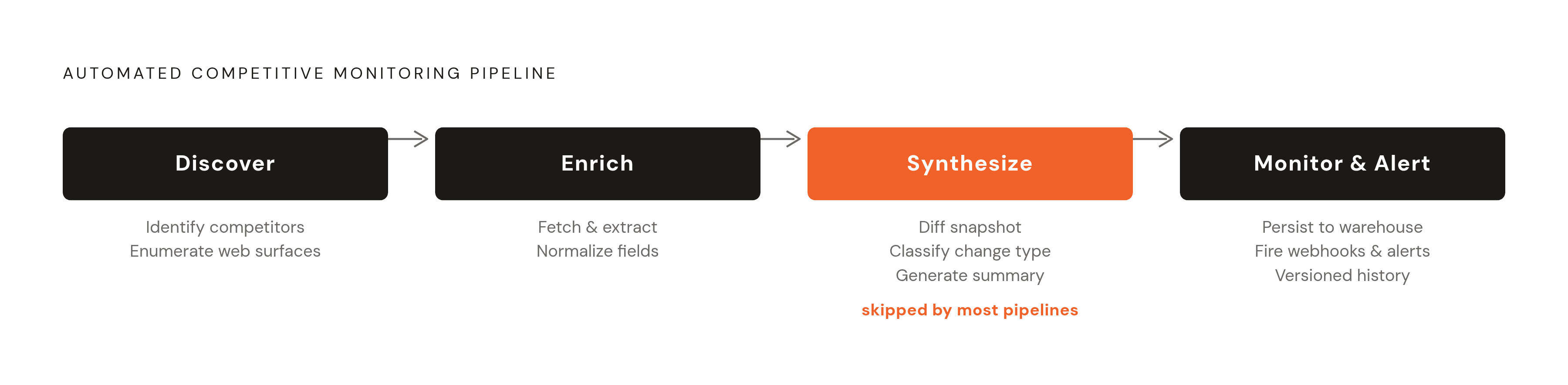
Two ways to run this, and they behave very differently once you scale past a handful of competitors.
A SaaS dashboard means logging in, clicking around, and exporting data by hand. It works, until nobody logs in for three weeks and the intelligence quietly goes stale. A pipeline you own that pulls data automatically from another system works the other way: define the workflow once, and it runs on its own, feeding data into your systems and triggering alerts without anyone remembering to check anything. Parallel AI's developer guide on automated market mapping frames it this way, and the framing holds up.
The pipeline itself breaks into four stages:
Discover identifies the competitor entities worth watching and enumerates the web surfaces tied to each one, including product pages, changelogs, pricing, and docs.
Enrich fetches and extracts structured content from each surface on a set schedule, applying AI extraction to normalize fields even when every competitor's site is structured differently.
Synthesize runs the diff against the last snapshot, classifies what kind of change happened (new product, price shift, messaging rewrite, new feature), and generates a plain-language summary through an LLM.
Monitor and alert persists the structured records into a data warehouse, fires off a webhook or chat notification for the changes that matter, and keeps a versioned history around for trend queries later.
Scheduling needs to match how fast each page type actually moves. High-cadence polling, every 1 to 24 hours, fits pricing and product pages best; Visualping data shows 68% of competitor monitors run on roughly this cycle, with 32% checking somewhere between every 5 and 60 minutes. Sitemap-level discovery for brand-new URLs can run daily or weekly, it's slower-moving by nature. And event-triggered re-crawls add a layer of responsiveness: if a news page changes, that is the cue to immediately re-crawl the linked product or pricing page, since announcements and price changes tend to travel together.
At real scale, batching avoids the bottlenecks that synchronous, one-at-a-time polling creates. Monitoring dozens of competitors across hundreds of URLs through synchronous, one-at-a-time polling will bottleneck fast. Batch API calls with webhook callbacks instead, it avoids blocking and lets requests run in parallel, which is the only way the cadence above holds up once the competitor list grows past a handful.
MCP integration adds a nice capability on top of all this, since with the pipeline exposed through an MCP server, an AI coding agent or assistant can query it directly, and a team member can ask a plain-language question and get back a synthesized brief pulled from live pipeline data, no dashboard-hunting required.
As the system scales past one analyst, Visualping found 35% of competitor monitors belong to organizational workspace accounts rather than individual users. That's a hint that access controls and shared alerting need to be part of the design early, not bolted on after the third person asks to be added to the Slack channel.
Closing the loop from detected change to actionable competitive decision
A pipeline that technically works but buries people in alerts is a pipeline nobody trusts, and that's the failure mode worth designing against from day one. Damco Group's analysis is blunt about it: teams don't need to hear about every website tweak, they need to know when a pricing shift signals a market repositioning, when a leadership hire signals expansion into a new segment, or when messaging changes hint at a roadmap pivot nobody announced yet.
That means building a triage layer before anything reaches a human inbox. Classify the change type first: a new product detected is a different animal than a price field getting updated, which is different again from a feature description edit or a brand-new URL showing up in a sitemap. Then route by severity, a new product launch from a top competitor deserves an immediate ping to the product team, while a minor copy edit on a docs page can sit quietly in the weekly digest nobody reads until Monday anyway.
Get that triage right, and the pipeline becomes something closer to a colleague who reads everything so nobody else has to, because the team can trust the alerts instead of drowning in them. That's the whole point of building it as infrastructure instead of a habit: habits fade when someone's on vacation, pipelines don't.