Why Webhook Callbacks Beat Polling Loops for Production Scraping APIs
Webhooks eliminate wasted API calls by notifying you only when scraping jobs complete.
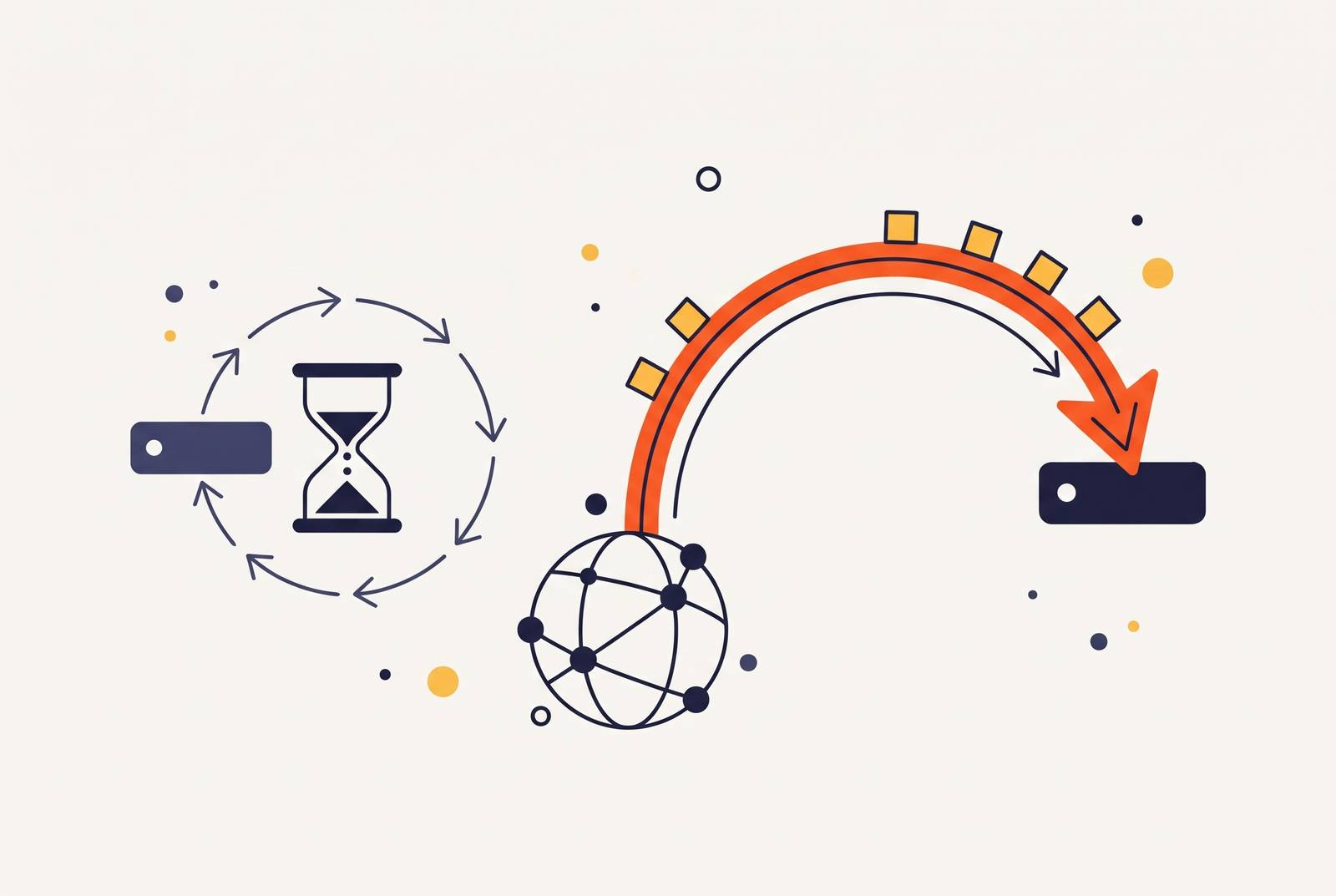
An event-driven web scraping API with webhook support notifies an application when an asynchronous job is ready. For production batch scraping, webhook callbacks work better than polling loops because they skip empty status checks and let downstream AI work start without waiting for the next polling interval. For reliable delivery in production, webhooks send the results and polling serves as a reconciliation fallback.
Webhook callbacks do perform better than polling loops for batch scraping jobs feeding LLM pipelines. A polling loop fires status checks on a fixed schedule regardless of whether the job has finished, so empty responses consume API quota and the pipeline waits out the full polling interval even when the scraping provider has already completed its work. Webhooks eliminate that scheduled wait by notifying the application at the moment the completion event occurs, letting downstream AI work start without sitting idle between checks. For production reliability, the pattern most teams arrive at uses webhooks as the primary delivery channel and a background polling job as a reconciliation fallback for notifications that were dropped or failed.
How scraping APIs bridge the gap between job submission and job completion
A batch scraping job does not finish just because the request to start it has returned. The job is submitted, the crawl takes an unpredictable amount of time, and the results become available on their own schedule. Submission is only the starting gun. The application still needs a way to learn that the work has finished before it can use the output.
That gap can leave an LLM pipeline, a RAG indexer, or an autonomous agent mid-task waiting for data. The delay is not merely a dashboard looking stale. It holds up the next piece of work. The two delivery patterns answer the same question from opposite directions, with polling making the application check the job and webhooks making the provider notify the application. The choice determines how much work the system does while nothing has happened.
Why polling feels like the safe default and where that intuition breaks down
Polling has genuine advantages, especially when an integration has limited networking options. It needs no inbound endpoint, no receiving-side networking configuration, and no webhook support from the scraping provider. If the application cannot receive callbacks or the provider cannot send them, polling is the viable route. An outbound status request can solve a problem that an unreachable webhook endpoint cannot.
Polling tracks elapsed time rather than actual activity, so a check fires whether the job finished, changed, or did nothing worth reporting. An empty response still consumes an API call. A loop built to run “as fast as possible” therefore creates a persistent background load, treating silence as something that must be fetched again.
A tighter interval reduces the wait between completion and discovery, but it also increases the number of checks made before completion. A longer interval saves calls by accepting more delay. Neither setting escapes the trade-off. Better implementation can make a polling loop orderly and easier to operate, but it cannot make a scheduled request know in advance whether there is news. That is the structural flaw, and batch volume gives it room to grow.
What the request math looks like once batch jobs reach production scale
The useful ratio is the share of an integration’s requests that reveal something new. A batch job can be checked repeatedly while producing only one completion event, so most of its status traffic may exist only to establish that it is still unfinished. More checking produces a more expensive account of the wait.
Across production batches, those empty checks can become the dominant share of request volume. The integration spends its allowance detecting a small number of changes through a much larger number of questions. Larger jobs make the tension harder to ignore because the loop must balance real delivery latency against the load of repeated checks.
Svix defines the distinction by who initiates the request and why. With polling, the receiver asks for updates whether or not a new event occurred, while a webhook request comes from the source when there is new information. In the basic webhook model, a given number of events produces that many notification calls, one per event. Polling instead produces calls throughout the schedule, including periods with no activity. Retries and follow-up data retrieval add their own traffic, but they are separate from continuously asking whether anything happened.
Empty checks risk exhausting the quota. Empty checks consume an allowance that useful work also needs, and exhausting it can trigger errors that block access or updates until the quota resets. Ghost traffic has a very real appetite. When that failure becomes part of day-to-day work, manual reconciliation and custom recovery scripts add to the cost. The cheap loop now comes with a maintenance department.
How does a scraping API notify you by webhook instead of polling?
A webhook reverses the direction of communication. Instead of the application repeatedly asking the scraping provider whether a batch is ready, the provider sends a notification when the completion event occurs. Between events, there is no need to send status-check requests. The receiver has something to process only when there is something to report.
Svix explains that webhooks trigger on their own when an event happens, while polling runs at fixed intervals. A job that finishes just after a poll can therefore wait the full polling interval before the next check detects it. Webhooks skip that scheduled wait, though it still takes time to deliver and process the results.
In return, the application needs a publicly reachable HTTPS endpoint before the first event arrives. That endpoint must stay available and be reachable from the provider’s servers. This is a real operational requirement. Local development needs tunneling to receive those calls, and firewalls can block them. Webhooks are not a way to avoid networking work, but a way to stop spending requests on work that has not finished.
The handler also needs signature verification, deduplication, and a quick response. Signature verification rejects fabricated events from an attacker who discovers the endpoint URL, while deduplication handles repeated delivery when a provider retries after a timeout. A slow response can provoke more retries. The resulting workload also fits serverless infrastructure naturally because processing follows events.
The reliability objection: what happens when a webhook fires and nobody is listening
The strongest objection to webhooks is straightforward. A notification is useful only if the receiver can accept it, and a receiver that is down, slow, or throwing unhandled exceptions can lose a payload without a trace. The endpoint is now part of the delivery path. That shifts responsibility for accepting and preserving the incoming information to the receiving system at the moment it arrives.
Providers can retry when a delivery times out, so the same event ID may arrive more than once. Most providers do not guarantee “exactly once” delivery. A handler must therefore handle an event that arrives again instead of treating each incoming request as new work. Otherwise, a mechanism meant to recover from failure can cause repeated processing.
A sudden wave of job completions can send more notifications than the listener can acknowledge within the provider’s timeout window. Retries then compound the incoming volume. The receiver is trying to recover while the doorbell keeps ringing, which is not known to improve anyone’s concentration. Fast acknowledgment is consequently part of reliability.
Visibility is another genuine drawback. With polling, requests and responses pass through code the team controls and can log, while an incoming webhook that fails before reaching the logging layer can disappear without a useful trace. Silence is also ambiguous in an event-driven system. A polling loop can notice that a job has stopped updating, whereas the webhook path needs an explicit failure event to report that condition, and not every scraping API emits one.
The production pattern most teams arrive at: webhooks as primary channel, polling as reconciliation fallback
The practical answer is to give the two mechanisms different jobs. Webhooks are the main path for real-time delivery, while a background polling job reconciles state and finds work missed when notifications were dropped or failed. The fallback exists precisely because endpoint outages and silent failures are possible.
A thin webhook payload makes that division clearer. The notification often contains only an event ID and serves as a signal that something changed. The receiver acknowledges it immediately, then makes a single follow-up API call to fetch the authoritative, complete data. Treating it that way avoids relying on the notification payload itself as the source of truth and keeps acknowledgment separate from the work that follows.
That follow-up request happens because there is an event to resolve. Reconciliation traffic checks for state that the normal delivery path missed. The system still makes API calls. What changes is why it makes them, with the normal path driven by completed work and the fallback devoted to finding gaps.
For a team implementing this pattern, deduplication by event ID is non-negotiable. Both a retried webhook and the reconciliation path may surface an event that has already been handled, so the handler must check whether that ID has been processed before acting. This is what makes the combined approach idempotent. With it, the system can recover missed delivery without treating every rediscovery as a new event.
Do webhook callbacks actually perform better than polling loops for batch scraping jobs feeding LLM pipelines?
Delayed delivery costs more when the consumer is software waiting to act than when it is a person checking a dashboard. LLM pipelines, RAG indexers, and autonomous agents can remain blocked until scrape results arrive. The delay sits directly in the workflow. A polling interval therefore becomes part of the time needed to complete an AI task, even when the scraping provider has already finished its work.
Webhooks fit AI workflows in two distinct roles. A trigger brings an external event into an AI workload, while a callback reports completion of asynchronous work already underway. The distinction is important for webpage monitoring. A callback saying that a scrape is complete does not, by itself, establish that the page changed. Automatically scraping when content changes requires a change-monitoring trigger, followed by the scrape and its completion notification.
For RAG pipelines, that separation supports change-triggered re-ingestion. Fixed crawl schedules can reprocess documents that have not changed, whereas change-monitoring webhooks initiate re-ingestion when new content actually appears. The downstream pipeline can use the completion callback to continue once the new scrape is ready. This connects freshness to real activity at both ends, from deciding when to fetch to deciding when to consume.
Svix describes webhooks as updates generated by the server that observes the triggering event. That principle suits AI applications that need up-to-date information as well as answers that read well. It also gives buyers a concrete architectural test. An event-driven web scraping API with webhook support should be evaluated for asynchronous batch callbacks and reliable receiving requirements, while change-triggered workflows additionally need change monitoring.
A unified web data API can bring search, scraping, crawling, batching, and native webhook callbacks into the same infrastructure. That reduces the fragmentation involved in stitching together a scraping provider, a queue, a polling cron job, and a separate notification service. Receiver-side reliability work still remains. But delivery no longer has to be bolted onto every workflow after the scraping work is done, leaving data arrival to determine when the AI pipeline can proceed.