How to Trigger Automatic Scrapes on Page Changes and Receive Instant Webhook Notifications
Webhook notifications fire only when meaningful page changes pass your detection rules.
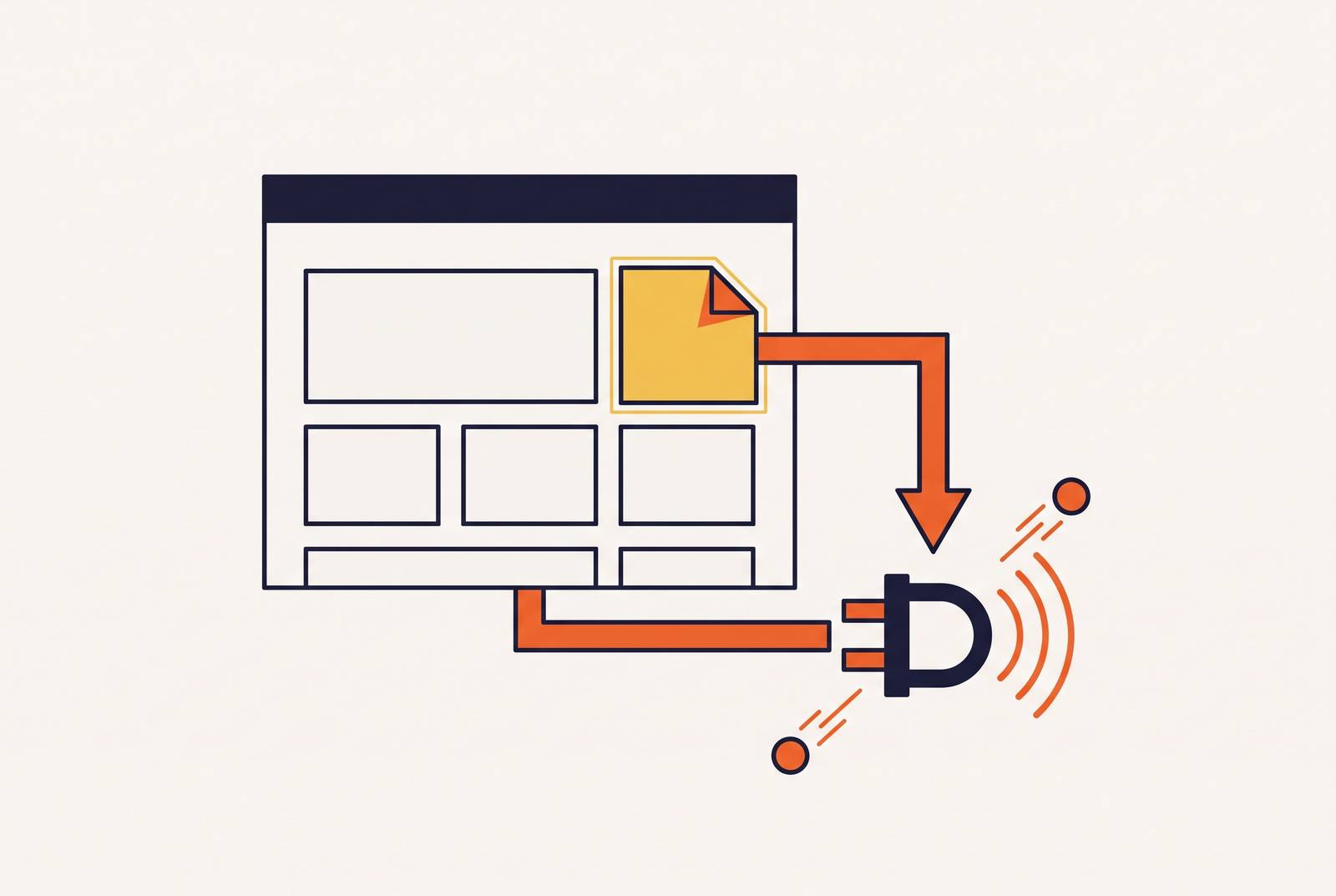
An event-driven web scraping API with webhook support needs four stages, namely a baseline snapshot, scheduled re-fetch, noise-filtered diff logic, and webhook dispatch. To trigger automatic scrapes on page changes, compare each fetch against the saved reference and send a structured event only when a relevant change passes the rules. Webhooks remove downstream polling, but “instant” notification means instant after detection.
To trigger automatic scrapes only when a webpage changes, the pipeline needs four sequential stages: a baseline snapshot that records the page before monitoring begins, a scheduled re-fetch at a configured interval, diff logic that compares the new version against the reference after stripping dynamic noise such as ads, timestamps, and session tokens, and a webhook dispatch that fires an HTTP POST only when a meaningful difference passes the configured rules. The fetch interval sets how quickly a change can be detected; checking more often buys earlier discovery at a higher cost. The webhook payload should include the event type, monitor name and URL, change summary, a detected-at timestamp in ISO 8601 format, the added, updated, or removed data, and a diff URL for inspection. On the receiving end, validate the delivery signature, deduplicate against a persistent store using a unique event ID, store the raw event, queue it for asynchronous processing, and return 200 immediately so slow responses are not treated as delivery failures.
Why batch scraping schedules fail AI pipelines that need current data
A pricing agent can reason well and still change a price based on yesterday’s competitor price. A recommendation engine can confidently surface an out-of-stock item. Neither failure requires a broken scraper. The fetch may have worked, the data may have parsed, and the scheduled job may have got its reassuring green tick. The source changed between runs, while the downstream system kept treating the old copy as current.
That gap makes freshness part of AI performance. Consider embeddings in a vector store. If a source document changes but re-embedding lags by hours, an agent can retrieve outdated information even when its underlying model is current. Better reasoning does not repair stale context.
Batch systems run because a clock says so, while event-driven consumers act when content they need has changed. Scheduled checks still have a role in discovering that movement. The distinction is what happens next. Instead of pushing every fetched copy into downstream processing, change detection gates that work on a meaningful difference.
The four-stage architecture every scrape-on-change system needs
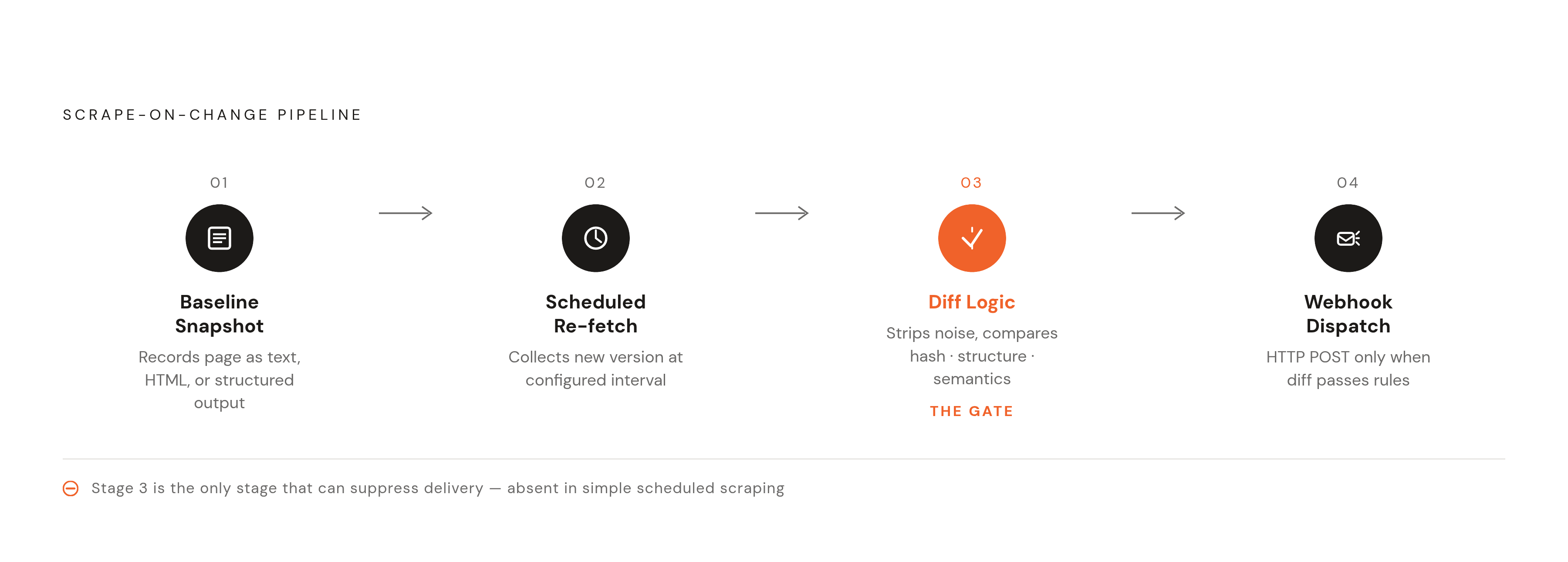
The baseline snapshot is the reference that makes a comparison possible. It records the page as text, HTML, or structured output before monitoring begins. Scheduled re-fetch then collects another version at a configured interval. That interval sets how long it takes to detect a change and how much fetching costs. Checking more often usually buys earlier discovery at a higher price.
Diff logic compares the new version with the reference after irrelevant content has been stripped away. Different methods answer different questions. Visual diff detects pixel changes, text or HTML diff detects wording changes, and semantic diff judges whether meaning changed. CSS selectors or XPath narrow the comparison to a specific region, while pages rendered by client-side scripts need a browser-based fetcher such as WebDriver or Playwright to read the final DOM.
Webhook dispatch completes the chain by sending an HTTP POST when the diff passes the rules. That is the handoff to automation. It can trigger enrichment or re-indexing without asking someone to translate an email into work. Keeping these four stages distinct also separates content monitoring from uptime monitoring. A page can be online and serving completely different information.
Setting the baseline and choosing what to watch
Start by choosing the smallest part of the page that contains the information the business needs. Full-page text monitoring works for news, policy documents, and documentation where changes anywhere in the content matter. A price, stock label, or CTA button calls for an element-specific CSS selector or XPath instead. Scope is the first noise filter you control. Watching the whole page to track one price invites the navigation bar to become a stakeholder.
Numeric tracking narrows the question further by extracting a value and tracking it over time. That supports a threshold rule, such as notifying when a price drops below a target. Visual comparison serves a different purpose. It suits brand monitoring and QA, where appearance is the subject, rather than structured data pipelines that need updated fields.
Once scope is set, capture the baseline using the same fetcher that will perform later checks. If client-side scripts build the content, a fetcher that does not run them may save an empty shell. Configure Browser Steps before taking that snapshot when reaching the content requires filling forms, accepting cookie banners, or logging in. The page state must be comparable across checks.
Choose the interval according to how quickly a missed update would cause harm. Tools commonly allow per-URL schedules ranging from minutes to once a day, so every target need not receive the same treatment. Checking more often cannot fix a poorly chosen reference. A clean baseline and a focused scope determine the quality of the signal that reaches every later stage.
How diff logic separates real changes from page noise
Strip dynamic ads, timestamps, cookie banners, navigation elements, and session tokens before comparing versions. Otherwise, ordinary page machinery looks like news. A rotating banner can change on every load without changing the information the pipeline needs. Raw comparison treats both events alike, which is how an alert system becomes a very diligent nuisance.
Content hashing, structural signature comparison, and semantic similarity each check what changed in a different way. Exact diff reports character differences, while semantic diff asks whether those differences alter meaning. Neither answers every monitoring question by itself. A reworded sentence may be irrelevant to a meaning-based monitor but important when the task is tracking exact policy wording.
AI-powered evaluation adds to semantic filtering by checking the differences it finds against a plain-English rule. A rule can ask for price drops below a target or ignore navigation and footer changes. changedetection.io implements AI change detection rules and AI change summaries, with support for a small language model, Gemini Flash, Ollama, and compatible model endpoints through LiteLLM. Its summaries can describe a price drop or newly added products.
meter uses content hash, structural signature, and semantic similarity checks while filtering ads, timestamps, and layout shifts. Its webhook expresses the result as added, updated, and removed items. That structure is the useful endpoint of comparison. A downstream handler needs to know what to update as well as that two large strings now differ.
How do I set up automatic scraping that only triggers when a webpage changes and sends a webhook notification instantly?
A focused JSON payload is the API contract between detection and every downstream consumer. Include the event type, monitor name and URL, change summary, detected-at timestamp, added or updated or removed data, and a diff URL for inspection. An email saying “something changed” leaves the actual work as an exercise for the recipient.
PageWatcher publishes a payload with the event value change_detected, plus monitor.name, monitor.url, change.summary, change.detected_at, and change.diff_url. Its timestamp uses ISO 8601, and its summary is plain-English AI output. This illustrates a concrete notification contract, though it is not the same as a payload containing structured field-level differences. The distinction affects how much work the receiver must do.
On the receiver side, validate the signature before accepting the event for processing. Then check a unique event ID against a persistent deduplication store, because at-least-once delivery can send the same event more than once. Store the raw event, queue it for asynchronous processing, and return 200 promptly. Slow responses can be treated as delivery failures. Keeping duplicate delivery from causing duplicate effects is idempotency.
After that handoff, downstream handlers can trigger a re-scrape for enrichment, re-embedding for a vector store, a Slack notification, or a warehouse write. Webhook-compatible tools connect to n8n, Zapier, Make, Slack, Discord, and custom API endpoints without requiring an SDK for basic wiring. Telegram is the exception to the plain-URL pattern. It needs a bot token and chat_id through its Bot API.
Retry logic, dead-letter queues, and what happens when the receiver goes down
Separate detection from delivery with a queue on the sender side. The detection worker should enqueue the event, while a delivery worker sends the POST. A receiver outage then does not have to become a detection outage. Calling the endpoint synchronously from the detection worker ties two distinct failure paths together, which is convenient right up until it is not.
Use exponential backoff with jitter and a bounded number of attempts. Retry intervals can grow from seconds to minutes to hours, with the window potentially spanning most of a day. Jitter spreads those attempts out. Without it, a recovered consumer can face every producer’s backlog at once, turning its welcome-back party into another outage.
Events that still fail after all retries should go into a dead-letter queue to be checked and replayed by hand or automatically. Instrument delivery attempts, response codes, retry counts, and DLQ depth as well. Batch failures are often visible in failed jobs, but a missing event can go unnoticed unless delivery is measured.
For asynchronous scraping jobs, completion webhooks also avoid the repeated status requests that polling requires. The latency and load advantage grows with larger job batches. That benefit holds whether or not the source content has changed. Reliable retries and a replayable DLQ make either kind of push pipeline accountable for unfinished delivery.
Choosing between self-hosted detection, managed APIs, and unified web data platforms
The best fit depends first on which work the team wants to own. Self-hosting fits teams that want full control of their data, an agents platform fits those that want broader workflow automation, and a managed API fits those that want less work running scraping infrastructure. An AI product that also needs search, crawling, and structured data at scale is a fit for a unified-platform service. These are different buying decisions. A completion callback alone does not establish that a service also detects page changes.
changedetection.io fits teams comfortable operating their own infrastructure. It runs in Docker, supports CSS and XPath filters, and sends notifications through Apprise to destinations including Slack, Discord, Telegram, and generic webhooks. A SaaS plan is available at $8.99/month when self-hosting is not desired. Hosted AI change summaries have been available since June 2026. Control is its defining reason to choose it.
Huginn fits a different requirement by placing detection inside an “agents that watch and act” platform. A Website Agent scrapes the page, a Change Detector Agent notices changes in extracted values, and downstream agents route the result. Monitoring is one part of the workflow.
meter fits teams that want a managed change-detection and scraping API without having to run scraping infrastructure. Its v1, released 2026-04-19, turns a plain-English data request into a reusable extraction strategy, runs on a cron schedule, and POSTs a structured JSON diff when it detects content movement. It manages antibot bypass, proxy rotation, and self-healing strategy rewriting. The stated fit is fast delivery at moderate volume, without queues, workers, or proxy pools for the scraping service to operate.
For broader AI data operations, the unified-platform option combines change monitoring with search, crawling, and structured extraction at scale. The alternative self-build path accumulates responsibilities gradually, from browser wait logic and proxies through snapshot storage, normalization, delivery, and dashboards. Each part looks manageable on its own. Teams must weigh whether owning that whole chain is better for the product than buying the layer they need.
What self-healing scrapers and emerging agent protocols mean for this pipeline
Self-healing extraction can fix a failure that content diff alone cannot fix. When a site changes structure and a selector chain breaks, agentic systems can detect the failure and rewrite the extraction strategy automatically. That reduces the need for manual repair. In 2026, this capability is moving from a differentiator toward an expected baseline for reliable AI data operations, though it does not replace a clear event contract or dependable delivery.
WebMCP approaches structured access from the website’s side. Its browser-native API lets sites expose typed tool calls to visiting agents, with the site defining what is offered. The W3C Draft Community Group Report is dated February 12, 2026, after the launch of Chrome 146 Canary Early Preview on February 10, 2026. The implementation is behind a feature flag. It is a preview in one browser channel, with broader deployment and W3C Standard status still unrealized.
If broadly adopted, that approach could change the choice between scraping a page and accessing its structured tools. The economic questions for ad-supported sites remain unresolved, so conventional fetching cannot simply be wished away. A clean JSON event sent to a queue keeps the boundary steady even as the ways of extracting data and the protocols that consume it change. Design for extensibility now by keeping the webhook payload and downstream consumers loosely coupled.