Choosing a Web Data API That Fits an Event-Driven AI Agent Stack
Five capabilities matter more than price when selecting a web data API for AI agents.

An event-driven web scraping API with webhook support should notify a pipeline when a monitored page changes or requested data is ready. Choosing one for an AI agent stack means testing five capabilities together, namely push delivery, freshness, structured output, burst tolerance, and agent-native integration. Price and coverage alone cannot establish whether it fits the architecture.
Why event-driven agent stacks need more from a web data API than they get from a generic one
In a traditional request-response application, a web data API supplies a lookup result. In an event-driven agent stack, it participates in the loop that leads from new information to action. That changes the consequences of a weak response. An incomplete page is not merely a disappointing search result when an autonomous agent uses it to make its next decision. Even when a request succeeds, the agent can act with confidence and still get it wrong.
The more steps the agent takes, the more it depends on the data. A customer service agent may read a ticket, search a knowledge base, retrieve order history, draft a response, check policies, and send the reply. Each step needs accurate context, and a stronger model cannot make up for facts it never received. The binding constraint becomes access to fresh, structured, verifiable data. An API priced attractively for occasional lookups may therefore be a poor fit for continuous consumption, even when its coverage looks impressive on paper.
How event-driven architecture changes what a web data API is asked to do
A workflow can check for a funding round every hour or receive a notification within minutes of one being detected. The first workflow ties the agent’s response time to a schedule. It also uses requests to check for changes when nothing has happened. Polling is simple and gives the caller control over frequency, but larger workloads bring wasted calls and rate limits. The clock becomes part of the bottleneck.
Push delivery changes who starts the conversation. An outside system sends an event, and the agent acts on it without having to keep asking for an update. That supports near-real-time work, but moves complexity into reliable delivery, retries, deduplication, and burst handling.
A streaming backbone then separates event arrival from the systems that consume it. Apache Kafka supports this pattern with persistent streams that consumers can use independently of one another. Conceptually, change detection starts the workflow, an API supplies current data, RAG retrieves relevant knowledge, tool calling executes an action, and orchestration coordinates the steps. The web data API has to fit between those stages. Batch processing still works well for model training and historical analysis, while new ways to build reactive agents have moved toward streaming.
The five API capabilities an event-driven agent stack actually requires
Without push delivery, the agent has to keep checking for results. The first requirement is therefore webhook delivery for the notifications the workflow needs. A callback saying a requested scrape is ready and a notification saying a monitored page changed serve different purposes. Both remove the need for polling at their own stage, but a completion callback on its own does not keep watch for changes. The API’s event surface must match the trigger.
A fast notification is useless if its content is old. The second requirement is real-time freshness backed by continuous monitoring of URLs or queries. An event-driven agent reasons about a particular moment, so cached content can undermine the workflow even when delivery is prompt. Monitoring sends events when the web content being watched changes. Freshness concerns the underlying observation independently of how quickly the API returns a response.
When extraction is unstable, the reasoning layer has to fix what went wrong. The third requirement is structured, schema-consistent output that the next step can use without having to strip out navigation, ads, and boilerplate. Markdown offers lightweight structure for text-heavy LLM inputs, while consistent fields support downstream parsing. These are related but separate tests. A neatly formatted response can still break a pipeline if a page redesign changes its field shapes.
A steady request benchmark hides the fourth failure mode. Event triggers can require dozens of URLs at once, making burst tolerance and scalable concurrency essential. Client-side JavaScript adds another load-bearing dependency because a large share of major websites rely heavily on it, leaving plain HTML fetches incomplete. Rendering must work at the concurrency the workflow needs, beyond what the documentation says it can do. Otherwise, the agent gets an empty plate, delivered impressively fast.
Bespoke tool connections create the fifth source of friction. MCP, the Model Context Protocol, provides a standard integration layer through which agents can query data stores dynamically. For web data access, an MCP server lets a framework discover, authenticate, and call tools without a custom connection for each one. Read-only access keeps things secure by default, so retrieving context stays separate from changing the source. MCP compatibility addresses integration, leaving the freshness and quality of the content returned as separate concerns.
How the context enrichment step inside a RAG pipeline changes what "good extraction" means
A page-change event tells an agent that something happened, but rarely supplies enough context to decide what to do. In a retrieval augmented generation pipeline, context enrichment brings in what is missing. It may retrieve semantically similar documents from a vector database, perform fast lookups in a key-value store, or correlate information from other event streams. The extraction layer supplies web content for that reasoning. Its job is not to reproduce the page’s appearance.
This makes extraction quality more demanding than readable text alone. The agent needs the surrounding facts in a form it can compare with stored knowledge and join with the event. Boilerplate consumes context that should hold evidence, while poor structure forces the model to reconstruct relationships before using them. Missing or stale grounding also increases hallucination risk. A tidy answer is no consolation if the facts behind it are absent.
AI-powered extraction can adapt to layout changes that would break fixed CSS or other path-based selection rules. That maintainability advantage becomes especially useful when a monitoring workflow watches the same pages for weeks or months. There is a real tradeoff, however. AI extraction costs more per page and adds latency, so its advantage is less clear for a one-shot lookup than for a long-running monitor. At high cadence, the evaluation has to weigh those costs against maintenance work and downstream reasoning errors caused by poor input.
How do page changes trigger scraping and webhook notifications in an event-driven pipeline?
A monitoring surface watches a defined set of URLs or query results and emits events when it detects changes. To start work automatically, the pipeline subscribes to those notifications instead of setting a schedule to keep checking on its own. Periodic scraping can eventually discover an update, but its schedule controls when the agent gets a chance to react. Monitoring with push delivery makes detection the starting point.
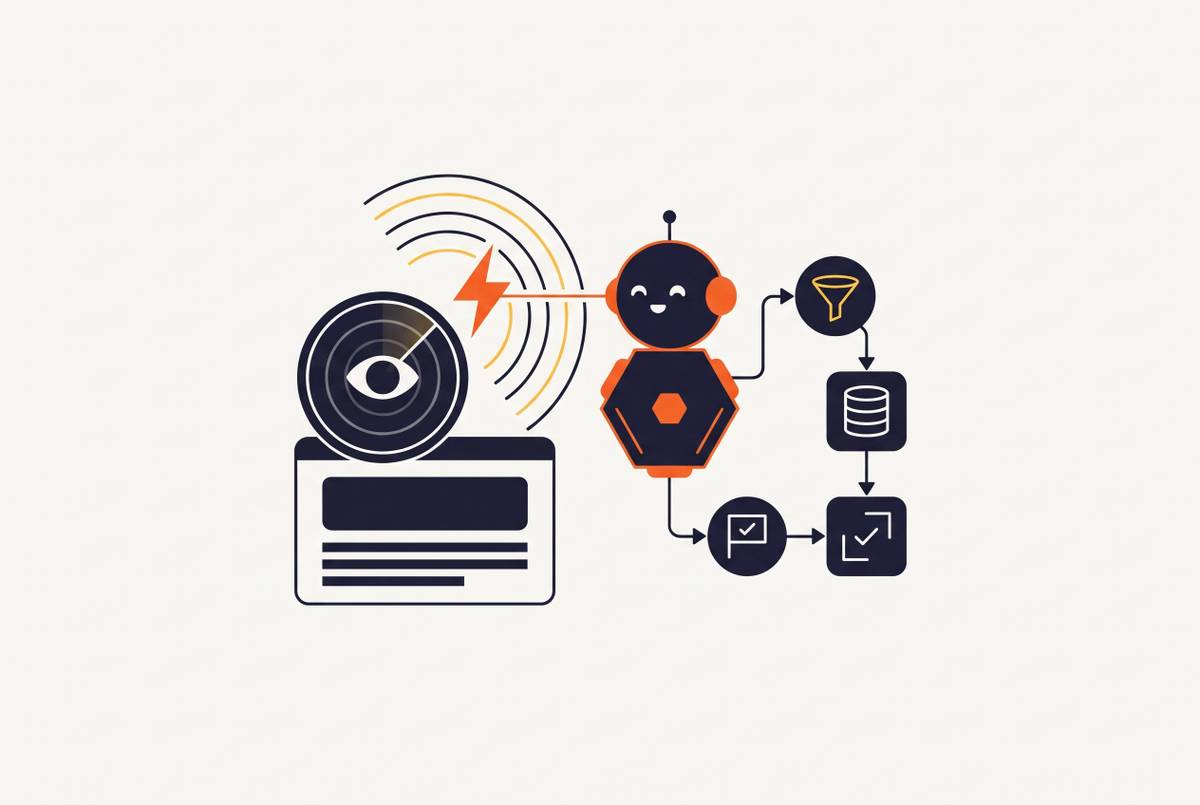
A competitive-intelligence workflow shows the chain clearly. A competitor updates a pricing page, the monitor detects the change, and a webhook reaches the pipeline. The context enrichment step then retrieves the updated page as structured content and brings in relevant knowledge for comparison. The agent reasons about the change and acts on it, enabling a response within minutes. Detection, delivery, enrichment, and action are separate stages, and delay in any one can blunt the benefit.
The lesson for developers is to ask what the subscription actually provides. Does it fire a webhook, or require polling for detected changes? Does the notification contain structured content describing what changed, or only a signal to fetch again? An AI-readable summary or binary change flag with the raw diff can support triage before full context is consumed. For hundreds or thousands of URLs, pricing also has to leave room for continuous operation.
The same event chain can watch for changes to supplier terms and send alerts when regulatory pages are updated. Those workflows also need a feedback path. Agent actions produce outcomes that can stream back into the pipeline, and monitoring the post-action page state can help verify the intended effect where that state reflects the action.
Legal and access constraints that now shape which web data APIs are safe to run at scale
A provider’s ability to retrieve a page does not establish that the access is compliant or dependable at monitoring cadence. The European Commission’s enforcement framework states that the AI Office’s and national competent authorities’ enforcement powers apply from August 2, 2026. The EU AI Act Service Desk identifies financial penalties for GPAI providers under Article 101. Those provisions make access compliance a selection issue, but they should not be flattened into a claim that every API customer has identical obligations.
A production team has to consider both the legal risks and whether the pipeline will keep working. An API that ignores a site’s crawler restrictions may offer coverage that becomes unreliable as the operator introduces stronger access controls. High-cadence monitoring magnifies that dependency across large URL sets. Provider selection depends on what the provider can supply while respecting restrictions.
The IETF AI Preferences Working Group’s 2026 drafts signal that the access landscape is still developing. These drafts impose no current production requirement and provide no guarantee of future access. For now, teams have to assess providers based on their documentation. Teams should ask how the API handles robots.txt, how it treats sites that restrict AI crawlers, and whether coverage claims describe compliant access. For EU-based or EU-serving deployments, those answers belong in risk assessment before a monitoring commitment.
How to evaluate a web data API against the five capabilities before committing to it in a production stack
A production evaluation should reproduce the failures the architecture needs to avoid. Begin by registering a webhook endpoint and making a known change to a monitored page. Measure change-to-delivery time under load, then check whether the payload has content the workflow can use or just says that the event happened. Separately, test callbacks for completed scraping jobs if the workflow needs them. For this event-driven use case, an API without a webhook surface fails the first gate.
Next, test freshness against an observable update. Request a recently changed page and compare the returned content with what a browser shows. Ask for a crawl timestamp to supplement a service-level promise. Measure detection lag for monitoring. Fast delivery and fresh observation are different measurements. Recording only request latency leaves the more consequential delay out of view.
Then pass the API output directly into the intended LLM step. If the workflow first needs to remove boilerplate or repair fields, the extraction is not ready for the proposed production path. Compare schemas across two or three page layouts on the same domain, because layout variation should not change downstream field shapes. For RAG, assess whether the output supplies the context needed to reason about the event. Attractive Markdown is not the entire exam.
Send concurrent requests at the volume a single event would produce, measure latency degradation, and note when rate limiting starts. Check whether batching can absorb bursts without per-request overhead. Include JavaScript rendering in the same test, since rendering that slows to seconds per page under burst load may not fit a real-time workflow. Testing those capabilities separately can conceal the bottleneck.
Finally, connect the API to the intended agent framework. Where an MCP server is available, test the connection without a bespoke adapter and inspect the authentication model for human provisioning steps that complicate autonomous workflows. Python and Node.js SDKs can make integration easier, and CLI tooling lets teams test monitoring and batches before they write integration code. Before committing, ask directly about compliant coverage and restricted sites. The purchase decision should rest on a working path from page change to grounded action, with access that the production stack can reasonably rely on.