Webhook-Driven Architectures for Real-Time Web Change Alerts
Webhooks let services push page changes instead of forcing apps to constantly poll.
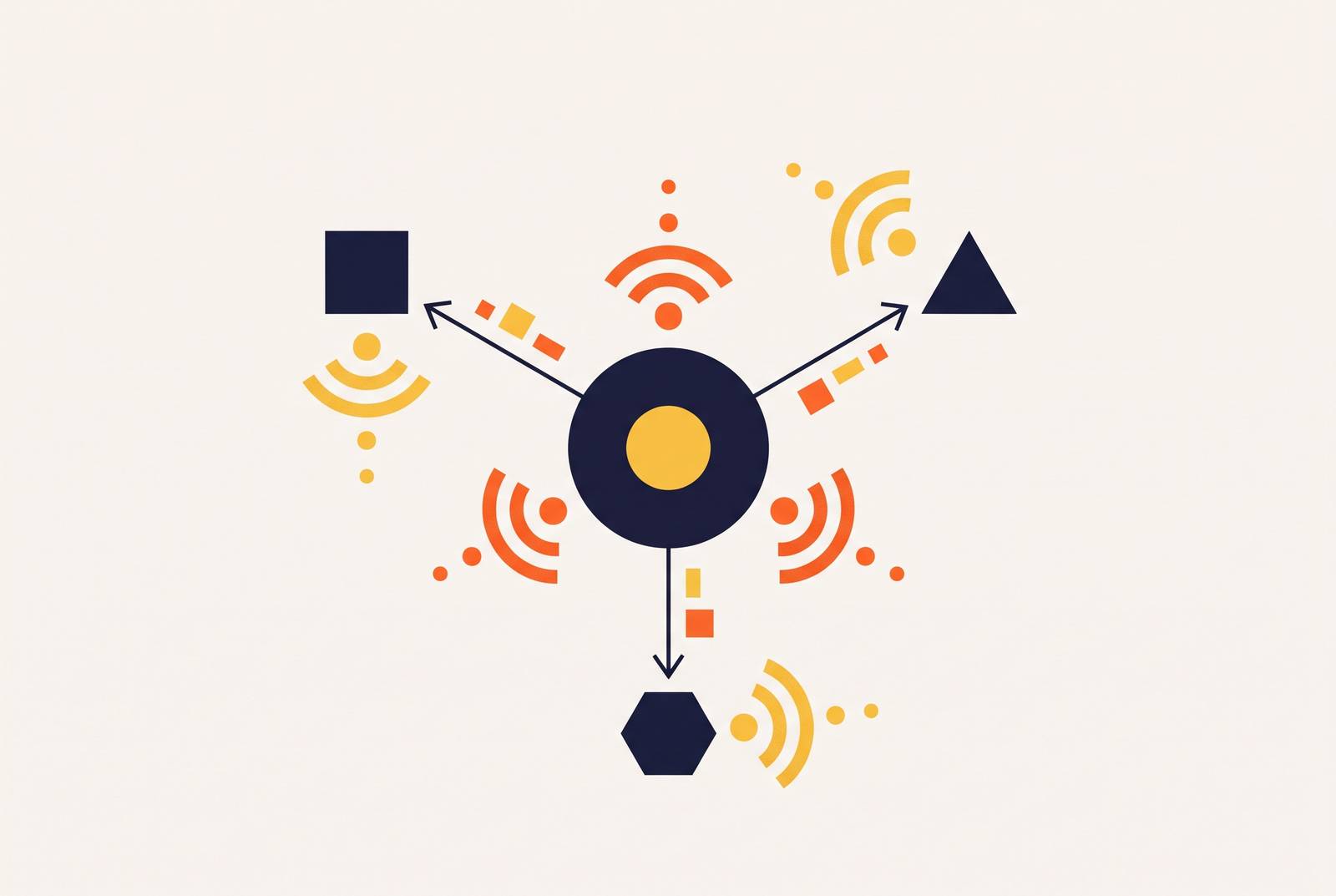
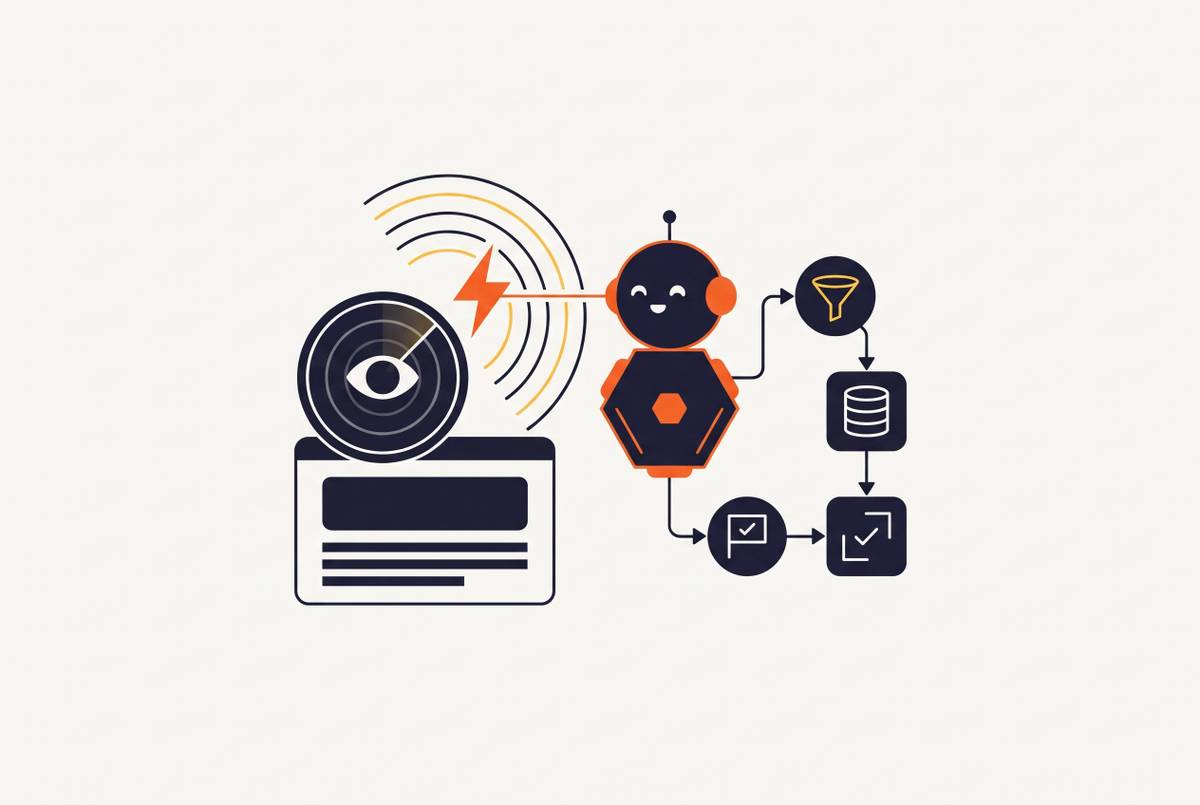
An event-driven web scraping API with webhook support monitors pages and sends an HTTP POST to a registered endpoint when it detects a change. The production pattern is a fast endpoint, queued processing, structured payloads, and a targeted polling fallback that catches missed deliveries.
Why polling breaks down as web change detection scales
Polling spends resources according to the monitoring schedule. An application repeatedly asks an API whether anything is new, and every request needs handling even when the answer is no. Silence still runs up the bill. As more clients poll more often, thousands of requests per second can pass through authentication checks and database layers without finding anything new.
The same schedule also sets a limit on freshness. Average discovery latency is roughly half the polling interval, so even a 10-second interval introduces a delay between a change and its discovery. Shortening that interval buys speed with more requests. For an AI agent expected to act on current web state, this creates a basic mismatch. The agent needs changes as they become available, but its pipeline serves periodic snapshots instead.
How do webhooks notify an agent automatically when a webpage changes?
The consumer registers a callback URL, and the service sends an HTTP POST containing event data when it detects a relevant change. The endpoint acknowledges receipt with a 2xx response. Failed deliveries typically trigger retries, often with exponential backoff, although the policy depends on the provider. The consumer no longer has to keep knocking.
This gives the architecture three components, which are a monitoring API, a webhook endpoint, and downstream processing logic. The API detects changes and constructs events, the endpoint receives them, and the processing logic decides what to do. Structured JSON can supply summaries, source URLs, timestamps, and identifiers for grouping related events. An AI agent gets what the change means.
Programmatic monitoring APIs can accept natural-language queries, scan the web on a cadence, and send events when results match, without requiring hardcoded CSS selectors. The webhook removes the consumer’s polling delay while leaving the monitoring service’s scanning interval in place. No detected events means no event-delivery traffic, but monitoring itself still has work to do. That is a more useful promise than pretending the entire web has acquired a doorbell.
Designing a webhook endpoint that can absorb production traffic without failing
The endpoint’s job is deliberately small and boring. It accepts the request, verifies its authenticity, publishes the event to an internal queue, and returns a 200 or 202 response promptly. As a compact pseudocode sketch, the handler is accept(payload) → validate(payload) → enqueue(payload) → respond(202). The queue handoff comes before acknowledgment so that receipt leads into asynchronous processing. The provider should not have to wait for the agent to finish its work.
Calling an LLM inside that handler breaks this separation. A slow downstream service blocks the response and can exceed the provider’s timeout window, turning processing latency into a delivery failure. Providers may eventually disable endpoints after retries are exhausted. The acknowledgment means the event has been accepted for processing.
Security checks belong before the event enters that path. They include cryptographic signature verification against the request parameters, matching the inbound account identifier to the configured account, and checking for a valid authentication token. The production endpoint must use HTTPS and be publicly accessible, with an integration-specific path such as /webhooks/monitor/pagename to make routing and logging clear. Rate limiting belongs at the edge router. With horizontal scaling, each container has its own memory, so a local limit does not cover the whole service.
Queue-based ingestion and event routing between the endpoint and the agent
Once the endpoint hands off an event, the queue lets events come in at one speed and be processed at another. Redis, SQS, and BullMQ are examples of technologies used for this role. A burst of callbacks can wait in the queue while workers process events at their own rate. This buffer also absorbs retry storms rather than passing the full burst straight into the agent layer.
A router then inspects each event and dispatches it to the appropriate worker or agent. For web monitoring, a page content change, a new mention, and a structured data update may require different actions. Routing makes that distinction explicit before expensive processing begins. A dead-letter queue captures events that still fail after the maximum number of processing retries. Without that destination, exhausted retries can become silent losses with no record of what went unprocessed.
Providers may send the same event more than once because of network failures or overlapping retries, so processing must be idempotent. An upsert keyed on the event identifier is the standard mechanism for making repeated delivery produce a consistent record update. Delivery twice must not mean acting twice. This matters even more when events from the recovery path enter the same processing flow.
Retry logic and the fallback polling path that keeps the system honest
Retries help with temporary failures, but they do not guarantee arrival. An endpoint can remain unavailable, a network request can time out, or a provider can exhaust its retry policy. Devam Gupta’s July 2026 paper, Two-Path Status Verification for Outbound Enterprise Messaging Pipelines, documents the consequence in messaging systems. A lost callback can leave a record indefinitely in its last-known intermediate state. In a web change pipeline, the corresponding architectural risk is treating an unresolved update as though no further work were needed.
The two-path design gives recovery its own route. The primary flow is webhook → endpoint → internal event → asynchronous processing → idempotent upsert. It handles ordinary delivery with low latency while keeping downstream work outside the HTTP request. The fallback flow is scheduled job → overdue unresolved records → provider status API → idempotent upsert. Both routes converge on the same update mechanism, so whichever arrives first, or if both arrive, the result remains consistent and non-duplicating.
In Gupta’s paper, a configurable scheduled job finds records still in a transitional or unresolved state after a configured interval and queries the provider’s status API to reconcile them. Recovery therefore depends on a status API and unresolved records that the job can inspect. It is not a magic net for events the system has no way to identify. A separate monitoring job detects prolonged sync failures and alerts administrators when reconciliation does not converge.
Does adding polling bring the old problem back in disguise? No, because this polling targets unresolved work rather than repeatedly querying every healthy resource for changes. Its cadence should follow the acceptable staleness window, with a competitive intelligence feed able to tolerate more lag than a time-sensitive lead trigger. Provider retry policy, status-query support, and reconciliation behavior therefore belong in an API evaluation. Once delivery is dependable, the next constraint is whether the agent can understand what arrived.
What the downstream AI agent needs from a webhook payload to act correctly
A reliable delivery system can still deliver an unusable message. Raw HTML diffs force an agent to separate the change from markup before it can reason about the event. Structured JSON removes that unnecessary detour through preprocessing. The payload should use typed fields and a consistent schema, with an event summary, source URL, timestamp, and change identifier for deduplication. It also needs enough structured context for the agent to decide whether to act immediately or fetch more data.
That context depends on the downstream decision being made. For competitive intelligence, a product name, announcement type, and source domain can let the agent route an event without fetching and parsing the page again. If the agent does need page content, Markdown preserves useful headings and lists while avoiding much of HTML’s token waste. Navigation bars, footers, ads, and tracking scripts say little about what changed.
For RAG pipelines, that event can trigger re-ingestion into the vector store only when content changes. This saves the cost of embedding pages that have not changed on every crawl cycle. URL selection can also benefit from llms.txt, an emerging domain-root convention that highlights important content and describes the site. It resembles a curated sitemap, and robots.txt concerns access rules. A monitoring service aware of the convention can use it to prioritize tracked URLs, but the agent still needs a clear event schema.
Three production patterns that use webhook-driven change detection in practice
For RAG knowledge base freshness, the monitoring service tracks documentation or knowledge pages and fires a webhook when a page changes. The downstream agent re-ingests only that page into the vector store. Unchanged pages stay out of the embedding bill. Scraping, diffing, and scheduling remain the monitoring service’s responsibility, while the consumer supplies the endpoint and re-ingestion logic within the reliability architecture described above.
Competitive intelligence takes events in through the same path but uses them to make a different choice. Monitors watch news sources, product directories, and company blogs for relevant mentions or announcements, including product launches, feature announcements, and funding rounds. A structured event gives the agent enough context to summarize it for a team channel, update a CRM record, or launch deeper research. Routing replaces re-ingestion as the central downstream choice. When the payload includes the necessary context, that choice does not require a second page fetch.
Lead generation makes recovery speed especially consequential for the business. A monitor watches job boards, tender pages, or regulatory filings for changes that show buying intent, then sends an event summary and source URLs through the webhook path. Downstream logic can route the signal into a team notification or CRM integration. Here, a missed callback is not merely a stale knowledge entry, but an opportunity left unprocessed. It uses the same ingestion layer, but has less time to recover than a less urgent intelligence feed.
Infrastructure considerations when the monitoring pipeline runs at scale
A pipeline handling hundreds of monitored URLs faces different pressure when activity grows to millions of requests. The endpoint, queue, and worker split allows workers to scale horizontally without changing the endpoint layer. Simultaneous deliveries from many monitors make this separation essential, because event arrival and agent capacity will not always rise together. The queue provides room between those two rates.
A DIY stack needs engineering work for proxies, browser rendering, anti-bot handling, deduplication, and retries, and that labor can dominate total cost. Managed APIs let teams pay per request for that work. A unified interface for search, scraping, crawling, and monitoring can also reduce the integration surface on the acquisition side. It does not remove the consumer’s need for routing, idempotent processing, or recovery.
Tracked pages may start sending automated clients content that cannot be trusted, including data that looks right but is wrong through data cloaking. A successful HTTP exchange is not proof of accurate extraction. Systems using AI-based extraction therefore need a budget for validation and reconciliation as part of the infrastructure, alongside checks that callbacks arrived. Fast delivery of the wrong content is still the wrong outcome.
Callback support needs to be assessed together with retry behavior, provider timeouts, structured payloads, and the status API needed for recovery. Acquisition coverage and pricing then determine how much operational work stays with the team. The best fit is the service that supports a complete path from detected change to useful action, including the days when delivery goes wrong.