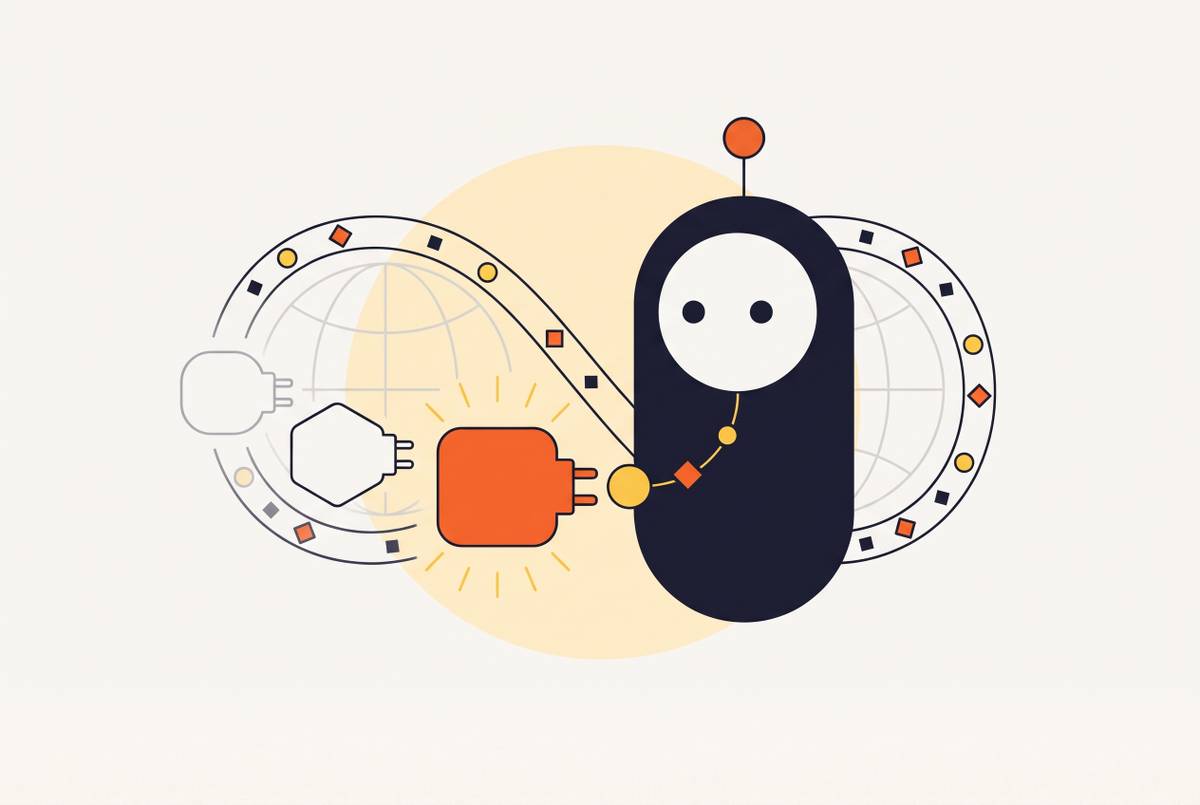
Real-Time Web Data Delivery Without the Polling Tax
Webhooks and event-driven APIs let agents act on web changes instantly.

An event-driven web scraping API with webhook support sends a callback when a monitored page changes or scraped data is ready, so an AI agent need not poll for updates. Real-time web data delivery without the polling tax depends on moving detection into infrastructure, persisting events before processing, and delivering agent-ready payloads. The goal is to pay for useful events.
Why polling is structurally incapable of delivering real-time web data
When the polling interval is fixed at T, the average detection delay is T/2. Polling every five seconds thus leaves an average wait of 2.5 seconds, plus the time for network and processing work. A change just after a check waits almost the entire interval to be discovered. This delay is built into the design. Shortening the interval reduces the wait, but it does not turn a scheduled question into an immediate notification.
For an LLM agent, that gap creates uncertainty about the evidence behind its next action. A polled result can be anywhere from zero to T seconds stale because of the polling interval alone. The agent has content, but not assurance that it reflects the latest state. That distinction affects correctness and speed. Without live retrieval, agents can hallucinate, pricing models can drift, and compliance systems can miss regulatory changes.
The polling tax has three parts that compound. Requests made while pages stay the same use compute to return unchanged content, and each billable poll adds to the API bill whether it finds a change or not. A price change or regulatory update can also affect the business before the next check fires. The meter runs even when nothing happens. Checking more often cuts the wait but adds more empty requests to the bill.
Domo distinguishes push-based ingestion, where events flow without waiting for an interval, from pull-based ingestion, whose latency depends on polling frequency. A poll every second is still a poll. The schedule, rather than the event, decides when the application gets to know.
The three event-driven delivery primitives and what each one is actually for
Webhooks, Server-Sent Events, and WebSockets solve different communication patterns. The choice starts with who needs to speak, when, and whether a conversation must remain open. These are not three interchangeable speed settings. Selecting the wrong one adds connection management or delivery complexity without improving the work the agent needs to do.
A webhook sends a one-off HTTP POST when an event occurs. The receiver need not keep a connection open, which makes this a natural fit for backend agent triggers and serverless functions. A page changes, the notification arrives, and the agent wakes up. No waiting room is required. In production, the backend validates and persists the external event before forwarding state changes to a watching frontend.
Server-Sent Events, or SSE, keeps a one-way stream open from server to client. That matches a model producing tokens while a client displays them. OpenAI’s API reference specifies SSE for streamed completion chunks. Standard HTTP infrastructure can handle that traffic. SSE works with existing HTTP load balancers without requiring stateful connection routing.
The July 2026 revision of the Model Context Protocol specification, effective 2026-07-28, also adds a POST-response notification stream to the protocol. It removes the initialize handshake and session IDs, replacing the old GET-based stream with subscriptions/listen for opted-in server-to-client notifications. This is a stateless-core change. WebSockets were not a specified MCP transport.
WebSockets earn their place when an agent and server exchange many turns in one session. Keeping a two-way connection open saves the overhead of repeated HTTP handshakes, but needs per-connection state, routing across nodes, and a way to withstand reconnect storms. Vercel’s 2026 runtime changes added native support, reducing one hosting obstacle. The operational obligations do not disappear with it. Most production AI pipelines use the primitives together, with webhooks for external triggers, SSE for watching clients, and WebSockets for dense two-way sessions.
Where batch still wins and why choosing streaming by default is its own kind of tax
Domo puts batch processing at hours to days, micro-batch at seconds to minutes, and streaming at sub-second latency, with each balancing speed against cost and how hard it is to build. If a delay from minutes to a full day causes no business harm, batch is the appropriate choice.
The failure modes also differ in important ways. A failed nightly batch job can be rerun, while a stream that silently drops events for hours can lose data permanently unless replay was built in from the start. Faster delivery brings a stricter operational burden. Choosing it everywhere means paying that premium even where no decision benefits.
For web data, the test is concrete. Discovering a competitor’s pricing change within minutes to trigger an agent response supports streaming or webhook-first delivery. Updating many thousands of pages for a weekly digest is a job for micro-batch or scheduled batch. The use case supplies the clock. Triconinfotech advises starting with specific uses that have high value, rather than trying to switch every pipeline to streaming at once.
How do you trigger a scrape on a page change and get a webhook callback?
A webhook-first design places change detection in the monitoring infrastructure. Target URLs are registered with that layer, which notifies the backend when it detects a change. The application receives a typed event instead of repeatedly asking whether anything happened. Detection and delivery are distinct responsibilities, however. A callback removes application-side polling for updates or job completion, but its arrival speed still depends on when the infrastructure detects the change.
The implementation should begin with durable delivery. When the webhook POST reaches the backend, the handler validates, persists, and queues the event before triggering agent work. Every payload needs an idempotency key because the same event may arrive more than once. The handler must be safe to run twice. Persisting the raw event first also makes replay possible if downstream processing fails.
Processing then hands the agent a clean, structured payload on which it can act. Domo calls this the serving-and-action phase, where processed data drives alerts, predictive analytics, or real-time features. Frontend visibility is a separate delivery task. If a human is watching, state changes can flow through SSE, while events without an active user session can be queued for the next agent cycle. WebSockets enter only when the session needs dense bidirectional exchanges.
Triconinfotech describes a streaming-first design with batch backfill, where events arrive at once to handle time-sensitive signals, while data-lake jobs run from time to time for reconciliation, historical indexing, and bulk re-crawls. Each path has a different job. This hybrid preserves responsiveness while giving correctness and cost control their own lane.
The operational requirement is to instrument every layer, including delivery confirmation, processing latency, agent action latency, and payload parse errors. Akraya identifies real-time observation of data flow, system performance, and model behavior as necessary for catching problems before they affect outcomes. Silence is not proof of good health. For API selection, concrete criteria include change-triggered notifications, ready-data callbacks, consistent payload schemas, and support for replay-safe handling. A unified API for search, scraping, crawling, mapping, batching, and monitoring reduces the integration work between tools with different event models.
How the data format arriving at the agent determines whether low latency actually helps
Fast delivery helps only if the arriving content is ready to use. Raw HTML can move the tax from waiting time to model tokens, filling the context window with scripts, styles, and navigation that take up space needed for useful evidence. The payload arrives promptly, wearing all its scaffolding. Equivalent semantic content in HTML may consume many times more tokens than Markdown, increasing inference cost and the risk that relevant text gets crowded out.
The format should follow the agent’s task. Markdown preserves headers, lists, emphasis, and hierarchy, which gives an LLM useful structure for retrieval-augmented generation and reasoning over prose. Structured JSON is better when the agent must act directly on extracted fields such as a price, date, or regulatory clause. The API layer should strip HTML noise before the payload enters the event pipeline so the agent is spared that cleanup.
Pulling a price from a product page does not require frontier-model capability, so cheaper, faster models should be the default for extraction. Synthesizing competitive positioning across many pages can justify frontier-model quality. Routing belongs in the architecture, where the distinction between extraction and synthesis is explicit.
MCP servers can handle browser rendering, CAPTCHA solving, IP rotation, and JSON normalization on an agent’s behalf. The agent then receives typed output, with raw HTTP responses already parsed. The protocol and the payload remain separate concerns. The same July revision removes the Mcp-Session-Id header so self-contained requests can land on any server instance, but it does not establish a universal tool-output format contract. Normalization still has to be supplied by the infrastructure.
Web monitoring as the production use case where event-driven delivery pays off most concretely
If a competitor’s price change is found hours later, internal pricing models can fall behind, while a policy update found after a compliance window closes is too late to act on. These are decisions with an expiry date. That makes monitoring a stronger case for event-driven delivery than workloads whose output remains useful next week.
In an event-driven monitoring setup, target URLs are registered once and the infrastructure watches for changes. When it detects one, the webhook payload provides the diff, including what changed, where, and when. The downstream agent need not re-fetch the page and reconstruct the comparison. A pricing agent can update internal models, while a compliance agent can flag the policy delta for the legal team to review.
Akraya describes event-driven systems as a way for organizations to respond immediately to changes. Monitoring gives that direction a concrete workflow, from an external page update to a domain-specific agent action. A unified monitoring, scraping, and extraction API removes another handoff. The change event and enriched content come from the same system, avoiding an integration seam between detecting a difference and obtaining the updated evidence.
A setup that polls a hundred competitor pages every five minutes sends requests no matter how often those pages change. Event-driven delivery sends downstream work only when a change is detected, so infrequently updated pages produce fewer callbacks and agent runs. Quiet pages stop waking the application unnecessarily.
Why organizational and data architecture readiness, not protocol choice, is the remaining barrier
The delivery protocols are mature, but an organization can still be unprepared to use them. Fragmented data systems can prevent an event from reaching an agent in a form it can consume. Akraya identifies data fragmentation and organizational silos as primary obstacles to operationalizing real-time AI at scale. A faster notification cannot fix that separation. Data, engineering, and business teams need to work together to keep the latency gains all the way through to action.
For developer teams, the practical starting point is the use case with the clearest latency requirement and most direct business consequence. Competitive monitoring, compliance alerting, and live pricing all provide that test. Triconinfotech recommends targeting decisions that benefit from immediacy rather than applying streaming uniformly across datasets. Scope is a form of cost control. Distributing streaming capability to engineering teams with genuine real-time needs is more sustainable than isolating it in a specialist team disconnected from the business.
Teams also need to cut the number of boundaries each event must cross. A unified web data API supplies one integration point for search, scraping, crawling, monitoring, and batching, while MCP access lets autonomous agents use the same infrastructure without a separate custom pipeline. Observability shows where those boundaries are when something fails. Delivery confirmation, processing and action latency, and payload errors reveal whether an apparently live system is actually delivering useful work. The teams best placed to avoid the polling tax are those delivering their first high-value event to an agent that can act on it.