Using Job Posting Patterns to Map a Competitor's Org Structure
Track competitor reorganizations through job postings months before official announcements arrive.
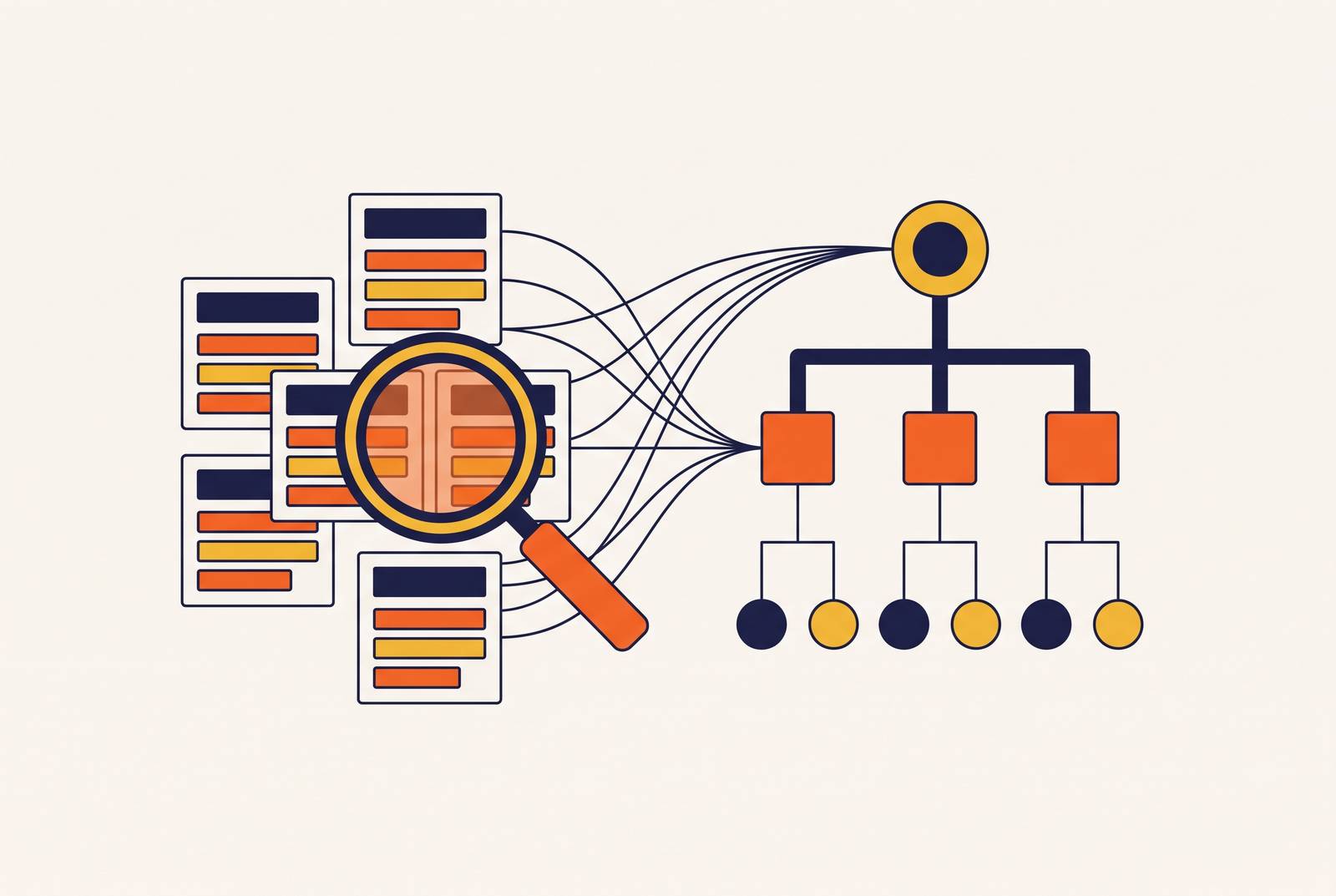
Job postings are the one public document a competitor gets penalized for writing vaguely, and that single fact makes them more trustworthy than anything in a press release or an investor deck. A press release can hide behind words like "innovative" and "best-in-class" forever and nobody notices. A job posting can't. If it's too vague, the wrong candidates apply, the right candidates scroll past, and the recruiting team misses its numbers for the quarter. Specificity is the whole mechanism of a job posting.
Think about what a recruiter actually wants. They want qualified people to apply, fast, so they write what the team is building, which tools it runs, who the role reports to, and how big the team already is. A posting that reads "Join our team building the next generation of real-time payment processing using event-driven architecture on AWS" is a gift. In one sentence it hands over the product direction, the tech stack, and the infrastructure strategy. No competitor would say that on an earnings call. A recruiter says it by Tuesday afternoon, because the job needs filling.
The hiring timeline is also just slower than companies want you to think. A strategic decision gets made, then budget gets approved, then headcount gets approved, then the job gets posted, then recruiting happens, then hiring, then onboarding, then execution, and only after all of that does the company make an announcement. That's seven or eight steps between the posting and the press release. Months, usually. Financial disclosures tell you where a company has already been. Job postings tell you where it's headed, months before anyone sends out a quote from the CEO.
How posting patterns produce an org chart nobody published
A single job posting is a data point. Three or four of them, pulled from different departments and read side by side, sketch an org chart that the company never drew for public consumption and certainly never released. Each posting is a node: who the role answers to, which function owns the budget, how big the team already is before this hire even lands. Stacking enough nodes together makes the shape of the organization visible, the same way connecting a handful of stars reveals a constellation.
The reporting line is the single most valuable field in the entire document. A posting that says a role reports "directly to the Chief Growth Officer" tells you precisely where that initiative sits in the company, with more precision than a press release would ever risk giving you. Press releases describe initiatives in the passive voice on purpose. Job postings put a name, or at least a title, right next to the work.
Watch for a reporting line that's moved, because that's a structural decision with teeth. A designer who used to report into marketing now reporting into product is a signal that design decisions will get made differently from here on, which matters a great deal to anyone trying to sell into that company or compete against it. The same goes for an enablement function folded into revenue operations: that's a company deciding sales enablement is now a revenue lever, not a training department.
Seniority mix tells you what phase the build is in. A wave of senior hires in one function usually means repositioning, people brought in to rethink the approach. A wave of junior hires usually means execution against a strategy that's already locked in. And when a function posts a VP, two senior managers, and four individual contributors within the same few weeks, that's a team being built from zero.
Technology requirements do similar work for the engineering side of the house. A run of postings shifting from Java and Oracle toward Python, Kubernetes, and cloud-native tooling describes a platform modernization in progress, one with real consequences for product timelines, for who the company is now competing with for talent, and for its cost structure going forward. And the level a role reports to tells you how much the company actually cares about it: a role reporting to the CTO or the CPO comes with executive sponsorship attached. A role buried under a middle manager inside an existing department is probably a maintenance hire, not a strategic one.
Four patterns that indicate structural moves before they are announced
Certain sequences of postings recur in postings analyzed before certain kinds of company moves, often enough that competitive intelligence teams watch for them on purpose. Four are worth knowing cold.
Executive hires carry the least noise of any signal in the dataset. A new Chief Data Officer means a data-driven transformation is underway. A VP of International means a company is expanding internationally. A Chief Compliance Officer means the company is bracing for regulatory scrutiny it doesn't currently have. Nobody posts a C-suite role on a whim, because the hire itself costs too much in time and money to be anything but deliberate.
Geographic expansion tells its real story only when you read the location next to the title next to the compliance requirement. A US company posting a London-based General Manager role, alongside enterprise account executives targeting UK financial services, alongside a solutions engineer who needs FCA compliance experience, is targeting a specific regulated vertical in a specific market. Those three fields only reveal the pattern together; remove any one of them and the pattern disappears, but keep all three and the intent is obvious.
Hiring velocity is the metric that actually matters, not the raw headcount. Going from zero machine learning postings to four of them in six weeks is a real signal. One customer success hire a month is just normal churn. Eight customer success postings in a single month is a company plugging a hole in a sinking boat. The change in speed is the tell, not the total count sitting on the board at any one moment.
Two examples show the patterns paying off. In 2023, a mid-sized fintech company watched its largest competitor post three separate "Head of AI" roles across different departments within the same month. Six months later, that competitor launched an AI-powered product that took a meaningful share of the market, and every signal that predicted it had been sitting in public view the entire time. In a separate case, a mid-market CRM competitor that had always focused on sales automation posted five roles in quick succession: a Director of Customer Success Platform, two engineers with backgrounds in health scoring and churn prediction, a product manager for "customer intelligence," and a data scientist specializing in predictive analytics. Read individually, those are five unrelated job ads. Read together, they describe a customer success product being built to sit next to the CRM, months before launch.
Where naive pattern-reading breaks down
The method fails in the same way every time: someone treats one posting as proof instead of as one piece of evidence to weigh against others. Three specific mistakes account for most of the bad conclusions drawn from this kind of data.
Ghost jobs are the first trap. Stale ads left open for a future pipeline, single ads that quietly cover several openings at once, and roles nobody ever intends to fill all inflate the raw count of postings sitting on a careers page. Twenty open roles doesn't mean a company is growing fast, but it does confirm a funded capability: somebody signed off on a budget line for this work, and that commitment is real even if the initiative gets killed before anything ships.
Senior hires are the second trap, mostly because they vanish from public view. Confidential replacements and roles filled through executive search firms often never touch a public job board. The workaround is to watch appointment announcements and, where the jurisdiction requires it, director and officer registry filings, since those catch moves the job boards never show.
The third trap is the requirements list itself, which mixes three different things without telling you which is which: what the team is actually running today, what they'd like to adopt, and whatever line the recruiter copied out of last year's posting because it was sitting right there. A technology name that appears in a single posting is a maybe. A technology name that shows up across five or more postings from the same company is a fact about their stack.
Hiring activity signals intent, not outcome. Companies fund projects that quietly die on the vine and never become a shipped product. That's true, and the counter to it is straightforward. A hiring pattern still represents a multi-quarter commitment of budget and attention. Even an initiative that fails tells you where a competitor's resources were tied up during that stretch, which is itself useful, competitive information.
The fix for all three traps is the same: cross-reference the hiring data against press releases, funding announcements, leadership appointment news, and product launches. When the hiring pattern lines up with a public move, confidence goes up. When it doesn't line up with anything public yet, that's often the most interesting case of all, because it may mean the initiative is still under the radar.
Building the collection pipeline
Turning this from an occasional observation into a reliable intelligence source means collecting from several places at once, because no single source shows the whole picture, and each one breaks in its own way.
Three surfaces matter most: a company's own careers page, its LinkedIn company profile, and general-purpose job boards such as Indeed and ZipRecruiter. It's worth knowing that Glassdoor legally merged into Indeed on July 1, 2026, and its job listings now run entirely on Indeed's infrastructure. Glassdoor no longer functions as an independent job board, so treating it as a separate source in a collection pipeline is now a mistake. Each of the remaining surfaces carries a different subset of a company's open roles and updates on a different schedule, so missing one means missing postings that appear nowhere else.
Careers pages carry the posting first and often include detail the aggregators strip out, including the reporting-line language that makes org-chart reconstruction possible. The tradeoff is that a careers page has to be crawled directly, since nobody is aggregating it for you.
Scrolling LinkedIn by hand doesn't produce anything you can call reliable intelligence. It produces an impression, which is a different thing. Getting real signal out of LinkedIn requires structured, repeated access to company pages on a schedule, not an analyst checking in when they remember to.
The collection layer breaks constantly, so build maintenance into the plan from the start. LinkedIn has changed the structure of its public jobs pages multiple times within a single year, and each change broke any scraper built against the old page layout. The target keeps moving, so homegrown scrapers built against job board endpoints carry heavy, ongoing maintenance costs, and the scraper has to move with it or stop working.
Structuring raw postings into org-intelligence-ready data
Raw posting text, sitting in a database as a wall of HTML and prose, isn't something you can analyze at scale. The enrichment layer, the step that turns that text into structured, comparable fields, is where an org-intelligence pipeline earns its keep.
A workable minimum schema needs eight fields: job title (normalized), function or department, seniority level, reporting line (pulled out of the description text), required technology stack, location and remote or hybrid status, posting date, and whether the posting is still open or has closed. Those eight fields are what let you ask questions across hundreds of postings instead of rereading each one by hand.
A research pipeline built by Georgia Tech and AdeptID, trained on 1.2 million job postings and combining semantic chunking, retrieval-augmented generation, and fine-tuned classification models, showed this kind of extraction can pull out features that older, simpler parsing tools miss entirely, things like remote work availability, pay structure, and required years of experience. The published results cover explicit fields like these, not the kind of implicit organizational signal, like an inferred reporting line, that org-chart work depends on most. Separate benchmarking of extraction accuracy on required-skills fields, tested on a small sample of postings, has found a substantial gap between scoring methods, which is a reminder that even fields considered "explicit" don't extract perfectly. Reporting-line extraction, which requires real inference rather than pattern-matching a label, should be treated as rougher and double-checked, not trusted at face value.
Titles need normalizing before any of this works, because competitors name the same job differently on purpose or by accident. "Customer Intelligence PM," "Product Lead, CS Platform," and "Group Product Manager, Retention" might describe the identical function at three different companies, or even inside the same company across two hiring cycles. Skipping normalization breaks pattern detection before it starts, since the software has no way to know these three titles are the same job.
Technology names need the same discipline applied through recurrence, not a single mention. One posting naming a tool might be aspirational, or copied from last year's draft. A tool name appearing across five or more postings within the same function is a fact about the stack, not a guess.
Where the enriched data goes matters as much as how it's structured. Reporting-line changes and new functions should route to whoever handles org-structure analysis. Technology stack shifts should go to product and engineering. Geographic expansion patterns belong with go-to-market strategy. Executive postings belong wherever leadership and M&A tracking happens. Routing by signal type matters because the failure mode of this whole method is too much data landing on one desk, enriched and tagged and completely unread, because nobody built a path for it to reach the person who'd actually use it.
What the legal boundary looks like for job-posting collection
Scraping public job postings for competitive intelligence carries low legal risk in the US under current case law, though the line around personal data is sharp, and regulators are tightening their grip on the space generally.
The main federal anti-hacking statute, the law most often raised against scrapers, has repeatedly failed as a claim against people collecting publicly available data. That doesn't mean scraping carries no risk. The risk has moved, from the CFAA toward breach-of-contract claims built on a website's terms of service, and, for anything touching Europe, toward GDPR. A major case brought by a workforce-data company is the clearest marker of where this landed: the federal anti-hacking claim in that case failed, but the contract law claim succeeded, and the company ended up agreeing to $500,000 in damages along with a permanent injunction in December 2022.
For the narrow use case this article covers, scraping public job listings for salary benchmarking and hiring-pattern analysis, with no login wall crossed and no personal employee data collected, current US case law generally treats this as outside CFAA territory. That's not a blanket legal clearance. Enforcement under contract law, copyright law, and various state statutes remains possible, and building a collection pipeline without a terms-of-service review attached to it is a gap worth closing before scale, not after.