Automating Prospect Research With AI-Powered Web Agents
AI agents that automate prospect research replace manual research cycles with continuous discovery.
Manual prospect research died the same way most bottlenecks do: slowly, then all at once. The old workflow, scanning LinkedIn, reading news feeds, and clicking through company websites, was never fast, and once sales teams tried to run it at scale, it became the main thing standing between a defined ideal customer profile and an actual pipeline. Reps weren't bad at this job. They were being asked to monitor a research surface that had grown far past what any person could track by hand, with more signals and more channels to cover.
Buying software didn't fix it either, at least not by itself. Outreach's Prospecting 2025 report found that roughly half of sellers still name account research as their top challenge, even though 45% of teams are already using some form of AI for that research. That gap between adoption and relief tells its own story: swapping a spreadsheet for a dashboard doesn't touch the underlying problem if a human still has to kick off every research cycle and stitch the results together by hand.
What changed the equation is structural: workflow automation replaced the human-initiated research cycle. AI systems can now sift through large datasets, surface leads that match a seller's criteria, and even propose new prospects based on which deals recently closed, work that used to require a person to start and finish every single cycle. The shift is driven by LLM reasoning combined with live web retrieval, working together rather than either one carrying the load alone. That combination is what turned prospect research from a task reps perform into a process a system runs, which is the argument the rest of this piece is built to unpack.
What a prospect research agent does end to end
A prospect research agent is a pipeline that discovers signals, retrieves live data, structures it, delivers CRM-ready intelligence, and reasons over that data rather than collecting it.
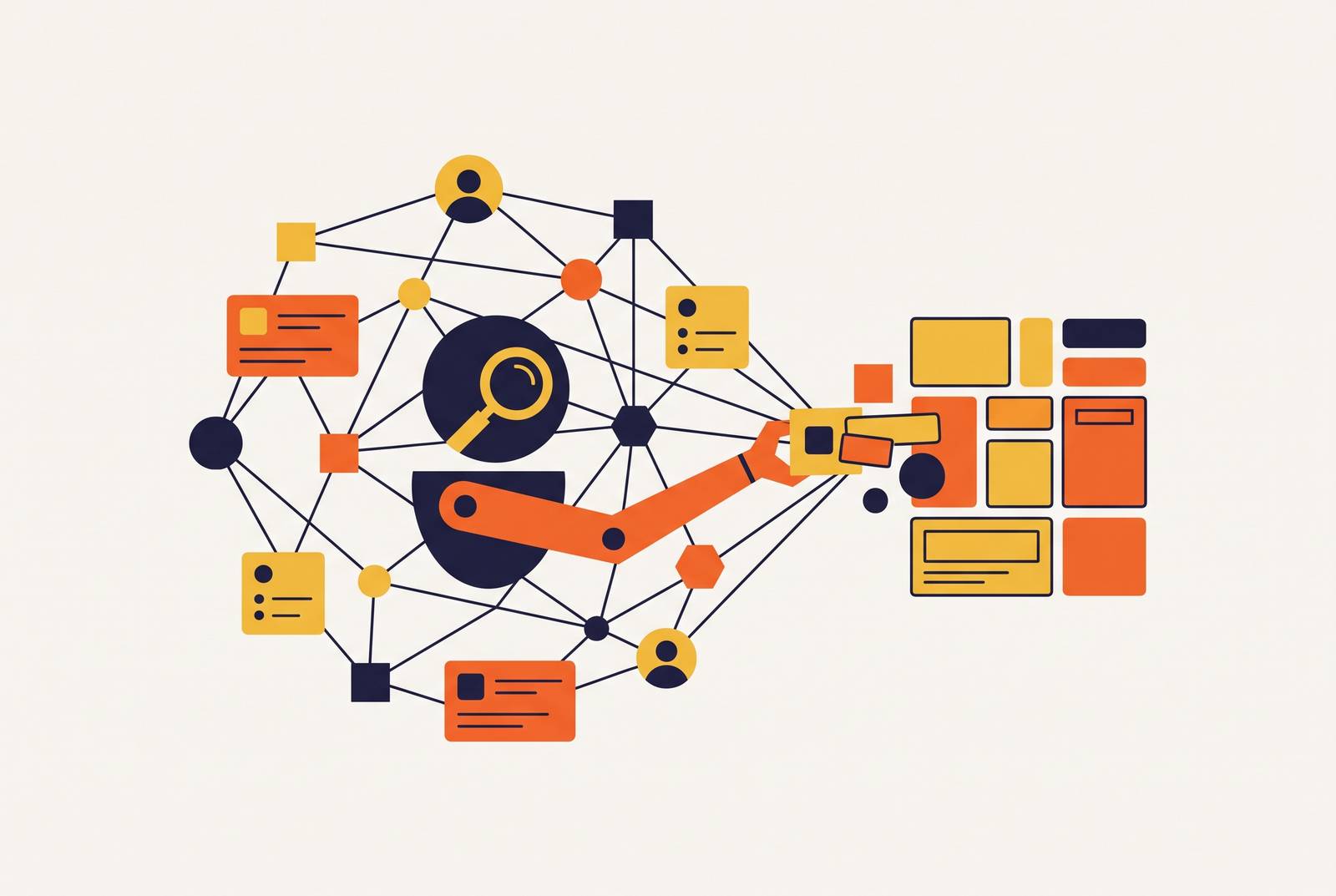
The canonical architecture runs: Web Sources → Collection Layer → Network Infrastructure → Parsing and Validation → Storage → AI Applications, and the agent orchestrates across all of these, not just the last step. Salesforce's Agentforce prospecting agent is a useful illustration of what that looks like in practice: it searches websites, third-party data vendors, and CRM records to find people whose job title, company movement, industry, partnerships, and expertise line up with an ideal customer profile, then returns a ranked list with its reasoning attached.
Underneath any specific product, five functional stages have to happen, and the connective tissue between them holds the chain together.
- Discovery: targeting accounts and contacts by firmographics, technographics, or, increasingly, a plain-language description of the kind of company worth chasing.
- Enrichment: filling in verified contact details, role context, recent activity, tech stack, and funding history.
- Signal detection: spotting which accounts show buying behavior, and doing it at the contact level rather than the account level, so the agent knows precisely who to message and what to say to them.
- Outreach generation: writing personalized first touches using everything the earlier stages assembled.
- Workflow automation: running the entire motion without a rep having to switch tools or manually export and re-import data.
Most tools on the market today are genuinely good at one or two of these five stages. Where they tend to fall apart is at the seams, the handoff points between discovery and enrichment, or between signal detection and outreach. Covering all five stages without losing coherence at any seam is the actual architectural challenge, and it's a harder problem than building any single stage well.
The data layer determines what the agent can do
An advanced model cannot make up for source data that is missing, stale, or collected wrong. A model reasons over whatever it's handed, so the data pipeline feeding it is the highest-leverage part of the entire system. A broken data feed will still produce broken outreach even with a better LLM. Clean, current data paired with a modest model will often outperform a flagship model running on garbage.
Consider what a model's training data actually contains. A model trained months or a year ago has no idea about last week's funding round, a pricing page that changed yesterday, or a new job posting that signals a company is expanding its sales team, and those are exactly the triggers that make outreach feel timely instead of generic. That's the gap targeted scraping is built to close: it constructs a retrieval context anchored to one specific source at one specific moment, and an answer grounded that way is a different animal from whatever the model would have guessed on its own.
Format matters just as much as freshness. Traditional scraping hands back raw HTML, full of navigation bars, ad scripts, and layout code that has nothing to do with the actual content. The current requirement is structured output, clean Markdown or structured JSON, that a model can reason over directly without first wading through boilerplate. Everything downstream in an LLM pipeline depends on what gets captured upstream. A scraper that dumps raw HTML filled with boilerplate still leaves the model doing cleanup work before it can reason.
Speed compounds the effect. Research into high-scale web intelligence found that agents grounded in data delivered in under 550 milliseconds behave like responsive systems, while slower delivery keeps them feeling like sluggish analytics tools that happen to have a chat interface bolted on. The practical lesson for anyone architecting one of these systems: put the investment into collection and parsing first. A weaker model running on clean, current data will beat a stronger model stuck reasoning over something dirty or six months old.
The web data infrastructure options developers are choosing
The tooling market for feeding these agents has split into two clear tiers, and picking the wrong one doesn't just cost money, it creates a steady stream of maintenance work that lands on engineers instead of on the infrastructure itself.
The first tier is purpose-built APIs designed from the ground up to hand back clean, structured content built for the agent pipeline use case from the start. These platforms typically ship with a suite of tools grouped by domain, such as dedicated toolsets for social platforms or ecommerce sites, so an agent can pick the right tool for a given site at runtime instead of a developer having to pre-wire every possible endpoint by hand. The trade they're offering is straightforward: they handle the browser automation, the proxy rotation, and the retry logic, so the pipeline receives usable data without the engineering team having to run that infrastructure themselves.
The second tier is made up of earlier-generation general-purpose scraping tools that have had AI capabilities retrofitted onto them, rather than being designed around LLM pipelines from day one. Tools in this category can absolutely get the job done, but they usually take more integration work to produce genuinely LLM-ready output, since the "AI features" are often add-ons layered on top rather than native to how the tool formats its results.
There's a third path outside both tiers: self-hosting an open-source library where an LLM drives an actual browser toward a plain-language goal, clicking through pages and extracting what it finds. One such project has become one of the most-starred browser-agent repositories on GitHub, with around 98,000 stars, MIT-licensed and actively maintained.
Capital markets have already placed their bets on where this is heading. In November 2025, Parallel Web Systems raised a large Series A at a high valuation for a search-and-extract API built specifically for AI models. In February 2026, Nebius acquired a web data company at a substantial valuation. Both moves are signals that purpose-built AI data infrastructure is attracting serious capital.
What's tying all of this together at the integration layer is the Model Context Protocol, or MCP. A growing list of web data providers now ship official MCP servers, so an agent can call these tools natively, without a developer writing custom glue code for every single integration. That standardization is exactly what makes the architecture in the next section possible to build without reinventing plumbing every time a new data source gets added.
How production prospect research agents are architected in practice
Across the platforms actually shipping prospect research agents today, a consistent pattern appears: a reasoning layer sits on top of structured retrieval, pulling from both internal CRM data and live external web sources, and writes the results directly into the workflow rather than handing them back to a person as a report to read and act on later.
Outreach's Research Agent is a clear example. It pulls structured insights from internal sources, things like call transcripts, meeting summaries, and emails, or from external sources such as Google-grounded web search, and saves the output directly into account fields, where it then feeds smart account plans, reporting, filters, and triggers elsewhere in the platform. The agent writes into the workflow itself instead of producing a side report nobody opens. Recent updates added buyer-seller tagging, so the model can tell which voice on a call belongs to the buyer and which to the seller, sharpening the summaries it produces. It also expanded the window of emails and meetings it processes, giving it more context per analysis, and added time-frame filters so users can define exactly which period the research should cover. The Research Agent launched in Outreach's February 2026 product update, ahead of the Spring 2026 Omni release, as part of the company's broader agentic push.
Salesforce's Agentforce prospecting agent follows the same structural logic from a different angle. HubSpot's Prospecting Agent expanded through 2026 into a similar workflow: researching people, watching accounts for signals, helping identify buying-group contacts, and running outreach under configurable controls, with 2026 updates adding signal-led account prioritization and a wider range of intent signals.
Clay's Claygent shows a related but distinct pattern: an agent with web research access that generates custom data points on demand, running enrichment across multiple providers in a waterfall so that if one provider can't validate a piece of data, another gets a shot at it. That multi-provider design improves match rates, keeps the whole pipeline from depending on a single data source, and offers a resilience pattern any team can borrow regardless of which platform it builds on.
For teams building something custom rather than adopting one of these platforms, the agentic browsing pattern fills a specific gap: an LLM driving a real browser toward a natural-language goal, which matters most when a target site has no API and no MCP server, and someone still needs structured data out of a page that only renders properly in a browser.
One design decision underlies all of these systems: internal-only retrieval, external-only retrieval, or a hybrid of both. Outreach's Research Agent, for instance, requires each agent instance to commit to either internal or external sources, not both at the same time. That constraint shapes what a single agent instance can actually answer, so teams should decide on it deliberately rather than discover it by accident three sprints into a build.
The infrastructure problems that only appear once the agent runs at scale
A prospect research agent that runs cleanly in development will hit a specific set of problems the moment it goes into production: concurrency limits, anti-bot defenses, proxy management, and data that goes stale faster than expected. Ignoring these at the architecture stage costs a team later, in downtime and in outreach built on old information.
Anti-bot defenses are the sharpest edge here. A scraper run against a live site in production will, sooner or later, come back with empty JSON because the target threw up a defense wall. The extraction logic that turns a page into structured data is the easy half of this problem now. Reliably getting the page in the first place is the hard half. Web scraping in 2026 sits between two forces pulling in opposite directions: AI is making extraction smarter and easier to build, while anti-bot systems on the other side are hardening just as fast. Data engineers who understand both sides build resilient pipelines that know when to pay for official APIs instead of scraping.
Scale introduces its own separate headaches. A small crawler can run flawlessly for weeks during development and then start hitting rate limits, IP-based restrictions, session controls, and automated traffic detection the moment request volume actually grows, and concurrency limits, queueing, retries, and rate-limit handling all start mattering in ways they never did on a developer's laptop. Network infrastructure is easy to overlook at build time for the same reason: it's invisible until it isn't. Separating proxy management out from the scraping application itself, building a network layer that assigns the right proxy type to the right workload, holds up far better under load than hard-coding a handful of IP addresses into the crawler and hoping.
Data freshness rounds out the list, and it's easy to underestimate because it fails quietly. LLM pipelines typically depend on recurring ingestion and refresh jobs, and when one of those jobs fails silently, the agent doesn't just have a data gap, it starts reasoning over information that's actively wrong.
All of this sharpens the build-versus-buy decision that shapes every architecture choice in this space. Building a scraping library in-house buys more control, but debug time accumulates, anti-bot patches turn into a recurring line item on the engineering roadmap, and data can go stale before the custom scraper is even production-ready. A scraping API, by contrast, absorbs the browser automation, the proxy logic, and the retry handling, so the pipeline gets its data without the team running that infrastructure directly. Neither answer is automatically correct. Making that call on purpose, with a clear view of what each path costs, beats defaulting into one because it's the first tool that showed up in a search result.
Legal and access constraints developers building these systems need to account for
None of the architecture above operates in a legal vacuum, and the rules governing automated web access are moving quickly enough that a decision that looked safe in 2024 may carry different risk today. Terms of service vary by site, enforcement varies by target, and what counted as acceptable data collection on one platform a couple of years ago is not a reliable guide to what's permitted, or tolerated, on that same platform now.
That uncertainty doesn't have a tidy resolution here, and pretending otherwise would be its own kind of misinformation. What it means practically is that legal review belongs in the architecture conversation from the start, not bolted on after a pipeline is already pulling data in production. A team choosing between a purpose-built API, a retrofitted scraping tool, and a self-hosted browser agent is not only making a technical trade-off. Each of those choices carries a different exposure profile, and understanding that going in beats finding out the hard way once the pipeline is already running at scale.
Sources
- AI prospecting tools: Complete implementation guide for 2026 | Outreach
- Best Sales Prospecting AI Agent | Sales Cloud | Salesforce
- HubSpot Prospecting Agent: What Changed in 2026
- Outreach AI Review 2026: AI Agents, Pricing, and Rep Impact | SyncGTM
- Web Scraping for AI Agents in 2026
- The emergence of the web data infrastructure layer for AI | MIT Technology Review