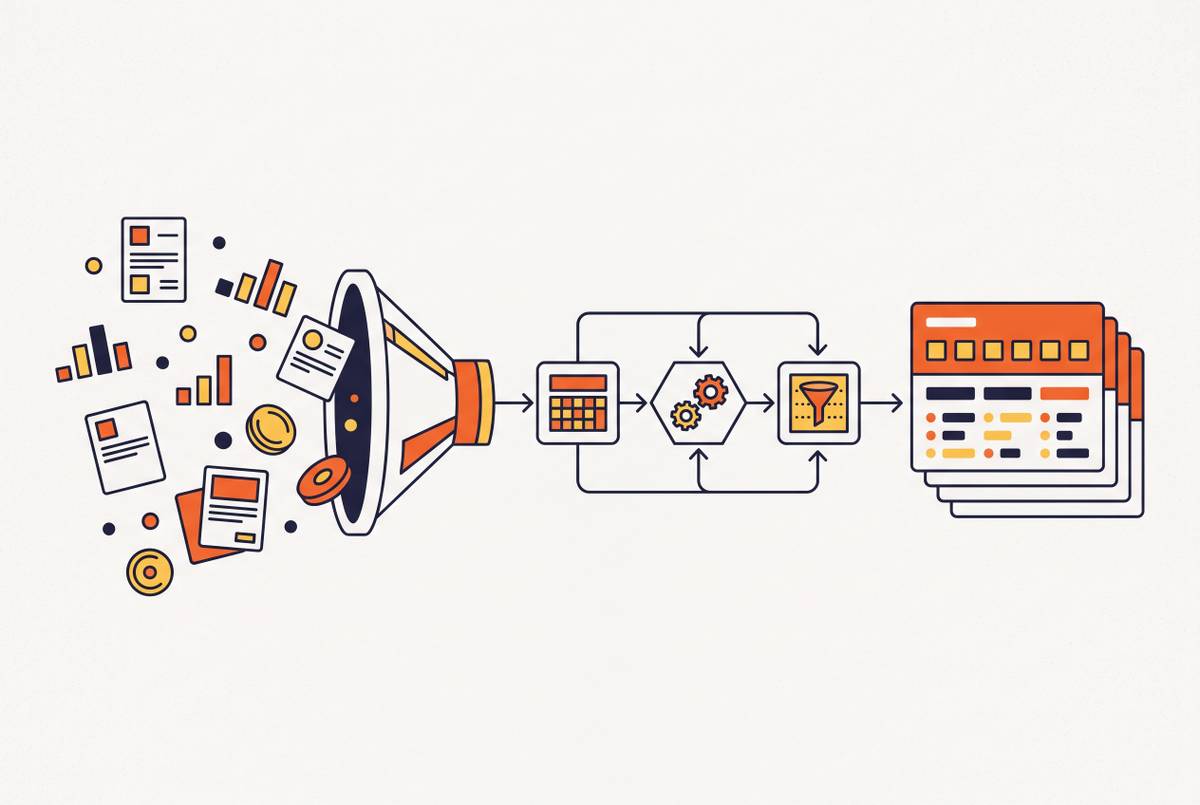
Building a Real-Time Account News Feed for Field Sales Teams
Sales reps need actionable alerts, not raw news feeds buried in noise.

A rep opens the account before a quarterly business review and scrolls through three months of notes to get ready, only to find out the champion left the company six weeks ago. Nobody told them. The news feed had it, buried under two dozen other alerts that never got opened, because the feed delivers headlines, not reasons to care. That's the whole article in miniature: a real-time account news feed only earns its name when it's built as a signal engine, not a news aggregator, which continuously reads the public web, figures out what changed, and tells the rep what to do about it.
The failure is architectural. Field reps traditionally burn 20 to 30 minutes per account doing manual research before a call, and the sales pitch behind every news feed is that automation collapses that time to almost nothing. That promise only holds if what gets surfaced is prioritized and actionable. A raw stream of headlines doesn't collapse research time, it just moves the research into a scrolling feed the rep now has to triage by hand.
A real signal engine answers three questions for every item it shows a rep: what changed, why it matters for this specific account, and what to do next. A keyword-matching aggregator answers none of them. It fires on "VP" or "funding" or a competitor's name and leaves the interpretation to the human, which is exactly the job the tool was supposed to take off their plate. More alerts without more reasoning is just the old static account plan problem running at higher speed: the plan goes stale the moment the account changes, and a louder feed doesn't fix staleness, it just makes the staleness noisier.
The three events that shift deal timing for a field account
Not every account event deserves a rep's attention, and the useful ones cluster into three categories, which is good news because it means the monitoring job is bounded rather than infinite.
Executive movement sits at the top of the list: hires, departures, and role changes. When a new VP arrives from a competitor, or a champion quietly leaves mid-deal, the entire buying-center map resets in a single event. Deals that looked stable can stall overnight because the person who championed them is gone, and deals that looked dead can reopen because the incoming executive has a different mandate.
Organizational and financial events come next: restructuring announcements, funding rounds, earnings commentary, M&A signals. These move budget authority and urgency at the same time, which is a rare combination. A funding round can unlock spend that did not exist a month earlier. A restructuring can freeze it just as fast.
Competitive and strategic signals round out the list: a competitor's name showing up in a job posting, a new product launch, a hiring pattern that reveals where a company is quietly investing. These don't change who holds the budget, they change the conversation a rep needs to have to win it.
The practical takeaway is narrower than "watch business news." It means watching the specific places these three event types leave fingerprints: careers pages, press release feeds, earnings transcripts, job boards, and trade publications. That's a short, concrete list of sources, and a short list of sources is what makes this automatable instead of an open-ended research project.
Continuous web monitoring as the only way to catch these signals before competitors do
Those three event types all share one property: they lose value fast. A rep who learns a champion left on the day it happened can call the replacement before anyone else does. A rep who learns it three weeks later, prepping for a QBR, is reading history, not intelligence.
Timing is the whole mechanism. OneAway's fintech deployment shows what the edge looks like in practice: its AI agent caught a prospect mentioning a relevant pain point in a podcast interview recorded weeks earlier, a detail no human SDR had time to dig up, and the prospect replied within twenty minutes of first contact. That's what happens when the monitoring layer never stops running.
The obvious objection is that periodic monitoring, checking in daily or weekly, covers most accounts well enough. It doesn't, because deal-timing signals don't wait for a convenient refresh window. An executive departure announced on a Tuesday morning is a trigger that expires within days, sometimes hours, once competitors and recruiters start working the same account. A pipeline that checks once a day will sometimes catch it in time and sometimes won't, and there's no way to know in advance which accounts will get the lucky timing.
If every vendor in a market has access to roughly the same public information, that access produces the same competitive math: the one running the faster pipeline reaches the new decision-maker first. So infrastructure speed becomes a sales advantage before a rep ever writes an email.
The pipeline architecture: how to wire a signal engine from public web sources to the rep's CRM
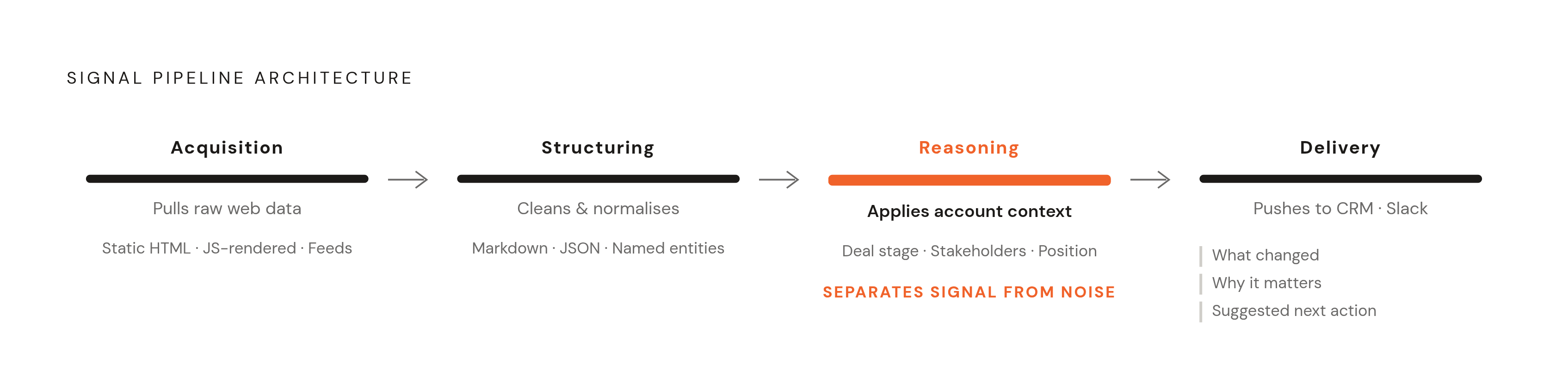
Building a signal engine that behaves this way comes down to four layers: acquisition, structuring, reasoning, and delivery. Each one has a distinct job, and if a pipeline skips one, it usually produces noise again, just with better branding.
The acquisition layer pulls raw data off the public web, and it has to handle three different kinds of source without falling over. Static HTML pages like press releases and company news sections are the easy case. JavaScript-rendered pages, the kind most modern careers portals and investor relations sites now use, are harder, because the content doesn't exist until a browser actually runs the page's code. Semi-structured feeds, like job boards and earnings aggregators, sit somewhere in between. A common pattern here is a two-pass approach: a first pass navigates each site's particular layout to pull raw event data, and a second pass enriches that data from the company's own site, which tends to follow more predictable structure than third-party sources do. The acquisition layer also has to survive pagination, dynamic rendering, and anti-bot defenses without depending on brittle CSS selectors that break the moment a site redesigns its careers page. A web agent built to interpret a page by its goal (find the job listing, find the press release date) rather than by its exact HTML layout keeps returning clean, structured output even when the underlying page changes shape. Running this layer in-house at real account coverage means ongoing engineering time spent on proxy management, CAPTCHA handling, and scraper maintenance, and enterprise teams routinely report that a substantial share of their data engineering hours go toward just keeping scrapers alive rather than toward anything resembling analysis, which is what makes the build-or-buy decision so sharp here.
The structuring and enrichment layer takes that raw acquisition and makes it usable. Feeding raw HTML straight into a language model is expensive and sloppy: raw HTML carries far more tokens than the actual content buried inside it, so every unprocessed page multiplies inference cost across a pipeline that might be indexing thousands of pages a day. This layer converts that raw material into clean Markdown, structured JSON, or HTML with explicit markers for named entities, before any of it reaches a reasoning model. On the output side, the emerging llms.txt standard, a single page with a brand name heading, a short summary, and organized sections of links, gives any account-owned pages a structure that's easier for both search engines and monitoring agents to parse, with a paired llms-full.txt version that inlines the complete content for agent consumption. Princeton-affiliated research cited by Bracket Media found that content with verifiable, structured information earns significantly higher AI visibility than unoptimized content, and the same logic applies in reverse: structured extraction feeding a reasoning layer produces better classification than a wall of raw text ever will.
This is where a structured web event actually becomes an account signal. An LLM or an orchestrated agent applies context specific to the account, deal stage, stakeholder map, competitive position, to decide whether an event matters and what kind of action it should trigger. This is the step that separates the architecture from simple rule-based automation. A rule can say "if executive leaves, fire alert," but it can't notice that a VP departure, combined with a restructuring announcement and a competitor's new hire, adds up to something different and more urgent than any one of those events alone. The recommended pattern here is a single orchestrator sitting over a chain of specialized agents: one main agent decides whether the moment calls for a web search, a CRM query, or content generation, and routes the work accordingly, without someone having to manually configure that routing per account. None of this works if the data underneath it is stale, so the reasoning layer needs to query a serving layer that reflects current reality, typically a streaming layer using Change Data Capture to keep materialized views continuously updated, rather than a batch-refreshed warehouse running an hour or more behind. The Model Context Protocol, an open standard built by Anthropic, is becoming the common language for this layer: it defines how an agent discovers outside data sources, understands their structure, and queries them, which lets the reasoning layer pull from CRM data, web data, and internal databases through one shared protocol instead of a custom connector for every single source.
The delivery layer is the last mile, and it's the one most tools get wrong by treating it as an afterthought. A signal that lands in a separate dashboard the rep has to remember to check hasn't solved anything; it has just relocated the noise. Delivery needs to land where reps already spend their day: CRM activity feeds, Slack, email, or a dedicated pipeline workspace. Every signal that reaches a rep should carry three fields: what changed, why it matters given the account-context reasoning from the previous layer, and a suggested next action the rep can accept, edit, or dismiss with one click. Webhooks are the right transport for this, firing the moment the acquisition layer detects a change and the reasoning layer classifies it as worth surfacing, rather than waiting around for the next scheduled poll.
The agent's pipeline, step by step
Walking through a single account shows how these four layers actually execute in sequence, start to finish, without a person touching anything until the output lands. The agent starts with a scheduled or event-triggered crawl: it holds a list of accounts, each one tied to specific monitored URLs, a careers page, a press release feed, an investor relations page, and it checks each one on a set schedule or the moment a change is detected. From there it moves into structured extraction, converting whatever raw content it just pulled into clean Markdown or JSON, pulling out named entities like people, roles, products, and dates, and comparing all of it against the last snapshot to isolate what's new. Next comes account-context enrichment, where the agent queries the CRM directly for the current deal stage, the stakeholder map, and any open opportunities tied to that account, then hands both the newly extracted event and that account context over to the reasoning layer together. The reasoning layer then performs signal classification and action generation, deciding whether the event rises to the level of a priority signal, sorting it into a category like executive change, competitive move, or funding event, and drafting a suggested next step, which might be a personalized outreach note, an update for other stakeholders, or a flag routed straight to the account executive. Finally, delivery happens through a webhook: the classified signal and its suggested action get pushed directly into the CRM activity feed or messaging layer, so the rep sees one prioritized item instead of a raw, unexplained alert. OneAway's fintech deployment runs exactly this sequence in production: the agent identifies accounts showing intent, enriches their contact data, researches recent company news, writes personalized email copy, sends it, monitors the replies, and flags any conversation that needs a human to step in, leaving the rep to act on finished output rather than babysit the pipeline that produced it. For larger territories, the same design scales out with a territory-level orchestrator that splits accounts into batches, assigns them to parallel sub-agents, and aggregates and de-duplicates the results before anything reaches a rep's inbox.
Crawler compliance when monitoring public sources
Monitoring public web sources for this kind of pipeline is legally sound as long as the acquisition layer sticks to publicly accessible data and respects the technical and policy signals that sites publish on purpose. Where this goes wrong tends to concentrate in a few specific, avoidable habits rather than in the practice of monitoring itself.
Sites are getting harder to crawl on purpose. The rate of 403 Forbidden responses served to AI crawlers more than doubled year-over-year between Q2 2025 and Q2 2026, so an acquisition layer that doesn't handle those responses gracefully won't just hit occasional errors, it will quietly lose coverage of a growing slice of the sources it's supposed to be watching, and no one will notice until a signal gets missed.
robots.txt remains legally unsettled but operationally non-negotiable. Studies show most AI crawlers currently ignore robots.txt rules, so a production pipeline built for account monitoring should treat that file as a floor rather than a suggestion, both to stay legally defensible and to avoid getting throttled or blocked outright by the sites it depends on. Pending litigation in this space (Meta v. Reddit v. Perplexity among the cases working through the courts) is still shaping what counts as acceptable crawling behavior, which is one more reason to build the acquisition layer around the most conservative reading of a site's published rules rather than the most permissive one.