Job Posting Signals as a Proxy for Buying Intent
New hiring patterns reveal budget approval windows before vendors make their shortlist.

Most B2B sales reps are showing up to a party after the guests have already voted on the playlist. B2B buyers finish 70 to 80% of their research before they ever pick up the phone with a vendor. 6sense research shows that by the time a rep sends that first cold email, 94% of buying groups already have their preferred vendor shortlisted. That's a rep who showed up too late, not one who forgot their talk track. That's a structural timing problem, and no amount of confidence on a discovery call fixes it.
The math gets worse when you look at who's actually in the room. So late outreach doesn't just miss the one person who filled out a form. It misses an entire committee that's already formed opinions, already compared vendors, and already has a favorite.
Teams leaning on inbound leads, static contact lists, or the same third-party intent feeds everyone else buys are entering the conversation after it's basically over. The fix is smarter timing and sharper targeting. It's finding a signal that fires before the committee even exists, back when the company is still figuring out it has a problem. Job postings do exactly that. They're public, they're free, and almost nobody reads them the right way.
What job postings reveal about a company's near-term spending
73% of job openings get posted within 30 days of a company approving new budget Origami: Hiring Signals for B2B Prospecting Guide. That's a tight, direct correlation. That's a company telling you, in writing, that money just moved.
Think about the mechanics for a second. Nobody staffs five SDRs and hands them a list of phone numbers written on a napkin. A new hire needs tools, seats, licenses, and infrastructure to do the job they were hired for, which means the budget for that stuff got approved right alongside the headcount.
This is a different animal than traditional intent data. Intent data tells you somebody at a company clicked around a comparison page, which is useful but thin. It's a whisper. A job posting tells you the company has approved headcount, shifted its org chart, and started spending, which is a much louder signal with real context attached to it, not just a score on a dashboard.
Almost nobody's using it systematically. Every competitor in a given space buys the same intent feeds, watches the same comparison-page visits, and fights over the same warm leads. Job postings sit out in the open, unwatched, free for the reading. That's the opportunity.
Reading a job posting as a buying signal: role type, seniority, and hiring volume
Reading a job posting for buying signal takes three inputs: role type, seniority, and volume. Role type tells you what category of purchase is coming. Seniority tells you how much budget authority is attached to the hire. Volume tells you whether this is routine backfill or a strategic bet the company just made.
Volume especially changes the story. One SDR posting is maintenance. Five or more SDR postings inside 30 days is a strategic initiative. Ten or more means the company is building an outbound engine from scratch. Same role, wildly different signal strength, depending purely on how many times it repeats.
A single posting isn't a signal on its own, and treating it like one will have you chasing noise. The real threshold is three or more related roles within 30 days, or department headcount growing more than 20% quarter over quarter Autobound: Hiring Signals B2B Sales Guide. Below that, it's just normal turnover. Above it, something changed.
So what does each pattern actually point to? Research confirms a handful of reliable mappings. Engineering headcount growing past 20% a quarter points to cloud spend, developer tools, and observability platforms, though the window stretches to 60 to 120 days because engineering evaluations take longer Autobound: Hiring Signals B2B Sales Guide Hiring Signals for B2B Prospecting: 2026 Complete Guide - Origami. A VP of Security or CISO hire triggers a full vendor review across endpoint, identity, cloud security, and compliance, usually within 30 to 90 days of that person's start date. And a new Head of Revenue Operations or VP of Sales is one of the strongest signals available, often preceding a broad go-to-market technology purchase, with a new CRO's first 90 days ranking among the best buying windows in B2B.
Seniority acts like a multiplier on all of it. An executive hire doesn't just need tools, they arrive with a mandate and discretionary budget from the board, and they tend to drag every existing vendor contract in their domain into a review. If you sell security software, watch for CISO postings. If you sell sales tech, watch SDR volume and RevOps titles. Match your product to the role, and the job board turns into a prospecting list that writes itself. Marketing team growth spanning demand gen, content, and marketing ops signals a marketing automation platform evaluation and ABM tool purchasing, with a buying window of 30–60 days Hiring Signals for B2B Prospecting: 2026 Complete Guide - Origami.
Signal stacking: why job postings alone are not enough
A job posting is a leading indicator, not a done deal. It tells you something is probably starting, not that the check is already signed. Treating one posting as gospel is how good signal-reading turns into wishful thinking.
Autobound and Salesmotion research shows a company hiring aggressively and showing activity on G2 comparison pages at the same time is a far stronger prospect than either signal alone.
Earnings calls add a layer that's easy to miss. When a CFO says something like "investing in go-to-market efficiency" or "scaling our sales organization," that phrase lines up almost exactly with the purchase implied by the job posting. It's corroboration in the company's own words, straight from the horse's mouth.
Then there's champion tracking, which might be the most underused signal on this whole list. When someone who used to buy or use your product moves to a new company, they carry that preference with them, at least for a while. But 91% of past champions never repurchase on their own, even three months into the new job. They're busy, they're onboarding, and reaching out isn't their top priority. Which means the vendor who reaches out first is the one who captures that warm relationship, before it goes cold from neglect rather than disinterest.
Timing rewards the fast mover here in a very literal, measurable way. Vendors who contact an account within 48 hours of a leadership change see conversion rates four times higher than those who wait. Stack enough signals on one account, rank it higher, and move quickly. That's the whole rubric. Signal stacking is defined as combining fit (ICP match), intent (G2 comparison activity, content consumption), and momentum (hiring surge plus leadership change plus earnings call language) into a weighted account score.
Why the signal has a short shelf life
Every signal has an expiration date, and this one's ticking louder than most. The window between a job posting and a purchase decision typically runs 60 to 120 days. After that, the shortlist is locked and any outreach that shows up is basically shouting into a closed room.
Manually watching for these signals doesn't scale, not even close. Checking LinkedIn, career pages, press releases, and job boards across every account in a territory, every day, would eat up all the selling time a rep has. And reps don't have much selling time to spare in the first place: Salesforce's State of Sales Report found reps spend only 28% of their time actually selling. Add manual signal-hunting on top of that already thin slice, and the math gets worse, not better.
This creates a quiet advantage, since almost nobody reads signals systematically, so the few who do get an outsized edge. Only 5% of senders personalize every single outreach email. Almost nobody's doing the work of reading signals systematically, which means the few who do get an outsized edge. But only if the signal actually reaches them while it's still warm. A signal is only useful within its buying window, and for SDR/BDR hiring surges that window is 30 to 90 days from the first posting. The answer is a system that watches continuously and surfaces the signal the moment it appears. It's building something that watches continuously and hands over the signal the moment it appears, no manual digging required.
Building a pipeline that monitors job boards at scale and routes signals automatically
The data layer is messier than it sounds. Job boards, company career pages, LinkedIn, and press releases are the primary sources and each requires different access patterns; career pages especially require a crawler that handles JavaScript rendering and dynamic content. This isn't a plumbing detail to wave away. LinkedIn changed the structure of its public jobs page three separate times in 2025, and each change temporarily broke a popular open-source scraper built for it. Build on one brittle, hand-coded scraper, and it's a matter of when it breaks, not if.
That fragility used to eat most of the available time. Under the old model, scraper maintenance, not new development, consumed the majority of engineering hours. LLM-powered scrapers change that math by detecting layout changes and re-mapping their own extraction logic, which shifts the human job from fixing broken selectors to checking that the data coming out the other end is actually good. AI agents read a page more like a person does than like a rigid script does: they still recognize a "Submit" button after its CSS class changes, they understand which postings match a role taxonomy instead of just pattern-matching on text, and they can click through search forms and filter dropdowns on their own.
The actual sequence runs in steps drawn from research. Scrape job boards and career pages on an ongoing basis, using something that renders JavaScript properly and hands back clean Markdown or structured JSON instead of raw HTML. Filter down to postings that match the role taxonomy built in the framework section above. Enrich every matched account with an ICP fit score, current CRM status, funding data, and whatever other signals are already stacking on it. Run a scoring pass that identifies 2–3 signals per account and filters to accounts with at least one high-confidence signal. Route the survivors into an outreach queue that carries the account, the signal, and a recommended message angle, not just a bare name and a phone number.
Data format is not a technicality here; it's the difference between a pipeline that works and one that quietly degrades. Raw HTML burns through tokens and muddies an LLM's reasoning, while clean Markdown or structured JSON keeps the semantic content the model actually needs to judge whether a role matters. Feed it garbage, get garbage scoring back out. This is exactly where a unified web data API, one that handles search, scraping, and crawling behind a single interface and returns clean structured data at scale, earns its keep: it takes the infrastructure headache off the table so the team can spend its energy on the signal logic instead of babysitting scrapers. The pipeline needs to continuously scrape job boards and career pages, detect relevant role patterns, enrich matched accounts with ICP fit data, score by signal density, and route to outreach with context attached, without human intervention at each step.
Turning a detected signal into an outreach that converts
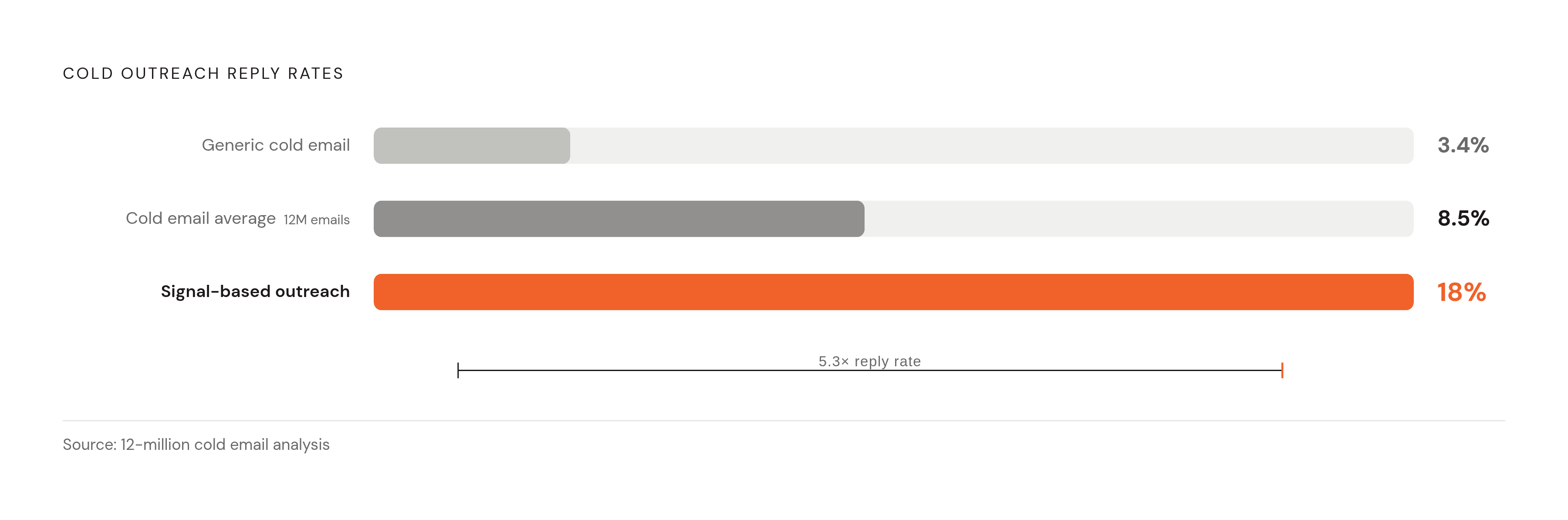
The response-rate gap between generic and signal-based outreach isn't subtle. That gap is timing and context doing the heavy lifting. It's timing and context doing the heavy lifting.
Run the math on volume and the case for this system builds itself. Two hundred targeted emails at an 18% reply rate beat a thousand generic emails at 3.4%, and the targeted batch does it with fewer sends, better outcomes, and a lot less risk to your sending domain Autobound: Signal-Based Selling Complete Guide. Quality beats spray-and-pray, and the numbers back it up plainly.
Building the actual message off a signal comes down to three dimensions: role type, seniority, and volume. Role type tells you the problem they're about to run into, so lead with that problem instead of pitching your product on page one. Seniority tells you which outcome language lands: a new CISO wants to establish authority fast, a VP of Sales wants to hit the number, a Head of RevOps wants efficiency and clean process. Volume tells you urgency: five SDR postings in a week deserves a faster, more direct conversation than a single lonely posting, so reference the scale directly in the message.
That's a sequence built around how fast the window closes, not guesswork.
Champion job-changes deserve their own playbook entirely. Reaching out to someone who already used your product at their last company is a warm, relationship-based message that references shared history, not a cold pitch dressed up as familiar. Reach them in the first few weeks before onboarding swallows their calendar whole.
The average buying group runs 10 to 13 decision-makers DataInfoMetrix: B2B Buying Signals Tech Sales Teams 2026. A single job posting might be your entry point into just one of them. Map the hiring pattern to the whole committee, not only the hiring manager who posted the role, or the deal stalls out the moment it hits someone else's desk.
Last thing, and it matters: never cite the job posting itself in the outreach. Telling someone "I saw you're hiring five SDRs" reads less like insight and more like you've been watching their LinkedIn a little too closely Tendem: Web Scraping Lead Generation Complete Guide. Let the signal shape the angle. It doesn't need a byline. Signal-based outreach achieves an 18% response rate when signal-specific personalization is applied, compared to 3.4% for generic outreach and an 8.5% overall cold email reply rate from a 12 million email analysis, showing that the difference is not copywriting but timing and context Autobound: Signal-Based Selling Complete Guide. In an example workflow, "New VP of Operations in EMEA" is detected, followed within 72 hours by a personalized LinkedIn note, plus 2 days by a regional case study email, and plus 5 days by a call with an efficiency-driven value angle.
A mature signal-monitoring operation at ongoing scale
The intent data market is worth $4.49 billion and climbing at a double-digit clip, yet only 24% of organizations report exceptional returns on it Salesmotion: Intent Signals Guide. The gap isn't the data, it's that most teams collect signals and never build a system to act on them. Job posting monitoring falls into the exact same trap without a structured response workflow wrapped around it.
A signal map isn't something you build once and forget. It needs to evolve as the ICP evolves. A company that starts chasing bigger enterprise deals will see different hiring triggers than one still selling into SMBs, so the role-to-purchase mappings need a regular check-up, not a permanent shelf life.
Coverage breadth matters more than most teams assume going in. Job boards alone miss postings that only ever show up on a company's own career page. Career pages alone miss the aggregated trends that only become visible once you're watching many boards at once. A serious operation covers both, continuously, not on a schedule someone remembers to run occasionally.
Cadence matters just as much. Signals are time-bound, so daily or near-real-time detection is the bar to clear, since a weekly manual check will reliably miss the first-mover window that makes this whole approach worth doing. Automation handles detection and routing, but humans still validate signal quality, sharpen the role taxonomy, and handle the exceptions the model gets wrong. The self-healing scraper is a fitting comparison here: the job shifts from constant maintenance to actual judgment.
Measure more than reply rates alone. Track signal-sourced pipeline, conversion rates on signal-qualified accounts against plain cold outreach, and time from signal detection to first contact. Those numbers make the whole system legible to leadership and justify the infrastructure spend in plain terms, not vibes.
The teams building this now are compounding a long-term edge. They're compounding an edge that gets sharper every hiring cycle, while everyone still working static lists watches the gap widen and wonders where all the good accounts went.
Sources
- How to Use Hiring Signals in B2B Sales (2026... | Autobound
- Intent Signals Guide: How B2B Sales Teams Identify and Act on Buyer Intent | Salesmotion
- Autobound: B2B Signal Intelligence Infrastructure
- Hiring Signals for B2B Prospecting: 2026 Complete Guide - Origami
- B2B Buying Signals that Sales Teams Should Track in 2026 | DataInfoMetrix | Data InfoMetrix