Industry News Aggregation Pipelines for Analyst Briefings
Automation replaces the analyst who manually routes weekly briefings days too late.
A logistics analyst spends 90 minutes every week pulling shipment exceptions into a spreadsheet, formatting it, and mailing it out. Nobody opens the file until Wednesday. By then, two of those exceptions have already turned into customer complaints. The report wasn't wrong. It was just late enough to be useless, like a weather forecast for yesterday.
A human being was standing in the exact spot where a message queue should have been, manually shuttling information from a source to a set of inboxes on a schedule that had nothing to do with when the news actually happened. The SQL was fine. The bottleneck had a pulse.
A briefing that lands two or three days after the news broke is a history lesson nobody assigned. It's a history lesson nobody assigned. In any sector that moves on competitor news, regulatory shifts, or market signals, that lag appears later as a real cost on somebody's P&L, usually blamed on something unrelated.
Hiring a faster analyst doesn't fix this. Nagging someone to check their inbox more often doesn't either. The fix is the one every bottleneck eventually gets: pull the human out of the plumbing and put a pipeline there instead, one that doesn't sleep, doesn't take Wednesdays off, and doesn't need reminding twice.
How AI agents are changing who consumes the web
The web used to have one kind of visitor: a person, a browser tab, a scroll wheel. That's changing fast. A second population now reads the web at scale, and it's made of software, not people, pulling content the moment it publishes and reasoning over it before a human even hits refresh.
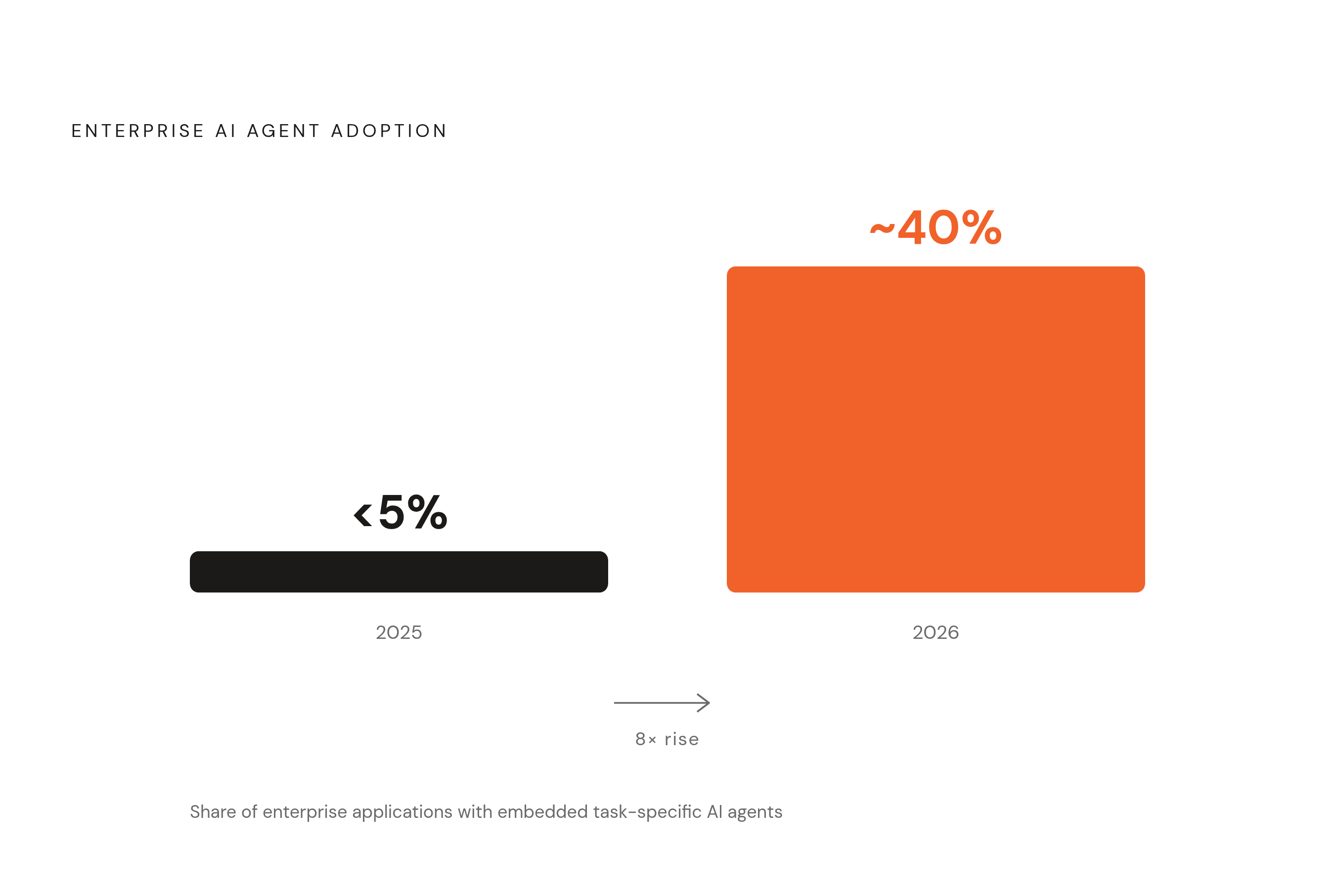
The shift looks more like a cliff than a slope. Adoption of task-specific AI agents inside enterprise applications sat under 5% in 2025. Projections put that figure near 40% by the end of 2026. Agentic AI data engineering (using AI agents to build and speed up the pipelines that feed other AI systems) is moving from research curiosity to standard job function in that same window. Gartner's forecast has AI-enhanced workflows cutting manual effort in data integration by 60% by 2027.
Anyone still building for a single audience, a person reading a PDF at 8 a.m., is going to miss this. That reader hasn't disappeared, but they're no longer the only one asking for the file. Agents want content shaped for instant parsing: no cleanup, no human standing between the scrape and the answer.
Why traditional batch pipelines break under live-web requirements
Traditional ETL got built for a calmer world: structured rows, overnight batch jobs, a warehouse feeding a dashboard. It was designed to stop the moment data landed in that warehouse. A pipeline built for AI doesn't get that luxury. It keeps going, feeding models, watching how those models perform, retraining when the data drifts out from under them.
That mismatch appears in a few predictable places.
Data goes stale fast when the pipeline only refreshes off a daily warehouse load. By the time it does, the agents and analysts reading it are already two steps behind whatever happened that morning. Hard-coded logic breaks just as fast: rename one field upstream, tweak a schema, and the whole thing throws errors instead of adapting, and someone loses an afternoon tracing the failure back to a single renamed column. Traditional pipelines were never built to read the unstructured material a briefing actually depends on either, things like news articles, press releases, filings, and earnings call transcripts that don't arrive as tidy rows. Patching a brittle pipeline usually costs more than building a fresh one, so teams keep building fresh ones, which is how an organization ends up running a dozen half-redundant pipelines instead of one that actually works.
The web itself doesn't cooperate. Over 70% of modern websites run on JavaScript frameworks, so a plain HTTP request comes back with a shell of a page, most of the real content missing. Many data teams acknowledge their existing infrastructure cannot support revenue work driven by advanced automation. Most data teams are admitting, out loud, that the plumbing can't carry the load it's already being asked to carry.
Stage one: source discovery and continuous web ingestion
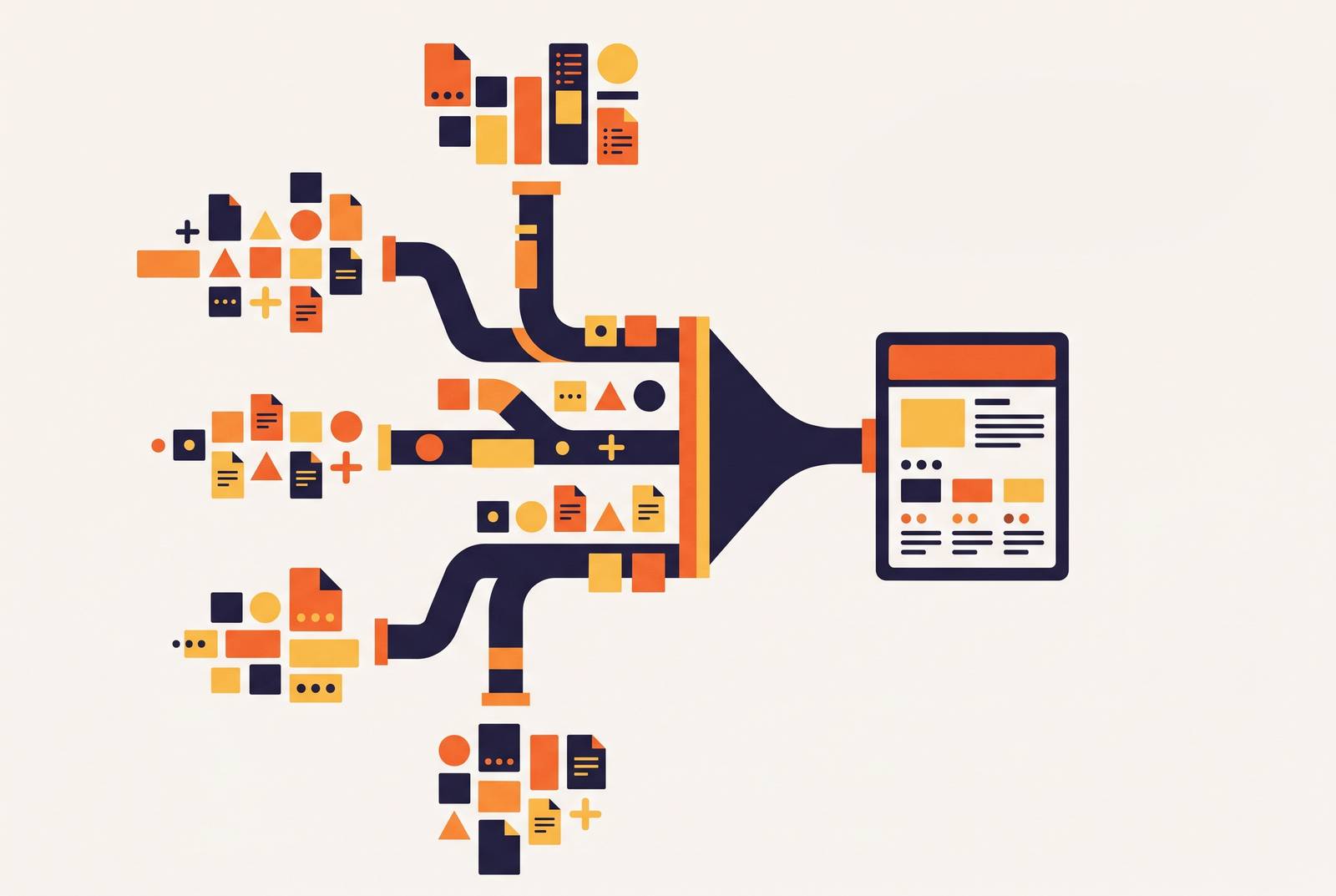
Analyst briefings pull from sources that share almost nothing in common: news sites, government and regulatory portals, investor relations pages, trade publications, RSS feeds, social platforms, and PDF filings clearly built by someone who's never heard of an API. Turning that mess into one coherent feed takes two different kinds of ingestion, and treating them as the same job is where a lot of pipelines go wrong.
Known-URL monitoring checks a fixed list of sources on a schedule or a trigger. That's the right tool for an earnings page, a regulatory RSS feed, or a competitor's press room, anywhere the pipeline already knows exactly where to look. Discovery crawling walks a domain or a wider slice of the web to surface content nobody pointed at, which is the only way to catch emerging coverage or a regulatory update that appears in an unexpected place. A pipeline running only one of these is running half a pipeline, and it will feel like it.
By 2026, the direction is event-driven, real-time architecture: streaming systems react the instant a page changes instead of waiting for a scheduled refresh. Copy that model. A briefing that updates once a day inherits the exact staleness problem the spreadsheet analyst had, just with better formatting.
JavaScript rendering isn't a nice-to-have here, it's the whole ballgame. With a large share of modern sites built on JS frameworks, an ingestion layer that fires off a bare HTTP request and calls it done will quietly miss most of the page. That's a systematic blind spot, and it produces briefings that look complete while leaving out exactly the parts that mattered.
Stage two: choosing and evaluating scraping and search API infrastructure
Three different jobs get lumped under the word "scraping," and that sloppy shorthand is the reason so many pipelines get under-built. A scraping tool pulls content from one known URL. A crawling tool walks across many pages inside a site or domain. Search-style tools handle discovery, finding pages nobody pointed at yet, though their strongest use cases sit apart from dedicated scraping platforms. A briefing pipeline that installs only one of these is betting the whole system on a tool doing a job it wasn't built for, and that bet loses eventually.
A few questions decide whether a tool survives contact with the real web. Does it render JavaScript the way an actual browser would, or does it just fetch raw HTML and hope? Can it handle anti-bot defenses (Cloudflare challenges, CAPTCHAs, session logins) without a team babysitting it every time a site updates its defenses? Does it hand back clean Markdown or structured JSON, or dump raw HTML that still needs a separate parsing step before anything downstream can touch it? And where does it fall short: no tool covers every corner of the web equally well, and e-commerce pages in particular remain a documented weak spot for at least some otherwise capable platforms.
The workflow that actually holds up looks the same across most setups. A search-style API finds the relevant URL first, then a scraping tool reads the page. Two complementary steps, one pipeline. Skipping the first step leaves the second one with nothing to point at.
Stage three: transforming raw web content into AI-ready structured data
Raw HTML is noise wearing a content costume. Navigation bars, cookie banners, ad slots, footer boilerplate, stray encoding artifacts, none of it is signal, and every bit of it burns tokens an LLM has to wade through before reaching the sentence that actually matters.
Some newer scraping approaches lean on LLMs to pull content out semantically instead of structurally. A brittle CSS selector breaks the moment a site redesigns its layout. Describing what's wanted in plain English doesn't break that way, because the model finds the thing even after the page changes shape.
Picking the wrong output format for the job is a common mistake, and it's worth getting specific about which format fits what. Markdown keeps the document's structure (headings, lists, tables) in a form LLMs read efficiently, and it fits narrative material like articles and press releases. Structured JSON fits tabular data instead: pricing tables, executive rosters, filing metadata, anywhere a downstream agent needs to query one exact field rather than read a paragraph hunting for it. Vector embeddings support retrieval-based systems, where the briefing pulls in only the relevant chunks of text at query time instead of reprocessing every document from scratch.
Think of it as feature engineering's cousin. A machine learning model doesn't get handed raw timestamps, it gets a rolling average or a time-since-last-event column, because that's the shape the model can actually use. Analyst pipelines need the same treatment: tag each piece of content with its publish time, its source's track record, named entities, a sentiment read. Handing the summarization model context instead of a wall of text stops it from shrugging its way through the job.
Stage four: summarization, synthesis, and briefing generation with LLMs
By the time content reaches this stage, it's already structured, tagged, and fresh. The LLM's job is to turn that material into a narrative: what changed, what matters, what needs a human's attention, without overriding the analyst's judgment on what to do about any of it.
One model trying to do all of that at once tends to produce mush. A multi-agent setup, several specialized agents each handling one narrow job, holds up better in practice. One agent watches the sources and flags new content the moment it appears. Another checks whether the flagged item is genuinely new or just a rehash, deduplication and novelty scoring, in other words. A third drafts the actual narrative section with source attribution built in from the start rather than bolted on after. A coordinator agent decides the item is urgent enough to push immediately or that it can sit until the next scheduled briefing.
That division of labor tracks where the field is headed anyway. Industry observers broadly point to 2026 as the year multi-agent systems, specialized agents coordinating under one central process, stop being a lab demo and become standard architecture. LangChain's framing of multi-step analysis, where one query's output shapes how the next one gets asked and an LLM steers the whole chain, maps almost exactly onto what briefing generation requires.
Stage five: reliable delivery, scheduling, and failure handling
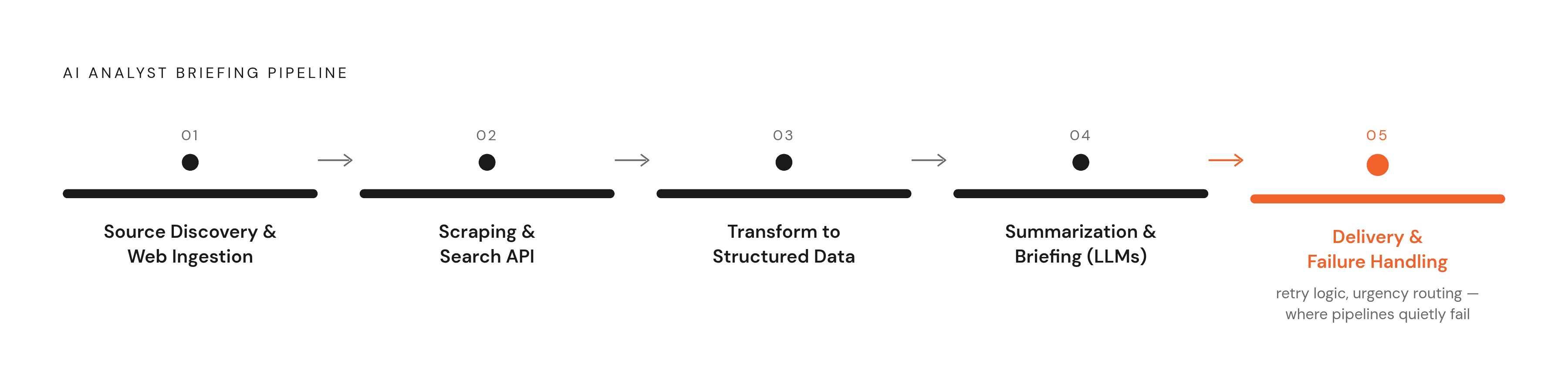
None of the first four stages matter if the briefing doesn't land somewhere a person will actually see it, on time, in a form they can act on. Delivery is where a lot of otherwise well-built pipelines quietly fall apart. The last mile, scheduling, retry logic, the fallback path when an email server hiccups, rarely gets the same engineering attention as the scraping and summarization stages upstream. The lack of engineering attention on the last mile, scheduling, retry logic, and the fallback path when an email server hiccups is visible in the finished product.
A pipeline that discovers sources instantly, scrapes cleanly, and summarizes sharply still fails the analyst if it can't be trusted to show up. Scheduling has to account for urgency, not just calendar time: an acquisition rumor and a quarterly regulatory filing don't belong on the same clock. Failure handling has to assume something, somewhere, will time out or throw an error on an ordinary Tuesday, and the system needs a way to retry, alert, or degrade gracefully instead of dropping a briefing into the void without telling anyone.
Getting that right is less glamorous than the LLM stage, no question. It's also the entire difference between a pipeline analysts trust and one they've quietly stopped checking.