Monitoring Regulatory and Compliance Pages for Policy Changes
Automated monitoring with webhooks catches regulatory changes faster than manual review.

To monitor regulatory and compliance pages, the system needs an event-driven web scraping API with webhook support in a larger pipeline that fetches and compares pages and sends changes to a human for review. Scheduled fetching detects page changes, while webhooks deliver structured results to receiving systems without notification polling. The essential distinction is that a callback delivers an event, but does not itself detect a changed page.
Why regulatory page monitoring has become an operational necessity, not a compliance nicety
The Federal Reserve, OCC, and FDIC issued revised interagency model risk management guidance on April 17, 2026, replacing the long-standing SR 11-7 framework with SR 26-2 / OCC Bulletin 2026-13. Teams checking weekly or monthly would have had days less lead time than teams watching near-real-time. That delay leaves less time to work out what the changed expectations mean and who will do the work. The publication date starts the clock.
The monitoring surface also spans cybersecurity regulations, privacy laws, AI governance, and third-party risk obligations. More pages compete for limited review time. Automation therefore has to do more than fetch documents faster, because a larger inbox is not a compliance strategy. It needs a design that keeps collection, detection of meaningful changes, and review by someone who is accountable as separate steps.
What the pipeline must do before the first line of code is written
Four requirements frame the design, namely collection, cleaning, documentation, and storage. Collection means targeted, scheduled fetching with robots.txt compliance enforced at ingestion. Cleaning removes PII, duplicates, and poor-quality content before persistence, while normalizing the material that remains. Data minimization belongs at the front door. Treating it as later housekeeping means storing material the pipeline should have rejected.
Documentation gives every fetched record a source URL, fetch timestamp, and pipeline version so counsel can reconstruct what the system saw. Storage preserves snapshots in an append-only ledger with an auditable, tamper-evident history. Nannini et al.’s compliance architecture paper identifies an exhaustive inventory of external actions, data flows, connected systems, and affected persons as a foundational compliance task. The same discipline applies here before tooling is chosen. Collection comes first because every later stage depends on what enters the system.
Targeting the right regulatory URLs and crawling them at the right rate
Seed the URL corpus from agency sitemap XML and known regulatory index pages. Those indices provide a targeted route to rulemaking, guidance, and bulletins. Scope is a budget control. Turning “monitor their guidance page” into “crawl their whole site” multiplies request volume before extraction or review even begins. Maintain the corpus so it follows the pages that actually publish relevant changes.
Apply per-domain rate caps to limit the risk of IP blocks and terms-of-service violations. A jurisdiction routing table should also drive policy switches for US federal agencies, EU bodies, the UK FCA, and sector-specific bodies, whose access terms may differ. One fetch policy cannot stand in for all of them. Monitor the terms themselves daily with a hash-and-diff loop. When a terms hash changes, halt that target until a human reviews the diff, so the system has two clear states and checks whether yesterday’s permission still applies.
Fetching pages as clean Markdown rather than diffing raw HTML
Raw HTML turns presentation changes into compliance noise. Layout tokens, rotating session identifiers, and ad injection can cause diffs even when no obligation has changed. Snapshot pages as Markdown instead, preserving headings, lists, and tables while stripping presentation. Then normalize whitespace and remove volatile timestamps before hashing. The aim is to stop treating the website’s new haircut as a new regulation.
PDF tables need a more careful path. Effective dates, entity thresholds, obligation categories, and penalty tiers can lose their relationships in a naive PDF-to-text conversion. For complex tables, use layout-preserved plain text with JSON metadata that retains spatial relationships, reading flow, confidence scores, and form elements. Keep Markdown for chunking and retrieval, and JSON for structured extraction and automation, stored separately. Once the content is clean, the comparison loop becomes straightforward rather than an exercise in interpreting broken furniture.
Building the snapshot-and-diff loop that detects meaningful changes
Choose fetch frequency by source type. Sources that change often, such as Federal Register daily publication and agency press release feeds, need polling every hour or more often, while standards-body specification pages may be checked daily. Frequency compounds the cost of scope. A daily task runs dozens of times per month per URL, while an hourly task runs into the hundreds. Model that request volume before committing to a cadence.
On each scheduled run, fetch the current content, normalize it, and compare its hash with the stored snapshot hash. If it differs, compute a line-level diff against the previous Markdown snapshot. A configurable minimum line-change threshold identifies candidate alerts. On a non-trivial diff, raise the candidate and append the new snapshot with its source URL and fetch timestamp, preserving the previous version. On no change, update only the last-checked timestamp.
The new snapshot becomes the baseline without erasing history. For high-signal attributes such as effective dates, entity counts, and penalty thresholds, add structured extraction and compare the JSON fields as well as the page text. Set a cap on retries for each URL in each run, and log each failure. A failed fetch must not silently graduate to heavier browser automation, because each retry can add a billable request. Detection needs a budget as well as a clock.
Extracting structured fields from diffs so alerts carry actionable context
A changed paragraph tells the team where to look, but not necessarily what to do. Pass the changed Markdown segment, rather than the whole page, to an LLM with a narrow schema prompt. The output should identify change type, affected entities, old value, new value, and effective date. Keep the extraction schema to five to eight fields. Scraping credits and LLM tokens both contribute to the cost of each extracted diff.
Change type can be an enumerated string with values including “new obligation,” “amended threshold,” “effective date change,” and “definition update.” Affected entities can be a list of strings, while old and new values preserve the extracted values and effective date records the timing stated by the source. Precision must not exceed the published text. Store the JSON beside the Markdown diff so compliance mapping can query it without requiring someone to read every alert.
Liu et al.’s survey of LLM agents in law identifies hallucination, outdated information, and verifiability as limitations of standalone models. Ground extraction in the fetched content. That provides evidence for review, with correctness still subject to verification. Attach a confidence score to each extracted field and route low-confidence results to a human review queue. A confident tone is not a confidence score.
How do page-change alerts reach the right people through webhooks?
Post a structured JSON payload to a registered webhook endpoint, letting the receiving ticketing system, GRC platform, Slack, or email integration handle presentation. This decouples detection from delivery. Include the source URL, fetch timestamp, change type, Markdown-formatted diff summary, extracted fields, and direct regulatory-page link. The recipient should have enough context to act without first reconstructing the scraper’s working day.
Route effective-date changes to the team responsible for that regulation’s controls, definition changes to policy, and penalty-threshold changes to risk. Ownership is part of the payload’s purpose. Ask Kaia’s Federal Register Tracker and Regulatory Impact Analyzer agents can operate within a system of record such as 360factors’ Predict360 or as standalone tools, generating audit trails as they work. Structure monitoring output to feed these workflows without manual re-entry. Choosing who gets an alert is a governance decision, and regulators are beginning to require human oversight where it was once an optional courtesy.
Satisfying the human oversight requirements that regulators are beginning to enforce
SR 26-2 says materiality, ongoing monitoring, and effective challenge apply to AI tools even when they fall outside the guidance’s formal scope. Effective challenge needs a human who can question and override AI-generated output. Put the interrupt between detecting a change and applying it to policy. Freeze action on the affected target until a named reviewer approves the diff, then resume or escalate according to the decision. Delivery of an alert is not approval of its contents.
The architecture paper identifies oversight evasion from reinforcement learning and runtime behavioral drift as agent-specific compliance challenges. An unattended policy-update path leaves no meaningful challenge point. Record who reviewed the change, what they saw, when they acted, and what they decided in the provenance ledger. Those records need to be append-only, timestamped, non-repudiable, and readable by counsel without translation.
Where the pipeline breaks in production and how to prevent each failure mode
Bot-detection blocks are a fetching problem that leaves page-change status unknown. The mitigation is a managed fetching layer with rotating infrastructure rather than a single-IP crawler, subject to the same access policies already defined. For programs whose monitored content cannot transit a vendor cloud, self-hosting is instead a structural requirement. Plan where that content can go before a security review forces a redesign.
Runaway agent cost needs explicit execution bounds and per-session spend caps. Leaving max_iterations=None on an agent polling live URLs can burn thousands of dollars in a stuck session. The meter does not recognize good intentions. Retry limits address failed requests, while a narrow extraction schema limits token use when a request succeeds. For a corpus beyond a few hundred URLs, the notes’ infrastructure-first approach favors a managed API over a custom agent stack on per-page economics.
Silent diff-loop failure needs an independent health alarm. Alert on “no successful fetch in N hours” rather than using the absence of change alerts as evidence that monitoring works. Format corruption needs a different check, namely validation of extracted tables against a known-good schema on a sample of pages, with alerts when validation fails. Terms-of-service drift belongs to the daily terms loop and its human-review halt.
Putting the full pipeline together — the end-to-end architecture in one view
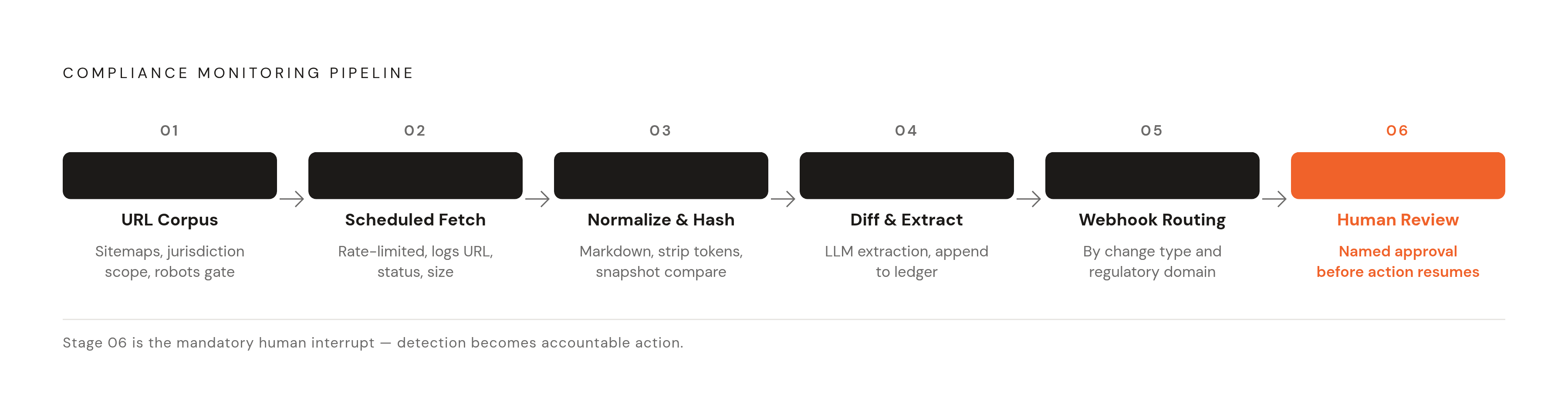
The architecture runs through six connected stages, beginning with URL corpus management and compliant fetching. Stage 1 takes agency sitemaps and indices into a corpus scoped by jurisdiction and regulatory domain, with a terms-diff loop and robots.txt gate at CI. Stage 2 fetches the pages in that corpus on the schedule set for them, through a rate-limited managed API where access is allowed. Log the URL, timestamp, HTTP status, and response size for each attempt.
Stage 3 converts fetched content into normalized Markdown, strips volatile tokens, and hashes the result against the stored snapshot. Matching content updates the last-checked timestamp, while changed content proceeds to comparison. Stage 4 computes the diff and sends the changed segment through narrow-schema extraction, preserving the snapshot, raw diff, and structured output in the append-only ledger. Markdown supplies the readable evidence. JSON supplies the fields that software can route and query. Neither replaces the other.
Stage 5 posts the structured webhook payload to the receiving system and routes it by change type and regulatory domain. Stage 6 pauses action on the affected target for a named human reviewer and records who reviewed it, when, and what they decided before it resumes or escalates. Independent fetch-health and validation alerts keep failures visible outside the change stream. That is continuous compliance in code, with publication leading to evidence, evidence reaching an owner, and action waiting for accountable review.