Structuring Competitor Feature Matrices From Public Documentation
Build competitor matrices from primary sources, not memory or marketing claims.

Where the evidence lives in public documentation
A competitor feature matrix is a spreadsheet: capabilities down one side, vendors across the top, each cell saying whether a product does the thing and how well. Sales likes it because it fits on one slide. Product likes it because it's a gut check on roadmap priorities. Marketing likes it because it writes half the battlecard for free. Here's where most teams get it backwards: they treat the matrix as a document you write once and hand off, when it only holds up as the output of a pipeline that runs constantly, quietly, in the background, forever.
Competitors ship weekly, rename old features to sound newer, and reshuffle pricing tiers just often enough that last quarter's matrix goes wrong without anyone noticing. Meertrack.com puts the shelf life of a hand-built matrix at about a quarter before drift sets in. Arisegtm.com pegs battlecard upkeep at 30 to 40 hours per quarter for a typical product marketing team, and that's just to keep pace with entropy that never lets up.
A shared spreadsheet somebody updates "when they get a chance" rots on a schedule you can set your watch to. That's an architecture failure. Fix the architecture (source discovery, extraction, a schema built to hold nuance, a monitoring loop) and the staleness mostly takes care of itself.
Good matrices start with primary sources: product documentation, feature reference pages, changelogs, release notes, pricing and packaging pages, and, where access allows, a free trial or sandbox account plus any demo recordings the vendor posted. Meertrack.com treats this as the core evidence set. None of it is a secondhand summary of somebody's opinion about the product, and that distinction is the whole point.
Secondary sources still earn a seat, just a smaller one. Analyst reports on a fixed annual cycle (Gartner, Forrester), vendor press releases, published case studies, and reviews on G2, Capterra, and TrustRadius add corroboration. Kognitos.com used this layered approach in an enterprise comparison, citing the Gartner Magic Quadrant for Intelligent Document Processing Solutions alongside vendor materials and review-site data. None of those secondary sources overrides a primary one; they just add confidence when they happen to agree with it.
A comparison of 11 scraping APIs published by context.dev shows what careful sourcing looks like in practice. Every tool spec, SDK capability, and pricing detail got checked against public documentation, open-source repositories, and live API endpoints as of September 2026, run through five standardized benchmarks. Copy that model. Don't just look something up. Check it against something that can't lie to you, like a running endpoint.
Each source type moves at its own speed, and that's the detail most teams miss. Pricing pages change with zero warning. Changelogs are dated, so at least you know when something shifted. Analyst reports update once a year, if that. A pipeline that treats all three the same way either checks pricing too rarely or hammers an analyst report's URL for no reason. Skip anything drawn from memory of a demo, a competitor's own marketing copy taken at face value, or somebody's writeup of a feature they never actually saw run. What this stage should produce is a source inventory: a finite, typed list of URLs per competitor that the pipeline can crawl. Not an open invitation to go search the internet and hope for the best.
Designing a schema that survives the web's inconsistency
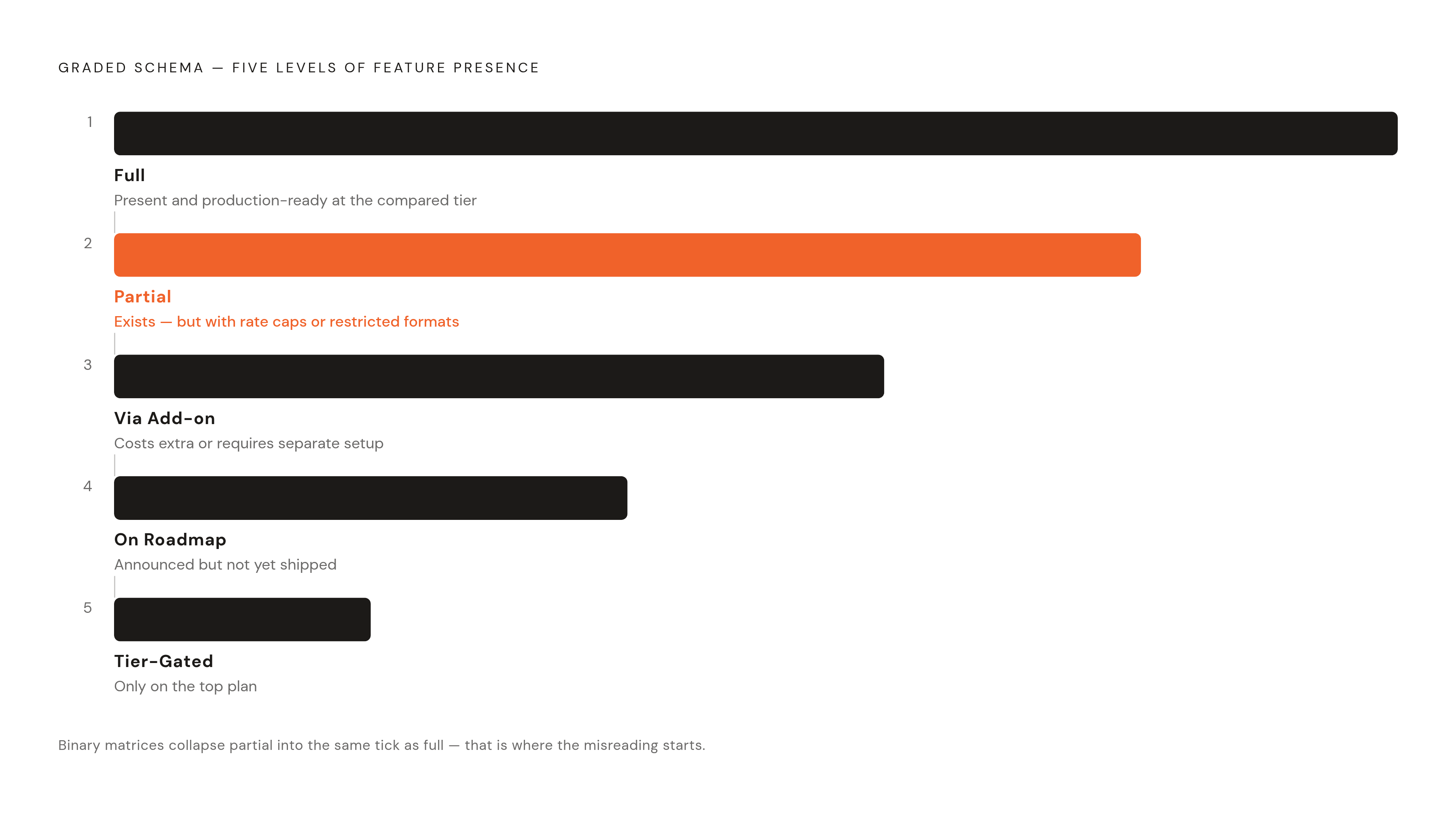
Checkmarks lie. Two products can both claim the same feature, and one means a fully documented interface with generous rate limits while the other means a beta webhook that falls over past a modest hourly request cap. This flattening of genuinely different capabilities into an identical tick is the mistake to fix first, before touching crawling or extraction. A binary schema doesn't just miss detail. It actively lies to whoever reads the matrix next.
Binary values work fine when the fact really is binary. A native Salesforce integration either exists or it doesn't. But most feature claims aren't like that, and forcing them into yes/no is where the lying starts. Meertrack.com lays out a workable set of graded values instead: "full" means present and production-ready at the tier being compared, "partial" means it exists with real limits like rate caps or restricted file formats, "via add-on" means it costs extra or needs separate setup, "on roadmap" means announced but not shipped, and "tier-gated" means it only shows up on the top plan.
The cell value is the least interesting part of the schema, honestly. A defensible matrix carries several fields alongside it, including the source URL where the claim got verified, the source type (docs, changelog, pricing page, analyst report), a last-verified date, a confidence level (high for something stated outright, medium for something inferred from context, low for anything resting on a secondary source alone), and a notes field for the nuance no single grade can carry.
Extend.ai's published comparison of Extend against Reducto, updated July 27, 2026, shows this at full depth. It doesn't stop at "has extraction" or "doesn't." It breaks decisions down by input types, parsing output format, schema extraction method, whether evaluation and QA tooling exists, human review workflow, deployment options, and starting price. It also captures tier-awareness directly: Reducto's Studio evaluations only show up on the Growth tier and above, a detail a plain yes/no schema erases completely.
JSON Schema, with nested objects, arrays, and field-level instructions, the same format document extraction APIs like Extend already use for parsing, maps cleanly onto a matrix's cell structure. Design the schema before the crawl starts, not after. Skipping that order is the mistake that causes most of what follows, because retrofitting structure onto text that's already been scraped and dumped into a spreadsheet is slow, expensive, and loses information nobody gets back.
Crawling competitor documentation at the right scope and depth
Documentation sites look uniform from the outside. They are not uniform on the inside. Most publish sitemaps and structured navigation that seed a crawl far more efficiently than following links page to page ever will. Many run versioned URL paths, like /docs/v2/ sitting right next to /docs/v3/, and a careless crawl mixes outdated content with current content in the same batch with no way to tell them apart later. A good chunk of modern doc sites render content in ways a plain HTTP fetch never sees. Changelogs tend to be paginated or append-only, which changes how often, and how, they need checking.
Scope decisions need to happen on paper before anything runs. Which URL patterns count (docs, changelog, pricing, blog announcements) and which don't (marketing copy, legal pages, community forums)? How deep does the crawl go, given that doc trees run surprisingly deep, and does it run breadth-first so the highest-signal pages get hit early? How often does each source type get recrawled, given that a pricing page might need a daily check while reference docs can wait a week?
Speed and cost trade off directly here, and the choice should be made on purpose, not by defaulting to whatever's flashiest. A useful distinction in the scraping landscape: runtime LLM scrapers run a model on every single page, flexible, but slow and expensive once dozens of competitors' full doc sites are in scope. Code-generation scrapers take the opposite approach. Analyze the site structure once, generate extraction code from that analysis, then run that code at native speed on every page after. That distinction is the reason a pipeline built for five competitors falls over at fifty, and most teams don't find out until it already has.
Most documentation sites carry less defense than e-commerce or social platforms, but not all of them. Some enterprise vendors route docs through CDN protection from a separate provider, and a pipeline built on brittle page-structure selectors breaks the moment that protection kicks in or the layout shifts even slightly. The crawl layer should output clean Markdown or structured HTML per page, never raw HTML dumped straight into an extraction prompt. A study on LLM-powered web scraping ("Benchmarking LLM-Powered Web Scraping for Everyday Users") found extraction accuracy swings wildly depending on how clean the input format is. Garbage in, garbage out, except here the garbage is unstripped nav bars and cookie banners.
Parse the sitemap first. Competitor documentation sites publish sitemaps almost universally, and a sitemap hands over a typed URL list that gets filtered by pattern before a single page loads. Cheap, fast, and it turns an open-ended crawl into a bounded one. Anyone skipping this step and crawling link-by-link is just paying more to get a worse map of the same territory.
Extracting structured feature claims from unstructured documentation pages
The same feature fact appears in a row in a pricing table, a bullet in a feature overview, a throwaway line buried in a changelog entry, or a cell in a comparison table the vendor built itself. A schema-first approach is what keeps a matrix from misreading the same fact three different ways depending on which format it happened to land in.
LLM-based extraction is the right tool for this job, but only on a short leash. The schema itself becomes the extraction target, graded values and all, with a citation requirement built into the prompt. The model gets told to pull only what's explicitly stated, not to guess or fill gaps by pattern-matching what usually shows up on pages like this one. Every extracted value needs a source snippet riding next to it: the exact sentence or table cell the claim came from.
Bigger isn't automatically better here, and the evidence says so directly. A paper out of Cairo University, on a system called AXE (Adaptive X-Path Extractor), showed a 0.6B parameter model hitting an F1 score of 88.1% once paired with DOM pruning that cut input tokens by 97.9%. Smaller model, sharper preprocessing, better result than throwing a huge model at a messy full page. Separately, researchers at McGill University found AI extraction methods held 98.4% accuracy even when the underlying page structure changed, which matters directly here since doc sites redesign on their own schedule, usually without warning anyone doing competitive research.
Vendor-published comparison tables, like the Extend vs. Reducto matrix from earlier, should get extracted first, before falling back to parsing prose. The vendor already did the categorization work. Re-deriving it from scratch is wasted effort dressed up as thoroughness.
Ambiguity needs an honest answer. A feature that shows up in a blog post but nowhere in the reference docs means the confidence field should say so. A low-confidence cell is honest. A wrong cell dressed up as confident is worse than an empty one, every time. For long documentation pages, split by section header before handing content to the extraction model: per-section extraction runs cheaper and lands more accurately than dumping a whole dense reference page in at once. After extraction, run a second pass checking whether each pulled value is actually backed by its cited snippet. That single consistency check catches hallucinated citations before they land in a live matrix.
Keeping the matrix current as competitors ship
Arisegtm.com's 2026 competitive intelligence playbook found that most B2B SaaS battlecards go stale faster than teams can update them. At a 50-person sales org, that works out to 400 to 600 hours a month in lost or wasted effort, which is multiple full-time roles' worth of labor spent chasing a moving target with a spreadsheet and good intentions.
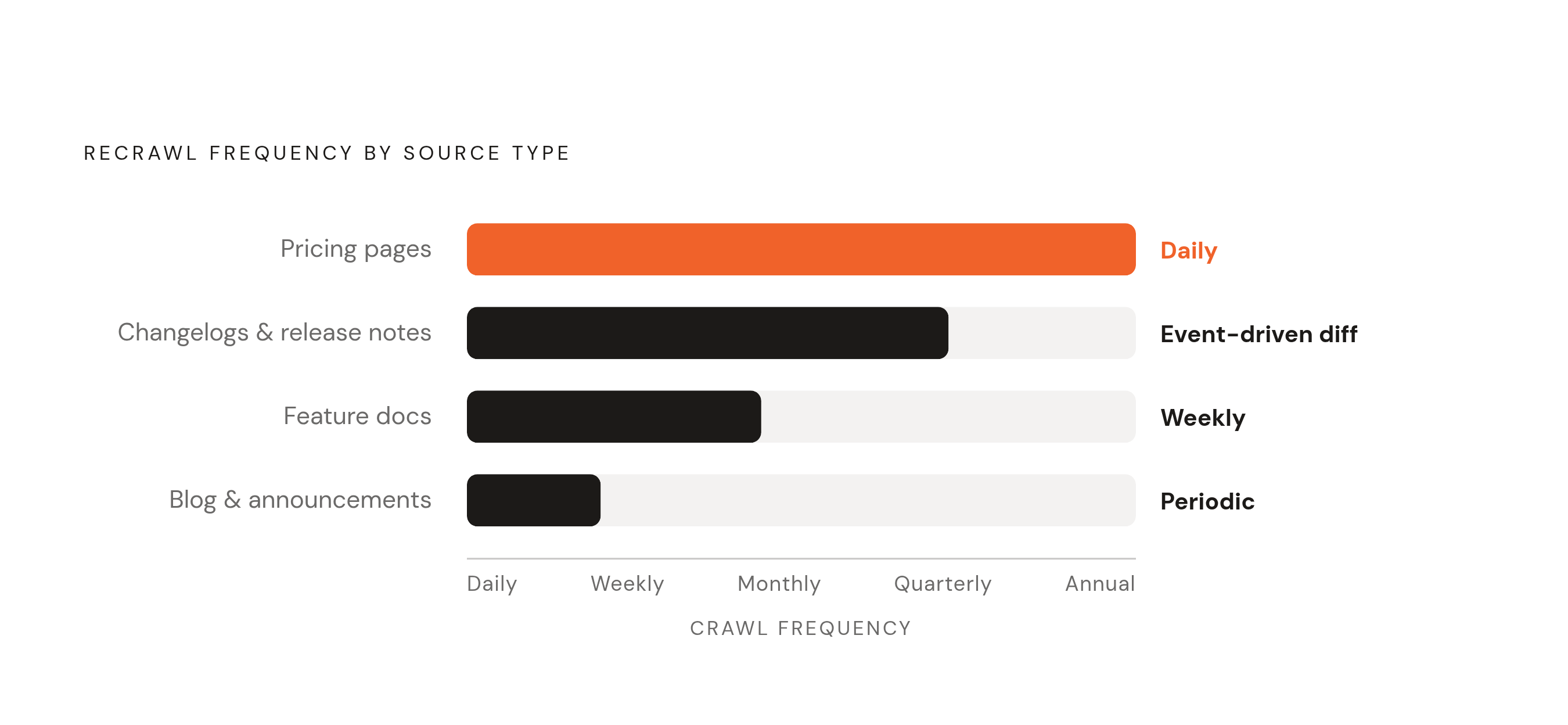
Monitoring frequency should match how fast each source type actually moves, not run on one blanket schedule out of convenience. Pricing pages change often and hit the matrix directly, so daily or near-daily checks make sense. Changelogs and release notes are event-driven: check on a schedule and diff against whatever was last seen. Feature docs move at a moderate clip, so weekly recrawls with diff detection cover most of it. Blog and announcement pages carry less signal per page, but they sometimes leak a feature before it's launched anywhere official.
Store the clean Markdown from the last crawl of a given URL. On the next crawl, compare new against old, and fire off re-extraction only when the diff actually means something, not on every whitespace change or footer update. That's diff detection doing its job: cheap to run, and it keeps the pipeline from re-processing pages that haven't changed.
Sometimes the signal is language. It's language. Arisegtm.com gives a concrete example: a competitor shifting from "workflow automation" to "AI-powered workflow" across dozens of pages over a couple of months, well before any formal announcement. That's repositioning happening in slow motion, and a pipeline that only tracks feature tables misses it completely.
Arisegtm.com describes CI automation today as mostly reactive: it tells you what a competitor already did. Where it's heading in 2026 is predictive, aiming to flag a move before it happens and suggest a response. Getting there needs webhook integration, where the pipeline fires an event when a diff crosses a meaningful threshold, with a payload naming the competitor, the URL, and what changed, so Slack or a database or a review queue gets the alert without anyone polling for it manually. Not every diff deserves an automatic write to the matrix, though. Route the significant ones to a human review step first. Automated detection, human confirmation, automated write, in that order, no shortcuts.
Tooling choices for each stage of the pipeline
Four distinct jobs make up this pipeline, and no single tool does all four well: crawling and page retrieval, structured extraction, diff-based monitoring, and output storage that can actually be queried later without turning into its own side project.
For crawling and retrieval, specialized extraction tools built for turning websites into clean, LLM-ready Markdown are one option. The better ones score paragraphs, lists, and tables against a target query before returning anything, which cuts token use hard compared to processing whole pages blind. Open-source, AI-native crawlers that plug into common LLM frameworks and return ready-to-use Markdown and JSON are another route, though anti-bot coverage against CDN protection like Cloudflare or Akamai usually means pairing the crawler with a separate proxy layer. Teams needing raw throughput across many competitors' full doc trees at once should look at high-performance crawling infrastructure built for speed at scale, some benchmarked well past tens of thousands of pages per second. And teams that don't want to stitch together separate vendors for crawling, scraping, batching, and monitoring are better off picking one unified web data platform instead of four disconnected ones. Every extra vendor contract is another data format to normalize, and that cost adds up faster than the sticker price suggests.
For structured extraction, natural-language-prompted tools that adapt to different page layouts without hardcoded selectors handle most of the day-to-day work, since they're built to survive a competitor's next site redesign instead of breaking on it. Direct LLM extraction against a defined JSON Schema is the other path, and it works well once the schema is solid. The AXE benchmark out of Cairo University, mentioned earlier, showed a 0.6B model paired with smart DOM pruning achieving strong extraction accuracy on this exact task. The extraction layer doesn't need to be the priciest part of the stack to be the most accurate one. Treating price and accuracy as the same thing is where a lot of tooling budgets go to die, quietly, one overpriced API call at a time.
For diff-based monitoring, the stack can stay simple on purpose: store the last clean Markdown snapshot per URL, hash it, and compare hashes on the next crawl rather than re-running extraction blind. Cron scheduling handles the timing, and a lightweight diff library handles the comparison. No need to buy a dedicated monitoring platform when a database column for "last seen content" and a scheduled job do the same work for a fraction of the cost.
For output storage, a relational database wins over a spreadsheet the moment more than one person needs to query the matrix by source type, confidence level, or last-verified date. Spreadsheets don't enforce schema, so a "confidence" column quietly turns into a place where someone types "pretty sure" instead of "medium." A proper schema, even a simple one, keeps the whole pipeline honest about what it actually knows versus what it's guessing.