Tracking Executive and Leadership Changes From Public Web Announcements
Detect executive changes from public announcements in real time.
Tracking executive and leadership changes from public web announcements requires an event-driven pipeline that turns new announcements into structured records and delivers them through webhooks. An event-driven web scraping API with webhook support fits this design, but monitoring and notification are separate jobs. Scheduled source checks find announcements, and webhook events push extracted records to downstream systems so those systems do not have to poll for results.
Why leadership changes are a high-frequency, crawlable web signal
Executive changes keep appearing in public channels where teams know to look. April 2026 alone produced CEO transitions at Apple, LinkedIn, Dow, Best Buy, Conagra Brands, lululemon, Keurig Dr Pepper, NASCAR, and Lucid Group. That roster spans technology, retail, industrials, consumer goods, sports, and electric vehicles. The breadth makes leadership announcements a recurring source of data.
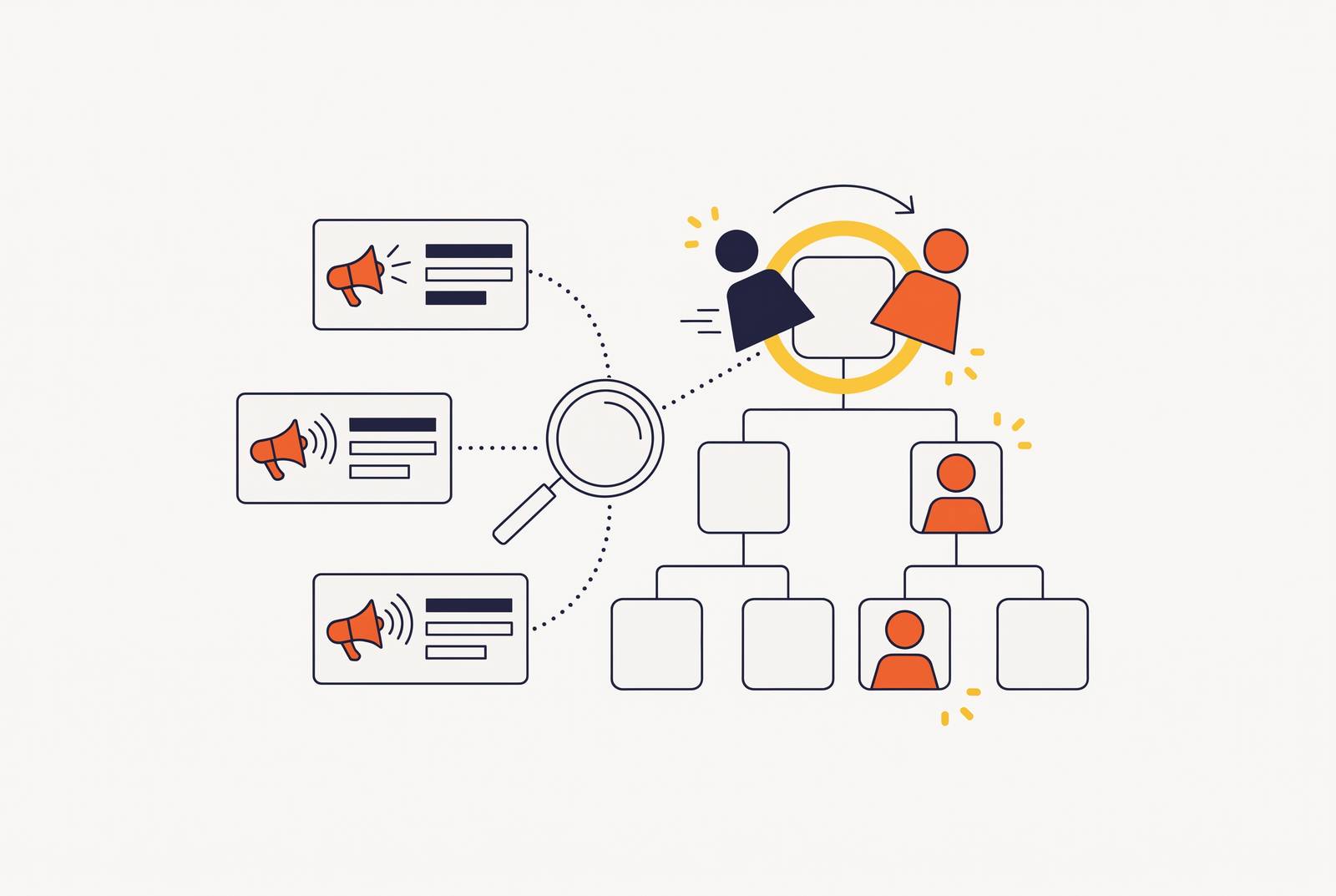
Each transition surfaced through a discrete, indexable event, including a press release, regulatory filing, investor communication, or trade media article. These announcements have identifiable publication venues and enough repeated structure to support automated collection. The executive musical chairs comes with paperwork. A pipeline can monitor those venues rather than search the entire web anew for every appointment.
Zapier named Dan Slagen to the hybrid role of “CMO and Chief AI Transformation Officer” in August 2026. Such appointments add new titles to the stream. That expansion gives monitoring systems more to collect, while making the definition of a leadership role less tidy.
What leadership change signals mean downstream — and who acts on them fast
An appointment can precede vendor re-evaluation, hiring waves, strategic resets, or M&A activity. It is an early indicator. Sales and strategy teams use that opening to time outreach and proposals before relationships solidify under new leadership. Detecting the announcement days or weeks before a competitor becomes aware of it changes when those teams can act.
Recruiters and competitive intelligence analysts have a related reason to watch the sequence that follows. A leadership change may be the beginning of a broader shift in appointments. MitchelLake states the logic explicitly in its intelligence model. “Watch the first two or three appointments that follow [a board appointment]; they signal direction more reliably than any statement”. The first signal therefore creates a reason to keep monitoring.
Investment teams also treat leadership changes as one of several kinds of catalysts for companies in their portfolios and those they target. Their alpha-generation workflows need near-real-time delivery. Speed keeps the delivery schedule from deciding whether the information is still useful when someone receives it. That is the business case for connecting detection directly to extraction and alerting.
Where leadership change data actually lives on the public web
Wire services are the easiest type of source to crawl. PR Newswire, BusinessWire, and GlobeNewswire publish formal appointments in consistently formatted, dateline-stamped releases rich in company names, roles, and people. Regulatory filings provide a different kind of precision. SEC 8-K filings and similar disclosures in other jurisdictions cover material leadership changes at public companies, with dates when the changes take effect, named roles, and names of successors in machine-readable formats.
Those sources do not cover the whole market. Trade and vertical media report changes at private companies that never appear in regulatory filings, and sometimes report appointments before or at the same time as wire releases. Company investor relations pages and newsrooms provide first-party announcements. They can precede wire syndication or publish notices that never reach a wire service, making them useful both for discovery and confirmation.
MitchelLake's Autonodal signal-intelligence platform and Intellizence aggregate signals from large numbers of sources. Their presence raises the standard for a custom feed. A useful custom pipeline must match or add to that coverage, looking beyond a handful of familiar newsrooms to the full range of sources. Source breadth belongs in the design before the scraper works.
The core technical challenge: turning raw announcement text into structured leadership-change records
Finding an announcement is only the first step. A downstream system needs a consistent record containing the company, role, outgoing and incoming individuals, effective date, and transition type. Source text expresses those relationships in different ways. A page containing two executive names and a date is not yet a usable appointment record, because the extraction must establish who is leaving, who is arriving, and when the change takes effect.
Raw HTML adds another layer of noise. It needs cleaning into usable Markdown or cleaned HTML before reliable entity extraction, with the results converted into structured JSON. Traditional selector-based scrapers depend on page layouts that publishers can change on irregular schedules. The maintenance bill arrives without an appointment. LLM-based extraction relies less on those layouts because it finds relationships in free-form text without training data for each source's layout.
Title taxonomy is the less obvious trap. A fixed classifier built around “CEO”, “CFO”, and “COO” can miss or misclassify the Zapier hybrid title even if it reads the page perfectly. Recognizing a person is not enough. The system must also recognize unfamiliar combinations of responsibilities as leadership roles rather than discard them for failing to match its vocabulary.
Function calling and structured output mode constrain extracted records to defined fields and formats, making the result predictable for downstream parsing. They do not, by themselves, make a static title list complete. Reliable extraction therefore needs both a stable record structure and an evolving understanding of which roles belong in it.
How do you monitor announcements and get notified via webhook?
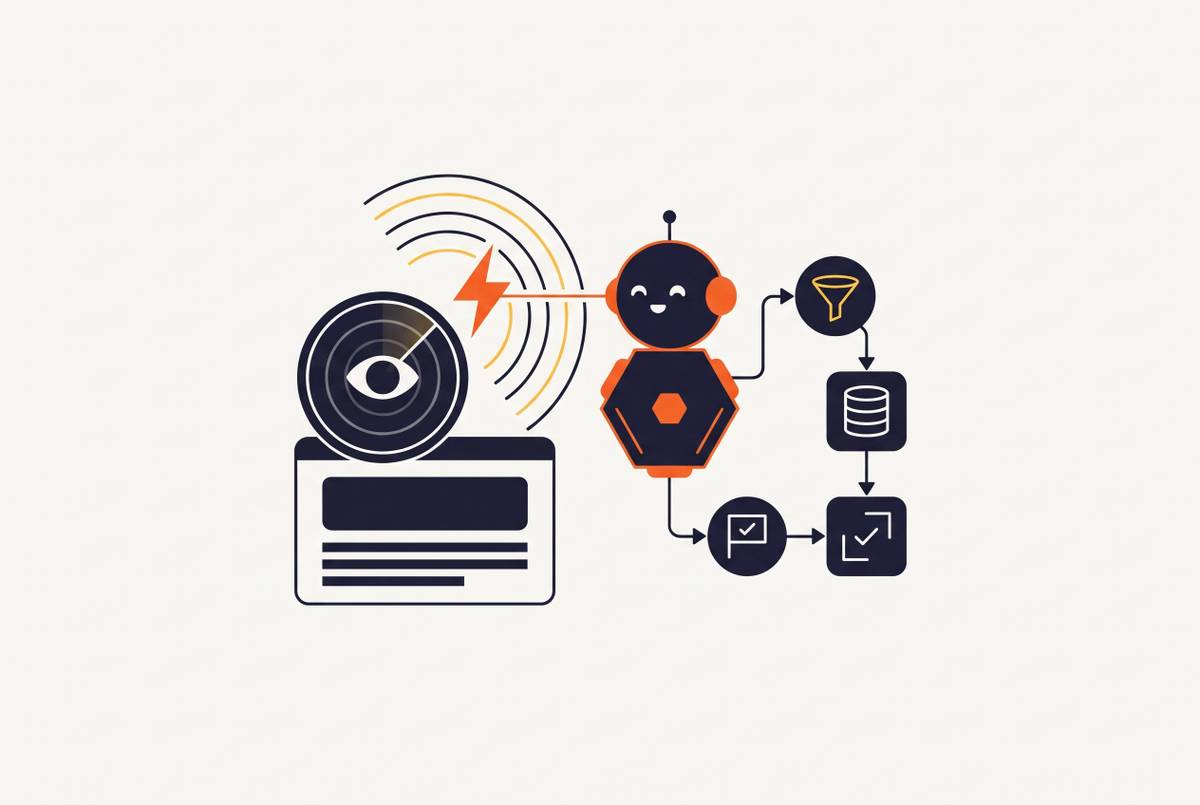
The architecture links three stages: monitoring, structured extraction, and delivery. Stage one checks wire feeds, regulatory endpoints, and publication pages on a schedule matched to their update cadence. Wire services warrant near-continuous polling, while niche trade publications may warrant hourly or daily sweeps. Not every source needs the same clock. To catch announcements within minutes, monitoring must check its fastest-moving sources more than once a day.
For sources without RSS or API feeds, crawling supplies the input. A single crawling and search API can handle scheduling, client-side script rendering, and deduplication at scale, so teams need not write code for those tasks for each source. The relevant selection criteria are concrete. They include scheduling, rendering, cleaned output, deduplication, and webhook callbacks when data is ready. A callback removes the need to poll for completed results, but it does not replace the checks that discover new announcements.
Stage two passes cleaned content to an LLM with a defined extraction schema. That schema includes company name, outgoing executive name and role, incoming executive name and role, effective date, transition type, and source URL. The transition type can be appointment, resignation, retirement, or interim. Structured output enforcement makes downstream parsing deterministic. The extraction prompt must also enumerate hybrid and newly created roles, and flag unrecognized titles.
Some sources require interaction before their content can be read. Agentic extraction can navigate paginated search results or reach publicly available trade media abstracts that static crawlers cannot reach. The extraction stage still has the same destination. It must populate the defined record rather than leave downstream systems to interpret an agent's free-form account of what it found.
Stage three writes the records to a database or data warehouse and compares them against watchlists of companies or individuals. Webhook events then push alerts to downstream systems such as CRMs, Slack, or email on record creation. This is where detection becomes usable delivery. Deduplication must account for the same appointment appearing across wires, trade outlets, and company newsrooms within hours, or one executive move becomes an inbox flash mob. Repeated alerts erode trust even when every source is genuine.
Handling anti-bot friction and site-level access constraints without breaking the pipeline
Access reliability varies across the source landscape. Wire services and regulatory filings are usually easy to access, but trade media and company newsrooms are more likely to have anti-bot defenses. Those defenses change frequently. A site that was crawlable last week may need a different approach this week, so teams must keep updating site-specific scraping logic after the integration is done.
The architectural response is managed crawl infrastructure. Teams should route requests through infrastructure that handles browser rendering, header rotation, and retries, rather than embed those concerns in the leadership-data application. This keeps access maintenance separate from extraction logic. It also avoids making every source-specific obstacle a new branch in the code responsible for identifying appointments and delivering alerts.
Collection scope should remain restricted to logged-out, publicly indexable pages, including press releases, investor relations newsrooms, and public filings. Public availability is not a compliance exemption. High-volume programs should review target-site terms of service and, for European sources, account for applicable EU AI Act requirements when automated systems profile individuals. Recording an appointment and assessing a person's work performance or other personal characteristics are different activities, so compliance planning needs to consider what the system does with the data.
Why human review remains a necessary stage even in a well-automated pipeline
A valid JSON record can still be wrong. Syntactically correct output can hide a mistake in a relationship or in how a record is ranked, giving people a dangerous false confidence in the results. Schema compliance cannot establish strategic significance. A competitor's executive hire in a niche publication may deserve more attention than a routine retirement at a low-priority company, even if both records look equally complete to the pipeline.
The design response is bounded human review at the prioritization and synthesis layer. Analysts should review a curated subset of flagged records on a weekly cadence. That review sits apart from immediate automated delivery. It preserves the speed of routine alerts while giving contextual judgment a defined place, rather than holding the whole feed until someone has read every announcement.
Intellizence combines AI-based curation with human curation. That hybrid model addresses the gap between broad collection and useful interpretation without treating automation as an all-or-nothing choice. Autonodal similarly tracks signals at volume while supporting analyst-written “leadership reads” that interpret them in context. The division of labor is clear.
Keeping the pipeline current as the leadership signal itself evolves
Leadership titles are changing faster than a static taxonomy can track. With dedicated Chief AI Officer roles, hybrid positions, and duties that involve agentic AI, a feed needs to recognize more kinds of appointments. The schema cannot be set in stone. Its fields and title vocabulary need to remain adaptable without sacrificing the consistent structure that downstream systems depend on.
A monthly schema audit should review flagged unknowns, unrecognized titles, and extraction failures. Schema versioning supports that ongoing work. This ongoing work enables incremental corrections before a conspicuous miss exposes a category the system has been quietly ignoring.
Source coverage needs the same continuing attention. As companies publish structured content optimized for machine readers, new canonical announcement sources will emerge alongside traditional wires. Today's source list will not remain sufficient. A unified web data API, structured LLM extraction with schema versioning, and a regular human review cadence give the feed an operating model for that change. Reliability comes from maintaining those connections after launch, continuing beyond the first successful webhook.