Building a Lead Enrichment Pipeline From Publicly Listed Funding Data
Tap funding announcements as your strongest buying signal before prospects get buried in inbound.
A funding announcement is one of the strongest buying signals sitting in public data, and most sales teams treat it like background noise instead of a trigger. The reason it works is structural: a funding round compresses three things into a single, time-stamped event, confirmed budget, stated growth intent, and public commitment. You won't find that combination anywhere else in public data, all at once.
Why funding announcements are a stronger buying signal
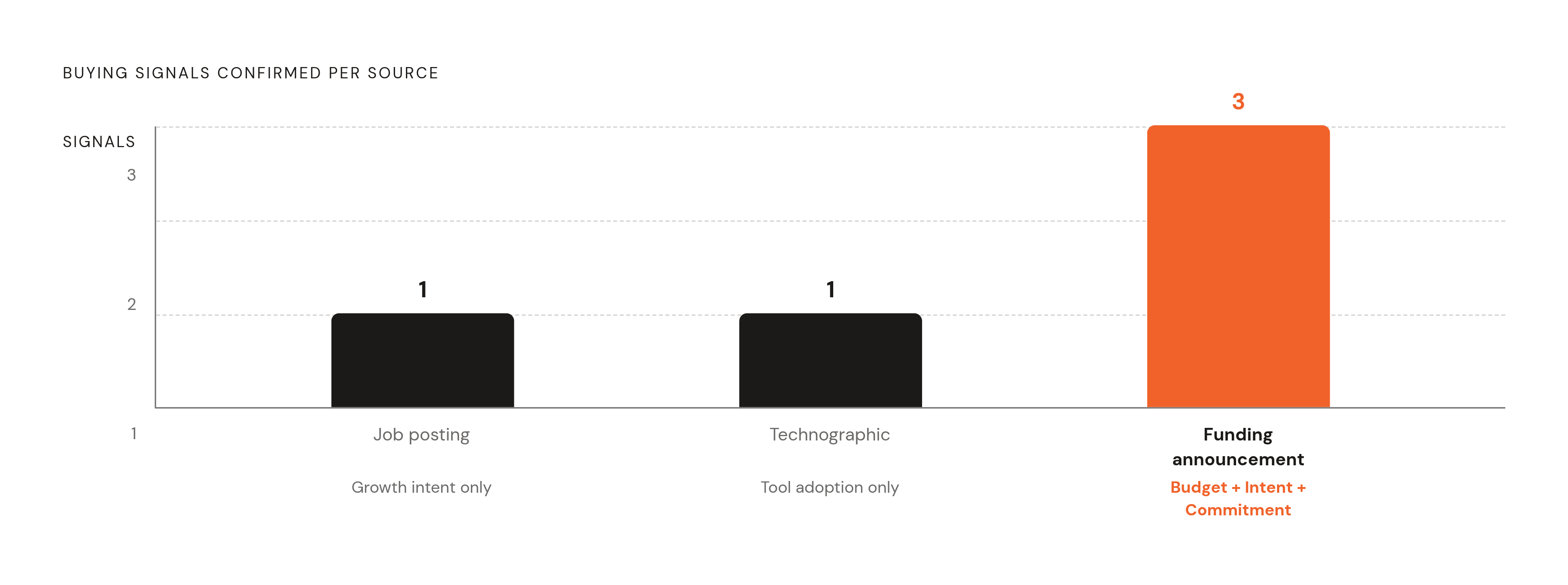
Most signals a sales team tracks give you one piece of the puzzle. A job posting tells you a company might be growing. A technographic change tells you they adopted a new tool. A funding announcement tells you they have money, they have stated intent to spend it on growth, and they've made that commitment publicly, on the record, with a dollar figure attached. That's three confirmations bundled into one event, and it's why a funding round deserves to be treated as a trigger rather than a headline to skim past.
The teams that win the deal are the ones who contact the prospect first, while the funding is still the freshest thing in the prospect's inbox, not the ones with the best pitch. Speed matters here for a reason that has nothing to do with being first in line and everything to do with data quality. Acting fast is a data quality advantage, because the decay clock starts ticking the moment that contact record is created.
That decay problem is the whole reason this needs to be a pipeline and not a habit. A person checking Crunchbase once a week is racing a 30%-a-year decay curve with a manual process. That's a losing race, and it's the exact gap an automated pipeline is built to close.
Sources of the raw funding signal and their access friction
Before any pipeline can trigger outreach, it needs a source for the raw signal. Teams building this out run into the same wall almost immediately: the two dominant sources for structured funding data are Crunchbase and PitchBook, and neither hands out low-friction programmatic access in 2026.
Crunchbase used to offer a self-serve basic API, but that's gone. Access now runs through sales-led packages named Fundamentals, which covers firmographic and financial records, Insights, which delivers LLM-generated market analyses, and Predictions, which forecasts outcomes by combining Fundamentals and Insights data with engagement data from Crunchbase's large user base. Crunchbase offers more than 600 endpoints of round-by-round funding data and firmographics, with strong coverage on tested funding rounds. For a team with budget to negotiate a contract and scale to justify it, that's a legitimate path. For a small team trying to prototype a pipeline this quarter, it's a non-starter.
PitchBook deserves a mention, and then setting aside. There's no self-serve public API, no published rate limits, no official SDKs, and no developer forum, access runs through an account manager after a separate standalone contract on top of an existing platform subscription. PitchBook's strength is private equity and venture depth, deals, funds, LPs, and valuations, with strong coverage on tracked rounds. That's genuinely useful data. It's also functionally inaccessible to a developer without an existing enterprise relationship, so it doesn't factor into how most teams will actually build this.
So scraping Crunchbase's public pages is the practical alternative, if a team doesn't have sales-led API access. It sounds simple until you try it. Crunchbase sits behind Cloudflare's enterprise-grade anti-bot system, so it blocks most automated scrapers outright, including Selenium-based approaches, which commonly come back with access-denied errors or get stuck in challenge loops. The good news is that what's extractable from the public pages is enough to build on: company name, description, industry, founding date, headquarters, employee count, round types, amounts raised, announcement dates, lead investors, and participating investors. Getting to the data without tripping the bouncer is the real challenge.
Two practical patterns for extracting funding data from public pages
Given the anti-bot wall on Crunchbase and the closed door on PitchBook's API, the extraction layer of a funding pipeline comes down to one of two practical patterns.
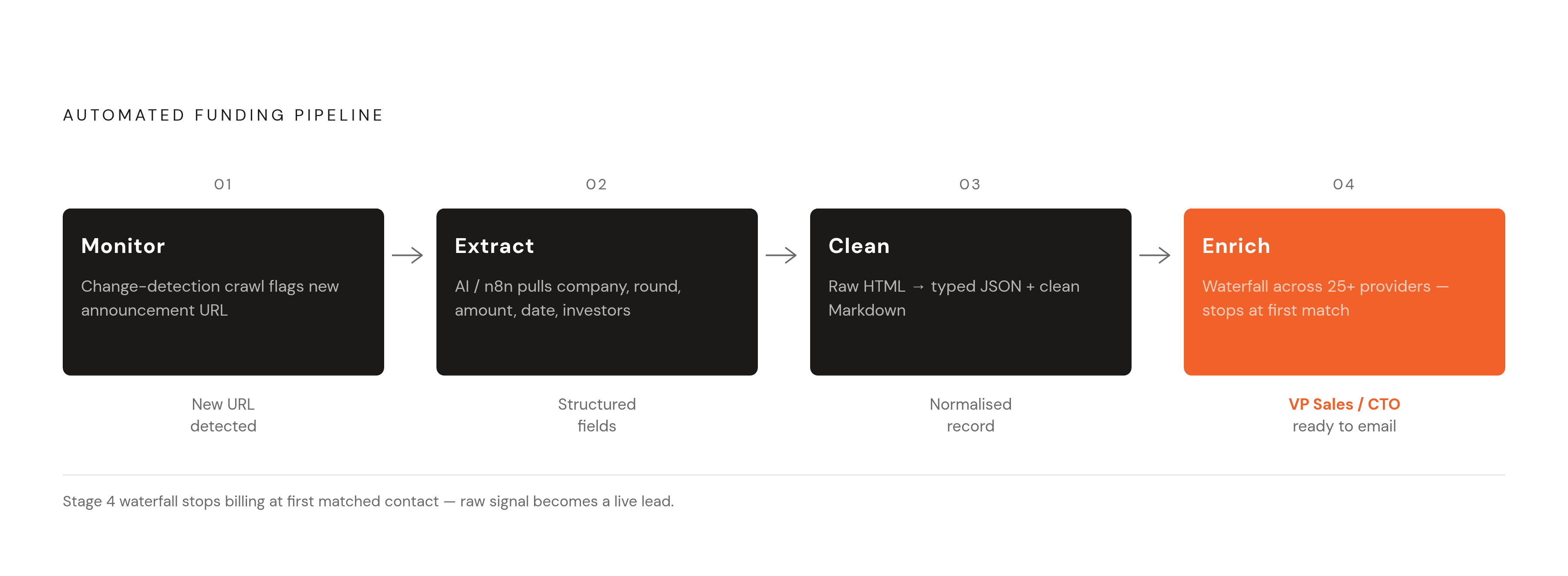
The first pattern is structured AI extraction from company announcement pages. This pattern skips Crunchbase and targets the company's own press release or investor announcement page instead. It uses a Pydantic schema that defines a FundingEvent model, preserving the currency strings exactly as displayed and extracting company, round type, amount, valuation, announcement date, lead investors, and participating investors. Going straight to the source sidesteps the anti-bot layer entirely, because a startup's own newsroom page usually isn't running Cloudflare's enterprise defenses. This pattern works best once a monitoring layer has already surfaced the announcement URL, a piece covered in the next section.
The second pattern works directly off Crunchbase's recent funding pages, using workflow automation rather than AI extraction. An n8n workflow can pull recent Crunchbase funding rounds straight into Google Sheets, capturing more than 10 data points per record, including LinkedIn URL, monthly traffic, and company size. For a team already running n8n for other automations, this is a low-lift way to get a scheduled pull without writing custom scraping code. It still has to get past the same anti-bot wall, so whether it holds up depends entirely on proxy and session handling being managed upstream.
The obvious pushback: why not just scrape Crunchbase directly and skip the workarounds? Because doing that at any meaningful cadence requires anti-bot bypass infrastructure, residential proxies, TLS fingerprint spoofing, challenge solving, and retry logic, and that infrastructure has to be managed somewhere, either in-house or through a managed API. When a team picks an extraction pattern, it's really picking which infrastructure problem it's willing to own.
Monitoring the web for funding events before manual discovery
A pipeline that only runs when someone happens to notice a funding announcement is assisted manual research wearing a pipeline's clothes, and it gives up the entire speed advantage the first section was built around.
A pipeline run starts when a new funding announcement URL appears on a monitored page that wasn't there during the previous crawl, a change-detection pattern that compares today's crawl against yesterday's instead of re-extracting the entire page every single time.
A scheduled crawler needs to revisit each source page at a set interval: daily for most sources, more often if a source moves fast. And diff logic needs to compare the current page state against the prior crawl, so it can flag what's new. Neither piece is exotic engineering.
The scraping infrastructure that makes funding-page extraction reliable at scale
The entire pipeline rests on the scraping layer holding up, and that's a riskier foundation than it sounds. If the anti-bot protection changes overnight and extraction fails silently, the pipeline keeps running, but it produces no signals, and nobody notices because no alert tells them otherwise. A pipeline that's quietly broken is worse than no pipeline, because the team keeps assuming it's working.
Not every page on the internet is equally hard to scrape. Anti-bot complexity is not uniform: pages that require bypass, Crunchbase among them, demand residential proxies, TLS fingerprint spoofing, challenge solving, and often several retries, and each successful request on one of those pages takes meaningfully longer and costs meaningfully more in proxy fees than pulling a basic HTML page.
That split points to a straightforward decision framework for tool choice. Browser automation like Playwright makes sense if the pipeline has to interact with a site: logging in, clicking through filters, waiting on dynamic content to render. A managed scraping API makes more sense when the job is repeatable public-page extraction at scale, with proxy handling and anti-bot retries already built in, which covers both the monitoring and extraction patterns described above.
Cost is where this stops being theoretical. If a pipeline scrapes a large volume of pages a month, across a mixed bag of page types, it loses money on a flat-rate plan. The pricing model that actually fits charges based on page complexity rather than flat per-request, so anti-bot pages and simple HTML pages aren't billed identically. Most teams report their proxy costs climbing year over year, and an infrastructure decision made today compounds into next year's bill. If a managed API handles proxy management for the team, nobody has to track or renegotiate that line item later.
What structured, model-ready data formats mean for the pipeline
What comes out of the scraping layer decides whether the enrichment and scoring stages run efficiently, or burn their compute budget cleaning up a mess that should never have reached them.
Raw HTML is an expensive input to hand an LLM or an enrichment step. A single source page can produce tens of thousands of tokens of HTML for a sliver of that in actual usable content. You pay for every one of those extra tokens, and they add nothing, so that waste multiplies across every page the pipeline touches. Feeding an LLM raw HTML is a bit like mailing someone a birthday card wrapped in a shipping crate; the gift's in there somewhere, but you've paid freight for cardboard.
Clean output looks different. It's Markdown that keeps the document's actual structure, headings, lists, tables, link text, with the navigation menus, cookie banners, and other boilerplate stripped out. It's typed JSON fields, company name, round type, amount, announcement date, lead investors, returned against a schema the pipeline already defines, instead of a wall of text the pipeline has to parse itself. And it's output that chunks predictably for embeddings and retrieval, so a retrieval pipeline indexing hundreds of pages doesn't end up with wildly inconsistent chunk sizes dragging down retrieval quality. What LLM-ready output looks like in practice spans clean Markdown, typed JSON, and predictably chunked text, each suited to a different stage of the pipeline.
The broader web is drifting toward this kind of structure on its own. The llms.txt proposal, put forward by Jeremy Howard, co-founder of Answer.AI and fast.ai, is one example of sites publishing a simpler version of their own content rather than forcing every crawler to fight through the full page. It's a small signal of where web publishing is heading: toward formats built for machines to read cleanly. A pipeline built around clean Markdown and typed JSON today is already pointed in that direction.
Enriching the funding lead: waterfall architecture and the tools that run it
Once the pipeline has a clean, structured funding event, the next job is to turn a company name into a contact worth emailing. No single enrichment vendor has every contact on file. A pipeline that only queries one provider is going to systematically miss some of its best leads. Waterfall enrichment is the fix: query multiple data providers in sequence, and only pay when a provider actually returns a match.
In practice, the pipeline submits a company identifier, a domain, a name, or a Crunchbase URL, along with a persona definition like VP of Sales, CTO, or Head of Engineering, to a waterfall orchestrator. The orchestrator works through providers in ranked order based on which ones have the best coverage for that particular persona type, stopping as soon as it finds a match and returning that record. The team pays for a result, not for every query along the way.
ZoomInfo's GTM Studio is one implementation of this pattern, running waterfall enrichment across more than 25 providers and automatically returning the highest-confidence result. That's the architecture that closes the loop the rest of this pipeline opened: a funding announcement detected within hours, extracted into clean structured data, enriched with a real contact, and handed to a seller before the signal has had time to go stale.