Scraping APIs That Return LLM-Ready Output Without Preprocessing
Choose a scraping API that returns LLM-ready output formats to avoid preprocessing delays.
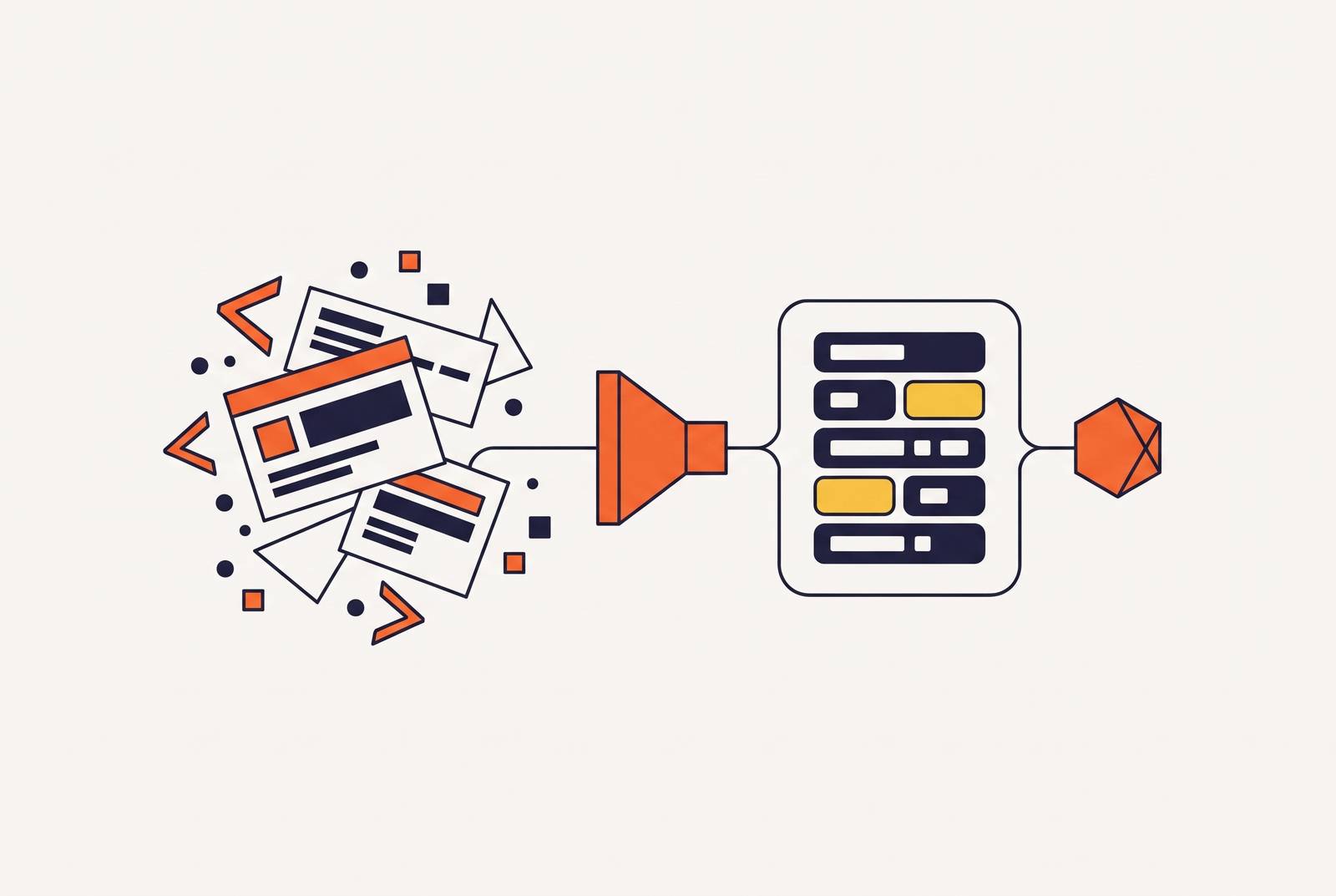
For LLM-ready structured data extraction from web pages, choose a scraping API that returns schema-aligned JSON for records or clean Markdown for documents, without a separate cleaning step. Fetch reliability is the prerequisite, but output format is the decisive selection criterion. Proxy count and speed cannot rescue a pipeline that delivers the wrong input to its model.
Why output format is the decisive factor when choosing a scraping API for AI pipelines
Scraping APIs are usually marketed through proxy counts, speed, uptime, and success rates. Those measures describe delivery. A successful request can still return navigation bars, ad markup, inline scripts, and footer boilerplate wrapped around the content the model needs. The page arrived, but so did the furniture.
That extra material consumes tokens without adding meaning, while fragmenting the headings, lists, and hierarchies that help a model understand a document. Faster delivery does not fix that mismatch. Markdown preserves document structure while removing HTML noise before the content reaches a vector store or model context window. Structured JSON goes further for field extraction, returning records ready for ingestion.
How do you get web content an LLM can use without cleaning it first?
LLM-ready output is content a model can receive and reason over without an intermediate cleaning, parsing, or reformatting step. A scraper can use an LLM to navigate pages or handle selectors and still return raw HTML. “AI-powered” describes the engine.
Markdown qualifies because it retains headings, lists, links, and blockquotes in a lightweight format. Structured JSON qualifies because it expresses fields and their relationships directly. Clean plain text can also be usable, but it discards hierarchy and context signals that help retrieval. Noise removal alone is not the whole job. Minimally processed HTML, with nested tables, inline styling, and script blocks, still leaves the downstream pipeline responsible for finding the useful content.
The pipeline still has to do that work with larger context windows. Models with million-token windows are available, but a window filled with boilerplate can still weaken reasoning. Some problems that look like context-limit problems are really raw-HTML problems wearing a technical hat. Nor does LLM-ready mean that every later pipeline operation disappears, since document retrieval still involves tasks such as chunking. The practical two-format standard is Markdown for documents and schema-aligned JSON for structured extraction.
The three production questions every scraping API must answer before output format matters
Can the API fetch the page? An extractor that produces beautiful Markdown from an easy demonstration page may fail on Cloudflare-protected pages, SPAs that rely heavily on client-side scripting, DataDome defenses, or login walls. When fetches fail, there is no output to use, and missing pages leave missing chunks in a vector store.
Cloudflare shows why getting access is still a separate hurdle in 2026. It blocks declared AI crawlers by default and has introduced Pay-Per-Crawl, which can withhold access with a 402 Payment Required response. Its AI Labyrinth feature targets crawlers that disregard “no crawl” directives or crawl without permission, drawing them into fake pages. A clean-page demonstration cannot establish reliability on guarded targets. Access needs to be verified for the actual sites involved.
Once access is established, the second question is whether the returned content is LLM-ready or leaves cleaning to the developer. The third is whether that combination scales cost-effectively. These questions belong in dependency order, even though format organizes the buying decision. For large amounts of standardized extraction, structured JSON APIs with predictable credit pricing may be a better fit than prompt-per-page extraction.
How the scraping API market has split into distinct tool classes, and why comparing across classes is a mistake
The 2026 scraping API market is not one league table. LLM-native extractors make Markdown or structured JSON the product, with RAG pipelines and agents as their intended consumers. Proxy APIs and unblocking platforms instead prioritize access to guarded pages and typically return raw HTML. That leaves parsing and formatting with the team.
Enterprise scraping platforms address heavily protected domains and high-volume access, often with custom pricing. They can return structured output, but they are sold mainly on their guarantees of access. Open-source self-hosted crawlers remove API charges while leaving infrastructure, proxies, retries, scaling, and monitoring to the operator. Engineering time remains part of the cost.
Evaluating an enterprise unblocking platform mainly on Markdown quality overlooks the problem it was built to solve. Expecting an LLM-native extractor to do best on the most heavily guarded domains makes the same mistake in reverse. Fetch reliability still needs testing within the chosen class. The workflow determines which tools belong in the comparison.
LLM-native scraping APIs: tools whose output is the product
For RAG and agent workflows, LLM-native APIs are the closest fit because their main deliverable is usable content. Within this class, default output, schema-based extraction, site-wide crawling, agent integration, and pricing distinguish the options. Single-page extraction is not enough for every pipeline. A document-ingestion workflow may need the API to traverse a site and return usable content across the discovered pages, while an action-taking agent may need only a few precise fields.
ScrapeGraphAI combines crawling and AI extraction in a single call. The developer supplies a natural-language prompt and a JSON schema, and the API returns structured JSON rather than Markdown that needs another extraction pass. Its crawl endpoint uses breadth-first traversal with configurable depth, page limits, and domain restriction. Those controls define the scope of the job. With credit-based pricing, the cost of each call is predictable, but a crawl costs more as it visits more pages. The trade-off is a focus on intelligent extraction rather than raw bulk crawling, with a learning curve for advanced schema design.
Spider takes a different technical route through a crawling engine written in a systems programming language with async I/O. Its smart rendering detects whether a page needs a browser, keeping static pages out of Chromium to save time and cost. Its Silk extraction model runs on dedicated GPUs, accepts a plain-English description of the desired output, and returns structured JSON without external API calls or per-token billing. The distinction is operational as well as financial. Its MCP server works with Claude, Cursor, Windsurf, and other AI coding tools.
Spider sells credits as needed, without a subscription, and those credits do not expire. The trade-offs are that it is a newer product, requires direct API use, and has no marketplace of pre-built scrapers. Neither approach establishes a universal winner. ScrapeGraphAI makes combined crawl-and-schema extraction central, while Spider emphasizes its crawling engine, rendering choices, and dedicated extraction model. Evaluate each design by the work it removes from the pipeline.
When structured JSON beats Markdown, and when it does not
Markdown is the better fit when the downstream model needs to read a document. For document retrieval, reading comprehension, and RAG, headings, lists, and blockquotes preserve the source’s semantic hierarchy. That structure supports chunking and ranking, saving the pipeline the work of reconstructing it. The document remains a document, minus the HTML scaffolding. Turning it prematurely into a narrow set of fields can discard context the task needs.
JSON is the better fit when an agent must act on particular values, including a price, a date, availability, or a product name. A schema-aligned record provides those values directly rather than requiring the agent to locate them in prose. Could an LLM extract them from Markdown? Yes, but that takes another model call and another step to interpret the content. When the scraping layer can return the required fields, secondary extraction is an avoidable expense and reliability burden.
The recommendation is therefore to match the format to the task at request time when the API supports it. The same pipeline may use a crawl to get documents for retrieval and a separate extraction to get records for action. Markdown is not a universal upgrade over JSON, or vice versa. The choice turns on whether the next consumer needs to read a document or consume a record.
How MCP changes the interface between scraping APIs and AI agents
The Model Context Protocol, or MCP, changes how an agent reaches a scraping API. Instead of requiring a person to write extraction code for each interaction, an exposed MCP server lets the agent invoke a scrape, crawl, or search as a tool. The agent requests data, and the API fetches and formats it. Output now crosses directly into the agent’s workflow. The returned format therefore matters to the whole pipeline, even if it is listed as a scraper setting deep in the documentation.
Anthropic open-sourced MCP in November 2024 and donated it to the Agentic AI Foundation, a directed fund under the Linux Foundation, in December 2025. The July 2026 stateless MCP specification places method and tool names in HTTP headers. This lets gateways and rate limiters route and authorize traffic without inspecting request bodies. Detailed protocol mechanics need not dominate API selection.
MCP support supplies the interface. An agent with an easier tool connection can still receive content that needs cleaning. That is why MCP servers and integrations with LangChain or LangGraph belong beside output quality in the evaluation. A convenient plug is useful only if the appliance does the right job.
The cost structure of LLM extraction at scale, and where it breaks down
The strongest objection to LLM extraction is valid for some workloads. Traditional selector-based scraping is computationally cheap once built, while prompt-per-page extraction incurs token costs on every processed page. On high-volume, standardized pages, those charges accumulate without necessarily buying much flexibility. LLM-ready output does not require LLM-based extraction. A conventional extraction process can still deliver schema-aligned JSON.
When a target rarely changes, a maintained selector can be cheaper than prompting a model on every page. Across thousands of disparate sites or unstructured pages, writing and repairing selectors becomes a much larger job. Engineering time belongs in the calculation too. Blocks, uneven results, and the work of keeping the system running in-house can eat up what looks like a saving in API charges.
Pricing also determines how confidently a team can budget. Token-based charges vary with page length and prompt complexity, while fixed credits per successful request offer more predictable costs. Credit pricing still needs a close look because crawls can cost more as they visit more pages. The practical recommendation is a hybrid. Use LLM-native extraction for complex, varied, or frequently changing sites where engineering savings justify it, and fixed-price structured JSON APIs for high-volume, standardized extraction on stable layouts.
What to actually evaluate when selecting a scraping API for an AI pipeline
For document retrieval and RAG, make Markdown the primary output requirement. For agent actions on named fields, require schema-aligned JSON. If the workflow does both, look for request-time format selection. This defines what a successful response must contain before access or speed enters the comparison.
Next, assess fetch reliability on the intended targets. Lightly protected public pages are within reach of most LLM-native APIs, but script-heavy SPAs, Cloudflare-protected pages, and login-walled content need specific verification before commitment. Then examine the integration layer. Check for an MCP server where agents need tool calls, native Python or Node.js SDKs where those languages are already used, and support for the existing orchestration layer, including LangChain, LangGraph, or n8n. Integration should reduce glue code.
Finally, stress-test pricing against actual volume. For token-based extraction, model page length and prompt complexity. For credits, check the charges for each successful request, how costs grow with a crawl, and whether unused monthly credits expire. An unused credit that disappears is still an expense. The API’s output is what the LLM will reason over, which makes format the selection criterion.